{"title":"Clinical Advances in Treatment Strategies for Obsessive-compulsive Disorder in Adults.","authors":"Daeyoung Roh, Ki Won Jang, Chan-Hyung Kim","doi":"10.9758/cpn.23.1075","DOIUrl":null,"url":null,"abstract":"<p><p>In the present article, we provide a comprehensive review of the treatment strategies for obsessive-compulsive disorder (OCD), a common, chronic, and often debilitating disorder, characterized by overwhelming obsessions and compulsions. OCD typically starts in childhood or adolescence and persists throughout life, causing functional impairment across multiple domains. The article begins by describing the historical concepts of OCD from religious and guilt-based explanations to psychoanalytic perspectives, and then explores the changing understanding of OCD as a treatable condition. Recent advances include the development of evidence-based psychological treatments, such as exposure and response prevention, and pharmacological treatments, such as selective serotonin reuptake inhibitors. The latest version of the Diagnostic and Statistical Manual of Mental Disorders, and the International Classification of Diseases, has removed OCD from the anxiety disorder grouping and regrouped it into obsessive-compulsive and related disorders. We conclude by highlighting the current state of knowledge and development in the clinical management of OCD, including recommendations for first- and second-line treatments, alternative, or augmentative strategies for and novel agents under investigation for OCD. In future, the latest advances in neuroimaging, electrophysiology, digital technology, and data-driven analysis will help elucidate the pathophysiology of OCD and develop personalized intervention strategies.</p>","PeriodicalId":2,"journal":{"name":"ACS Applied Bio Materials","volume":" ","pages":"676-685"},"PeriodicalIF":4.7000,"publicationDate":"2023-11-30","publicationTypes":"Journal Article","fieldsOfStudy":null,"isOpenAccess":false,"openAccessPdf":"https://ftp.ncbi.nlm.nih.gov/pub/pmc/oa_pdf/0b/b4/cpn-21-4-676.PMC10591165.pdf","citationCount":"0","resultStr":null,"platform":"Semanticscholar","paperid":null,"PeriodicalName":"ACS Applied Bio Materials","FirstCategoryId":"3","ListUrlMain":"https://doi.org/10.9758/cpn.23.1075","RegionNum":0,"RegionCategory":null,"ArticlePicture":[],"TitleCN":null,"AbstractTextCN":null,"PMCID":null,"EPubDate":"2023/7/17 0:00:00","PubModel":"Epub","JCR":"Q2","JCRName":"MATERIALS SCIENCE, BIOMATERIALS","Score":null,"Total":0}
引用次数: 0
Abstract
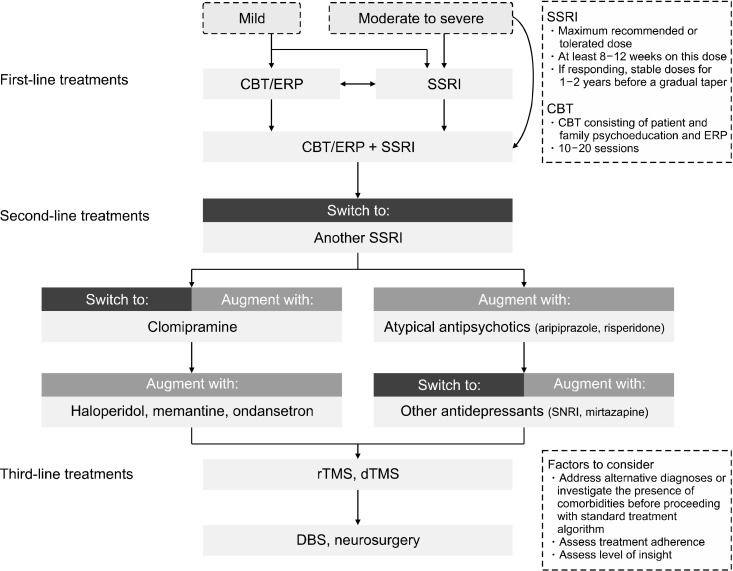
In the present article, we provide a comprehensive review of the treatment strategies for obsessive-compulsive disorder (OCD), a common, chronic, and often debilitating disorder, characterized by overwhelming obsessions and compulsions. OCD typically starts in childhood or adolescence and persists throughout life, causing functional impairment across multiple domains. The article begins by describing the historical concepts of OCD from religious and guilt-based explanations to psychoanalytic perspectives, and then explores the changing understanding of OCD as a treatable condition. Recent advances include the development of evidence-based psychological treatments, such as exposure and response prevention, and pharmacological treatments, such as selective serotonin reuptake inhibitors. The latest version of the Diagnostic and Statistical Manual of Mental Disorders, and the International Classification of Diseases, has removed OCD from the anxiety disorder grouping and regrouped it into obsessive-compulsive and related disorders. We conclude by highlighting the current state of knowledge and development in the clinical management of OCD, including recommendations for first- and second-line treatments, alternative, or augmentative strategies for and novel agents under investigation for OCD. In future, the latest advances in neuroimaging, electrophysiology, digital technology, and data-driven analysis will help elucidate the pathophysiology of OCD and develop personalized intervention strategies.
期刊介绍:
ACS Applied Bio Materials is an interdisciplinary journal publishing original research covering all aspects of biomaterials and biointerfaces including and beyond the traditional biosensing, biomedical and therapeutic applications.
The journal is devoted to reports of new and original experimental and theoretical research of an applied nature that integrates knowledge in the areas of materials, engineering, physics, bioscience, and chemistry into important bio applications. The journal is specifically interested in work that addresses the relationship between structure and function and assesses the stability and degradation of materials under relevant environmental and biological conditions.




 京公网安备 11010802042870号
京ICP备2023020795号-1
京公网安备 11010802042870号
京ICP备2023020795号-1

 分享
分享
 求助内容:
求助内容: 应助结果提醒方式:
 扫码关注我们
