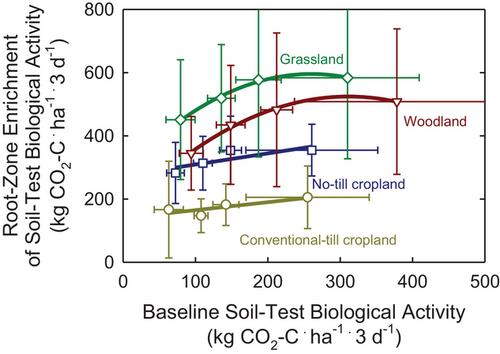
{"title":"Root-zone enrichment of soil-test biological activity and particulate organic carbon and nitrogen under conventional and conservation land management","authors":"Alan J. Franzluebbers","doi":"10.1002/saj2.20574","DOIUrl":null,"url":null,"abstract":"<p>Biologically active and intermediately labile fractions of soil organic matter are important features of conservation agricultural management systems. Depth distribution of soil-test biological activity (STBA) and particulate organic carbon (C) and nitrogen (N) were characterized under cropland, grassland, and woodland across 25 research stations in North Carolina. Most (87%) of the 310 fields sampled were on Ultisols (udults or aquults). Variation in STBA in the surface 30-cm of soil was controlled primarily by land use and to a lesser extent by soil texture and physiographic region. Baseline concentrations of STBA and particulate organic C and N at 30-cm depth were relatively narrowly constrained compared with contents in the 0- to 10-cm depth. Root-zone enrichment (i.e., total minus baseline contents) of STBA (mean ± standard error; kg CO<sub>2</sub>–C ha<sup>−1</sup> 3 d<sup>−1</sup>) followed the order: conventional-till cropland (194 ± 17) < no-till cropland (274 ± 26) < woodland (421 ± 17) < grassland (537 ± 15) across locations. Proportion of root-zone enrichment of soil organic C as particulate organic C was 43 ± 2%. Root-zone enrichment of particulate organic C (Mg C ha<sup>−1</sup>) followed the order: conventional-till cropland (3.8 ± 0.6) < no-till cropland (8.7 ± 0.8) < grassland (14.1 ± 0.5) < woodland (16.3 ± 0.6) across locations. The C:N ratio of root-zone-enriched particulate organic matter was greater under woodland than under other land uses likely because of N input limitations. Conservation land uses increased root-zone enrichment of these active and intermediately labile fractions independent of soil types and regions in the state.</p>","PeriodicalId":101043,"journal":{"name":"Proceedings - Soil Science Society of America","volume":"87 6","pages":"1431-1443"},"PeriodicalIF":0.0000,"publicationDate":"2023-07-20","publicationTypes":"Journal Article","fieldsOfStudy":null,"isOpenAccess":false,"openAccessPdf":"https://onlinelibrary.wiley.com/doi/epdf/10.1002/saj2.20574","citationCount":"0","resultStr":null,"platform":"Semanticscholar","paperid":null,"PeriodicalName":"Proceedings - Soil Science Society of America","FirstCategoryId":"1085","ListUrlMain":"https://onlinelibrary.wiley.com/doi/10.1002/saj2.20574","RegionNum":0,"RegionCategory":null,"ArticlePicture":[],"TitleCN":null,"AbstractTextCN":null,"PMCID":null,"EPubDate":"","PubModel":"","JCR":"","JCRName":"","Score":null,"Total":0}
引用次数: 0
Abstract
Biologically active and intermediately labile fractions of soil organic matter are important features of conservation agricultural management systems. Depth distribution of soil-test biological activity (STBA) and particulate organic carbon (C) and nitrogen (N) were characterized under cropland, grassland, and woodland across 25 research stations in North Carolina. Most (87%) of the 310 fields sampled were on Ultisols (udults or aquults). Variation in STBA in the surface 30-cm of soil was controlled primarily by land use and to a lesser extent by soil texture and physiographic region. Baseline concentrations of STBA and particulate organic C and N at 30-cm depth were relatively narrowly constrained compared with contents in the 0- to 10-cm depth. Root-zone enrichment (i.e., total minus baseline contents) of STBA (mean ± standard error; kg CO2–C ha−1 3 d−1) followed the order: conventional-till cropland (194 ± 17) < no-till cropland (274 ± 26) < woodland (421 ± 17) < grassland (537 ± 15) across locations. Proportion of root-zone enrichment of soil organic C as particulate organic C was 43 ± 2%. Root-zone enrichment of particulate organic C (Mg C ha−1) followed the order: conventional-till cropland (3.8 ± 0.6) < no-till cropland (8.7 ± 0.8) < grassland (14.1 ± 0.5) < woodland (16.3 ± 0.6) across locations. The C:N ratio of root-zone-enriched particulate organic matter was greater under woodland than under other land uses likely because of N input limitations. Conservation land uses increased root-zone enrichment of these active and intermediately labile fractions independent of soil types and regions in the state.



 京公网安备 11010802042870号
京ICP备2023020795号-1
京公网安备 11010802042870号
京ICP备2023020795号-1

 分享
分享

 求助内容:
求助内容: 应助结果提醒方式:
 扫码关注我们
