Probing for the presence of semenogelin in human urine by immunological and chromatographic-mass spectrometric methods in the context of sports drug testing

IF 4.1 Q2 CHEMISTRY, ANALYTICAL Analytical science advances Pub Date : 2021-12-22 DOI:10.1002/ansa.202100058
Johanna Breuer, Andreas Thomas, Hans Geyer, Mario Thevis
{"title":"Probing for the presence of semenogelin in human urine by immunological and chromatographic-mass spectrometric methods in the context of sports drug testing","authors":"Johanna Breuer,&nbsp;Andreas Thomas,&nbsp;Hans Geyer,&nbsp;Mario Thevis","doi":"10.1002/ansa.202100058","DOIUrl":null,"url":null,"abstract":"<div>\n \n \n <section>\n \n <h3> Rationale</h3>\n \n <p>An increasing number of adverse analytical findings (AAFs) in routine doping controls has been suspected and debated to presumably result from intimate contact with bodily fluids (including ejaculate), potentially facilitating the transfer of prohibited substances. More precisely, the possibility of prohibited drugs being present in ejaculate and introduced by sexual intercourse into the vagina of an athlete and, subsequently, into doping control urine samples, was discussed.</p>\n </section>\n \n <section>\n \n <h3> Methods</h3>\n \n <p>Two testing strategies to determine trace amounts of semenogelin I, a major and specific constituent of semen, were assessed as to their applicability to urine samples. First, the testing protocol of a lateral flow immunochromatographic test directed against semenogelin was adapted. Second, a liquid chromatography/tandem mass spectrometry (LC-MS/MS)-based method was established, employing solid-phase extraction of urine, trypsinization of the retained protein content, and subsequent detection of semenogelin I-specific peptides. Sensitivity, specificity, and reproducibility, but also recovery, linearity, precision, and identification capability of the approaches were assessed. Both assays were used to determine the analyte stability in urine (at 3 µL/mL) at room temperature, +4°C, and -20°C, and authentic urine samples collected either after (self-reported) celibacy or sexual intercourse were subjected to the established assays for proof-of-concept.</p>\n </section>\n \n <section>\n \n <h3> Results</h3>\n \n <p>No signals for semenogelin were observed in either assay when analyzing blank urine specimens, demonstrating the methods’ specificity. Limits of detection were estimated with 1 µL and 10 nL of ejaculate per mL of urine for the immunochromatographic and the mass spectrometric approach, respectively, and figures of merit for the latter assay further included intra- and interday imprecision (4.5-10.7% and 3.8-21.6%), recovery (44%), and linearity within the working range of 0-100 nL/mL. Spiked urine tested positive for semenogelin under all storage conditions up to 12 weeks, and specimens collected after sexual intercourse were found to contain trace amounts of semenogelin up to 55-72 h.</p>\n </section>\n </div>","PeriodicalId":93411,"journal":{"name":"Analytical science advances","volume":"3 1-2","pages":"21-28"},"PeriodicalIF":4.1000,"publicationDate":"2021-12-22","publicationTypes":"Journal Article","fieldsOfStudy":null,"isOpenAccess":false,"openAccessPdf":"https://chemistry-europe.onlinelibrary.wiley.com/doi/epdf/10.1002/ansa.202100058","citationCount":"5","resultStr":null,"platform":"Semanticscholar","paperid":null,"PeriodicalName":"Analytical science advances","FirstCategoryId":"1085","ListUrlMain":"https://onlinelibrary.wiley.com/doi/10.1002/ansa.202100058","RegionNum":0,"RegionCategory":null,"ArticlePicture":[],"TitleCN":null,"AbstractTextCN":null,"PMCID":null,"EPubDate":"","PubModel":"","JCR":"Q2","JCRName":"CHEMISTRY, ANALYTICAL","Score":null,"Total":0}
引用次数: 5

Abstract

Rationale

An increasing number of adverse analytical findings (AAFs) in routine doping controls has been suspected and debated to presumably result from intimate contact with bodily fluids (including ejaculate), potentially facilitating the transfer of prohibited substances. More precisely, the possibility of prohibited drugs being present in ejaculate and introduced by sexual intercourse into the vagina of an athlete and, subsequently, into doping control urine samples, was discussed.

Methods

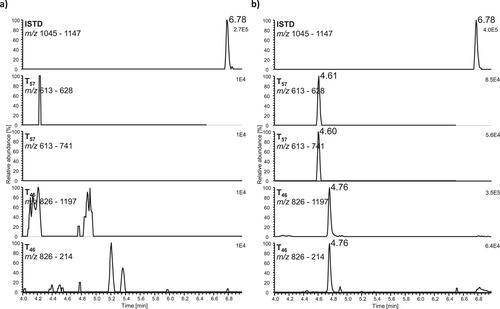
Two testing strategies to determine trace amounts of semenogelin I, a major and specific constituent of semen, were assessed as to their applicability to urine samples. First, the testing protocol of a lateral flow immunochromatographic test directed against semenogelin was adapted. Second, a liquid chromatography/tandem mass spectrometry (LC-MS/MS)-based method was established, employing solid-phase extraction of urine, trypsinization of the retained protein content, and subsequent detection of semenogelin I-specific peptides. Sensitivity, specificity, and reproducibility, but also recovery, linearity, precision, and identification capability of the approaches were assessed. Both assays were used to determine the analyte stability in urine (at 3 µL/mL) at room temperature, +4°C, and -20°C, and authentic urine samples collected either after (self-reported) celibacy or sexual intercourse were subjected to the established assays for proof-of-concept.

Results

No signals for semenogelin were observed in either assay when analyzing blank urine specimens, demonstrating the methods’ specificity. Limits of detection were estimated with 1 µL and 10 nL of ejaculate per mL of urine for the immunochromatographic and the mass spectrometric approach, respectively, and figures of merit for the latter assay further included intra- and interday imprecision (4.5-10.7% and 3.8-21.6%), recovery (44%), and linearity within the working range of 0-100 nL/mL. Spiked urine tested positive for semenogelin under all storage conditions up to 12 weeks, and specimens collected after sexual intercourse were found to contain trace amounts of semenogelin up to 55-72 h.

Abstract Image

查看原文
分享 分享
微信好友 朋友圈 QQ好友 复制链接
本刊更多论文
在运动药物检测的背景下,用免疫和色谱-质谱法探测人尿中存在的卵磷脂
在常规兴奋剂控制中,越来越多的不良分析结果(AAFs)被怀疑和争论可能是由于与体液(包括射精)的密切接触,可能促进违禁物质的转移。更确切地说,讨论了违禁药物存在于射精中,并通过性交进入运动员阴道,随后进入兴奋剂控制尿样的可能性。方法采用两种检测方法对精液中主要特异性成分精液凝胶I的适用性进行评价。首先,采用了针对半球蛋白的横向流动免疫层析测试方案。其次,建立了基于液相色谱/串联质谱(LC-MS/MS)的方法,采用固相提取尿液,胰蛋白酶化保留的蛋白质含量,随后检测semenogelin i特异性肽。评估方法的灵敏度、特异性和重复性,以及回收率、线性度、精密度和鉴定能力。两种检测方法均用于在室温、+4℃和-20℃下测定尿液中分析物(浓度为3 μ L/mL)的稳定性,并在(自我报告的)独身或性交后收集的真实尿液样本进行既定检测以验证概念。结果两种方法在分析空白尿液标本时均未观察到精球蛋白的信号,证明了方法的特异性。免疫色谱法和质谱法的检出限分别为1 μ L和10 nL/mL尿液,而质谱法的优点进一步包括日内和日内不精密度(4.5-10.7%和3.8-21.6%)、回收率(44%)和0-100 nL/mL工作范围内的线性。在所有储存条件下,在12周内,加了钉子的尿液检测出精蛋白阳性,在性交后收集的样本在55-72小时内发现含有微量的精蛋白。
本文章由计算机程序翻译,如有差异,请以英文原文为准。
求助全文
约1分钟内获得全文 去求助
来源期刊
CiteScore
4.60
自引率
0.00%
发文量
0
期刊最新文献
Stimuli-Responsive Crosslinked Chitosan/PVP/PEG Hydrogel Networks for Targeted Drug Delivery and Antimicrobial Performance. Electronic Smoking Devices Among University Students: Usage Patterns and Chemical Composition of Inhaled Substances Innovative Nanomaterial-Based Approaches for the Recognition of Amphetamine in Attention Deficit Hyperactivity Disorder Management. Atmospheric Deposition of Organic Pollutants: A Comprehensive Review of Sampling and Analytical Methodologies Smartphone-Based Colorimetric Determination of Imeglimin Hydrochloride Using Eosin Y: A Simple and Eco-Friendly Analytical Approach
×
引用
GB/T 7714-2015
复制
MLA
复制
APA
复制
导出至
BibTeX EndNote RefMan NoteFirst NoteExpress
×
×
提示
您的信息不完整,为了账户安全,请先补充。
现在去补充
×
提示
您因"违规操作"
具体请查看互助需知
我知道了
×
提示
现在去查看 取消
×
提示
确定
0
微信
客服QQ
Book学术公众号 扫码关注我们
反馈
×
意见反馈
请填写您的意见或建议
请填写您的手机或邮箱
已复制链接
已复制链接
快去分享给好友吧!
我知道了
×
扫码分享
扫码分享
Book学术官方微信
Book学术文献互助
Book学术文献互助群
群 号:604180095
Book学术
文献互助 智能选刊 最新文献 互助须知 联系我们:info@booksci.cn
Book学术提供免费学术资源搜索服务,方便国内外学者检索中英文文献。致力于提供最便捷和优质的服务体验。
Copyright © 2023 Book学术 All rights reserved.
ghs 京公网安备 11010802042870号 京ICP备2023020795号-1





