{"title":"Applying transfer learning to achieve precision marketing in an omni-channel system – a case study of a sharing kitchen platform","authors":"Ming‐Chuan Chiu, Kai-Hsiang Chuang","doi":"10.1080/00207543.2020.1868595","DOIUrl":null,"url":null,"abstract":"Omni-channel marketing is an enhanced cross-channel business model involving shared data that allows enterprises to enhance and facilitate customer experience. Omni-channel opportunities shape retail business and shopper behaviours by coordinating data across all channel platforms while enabling their simultaneous use. Artificial intelligence (AI) has played an increasingly critical role in marketing analysis. With the proper training, AI can predict consumer preferences and provide recommendations based on historical data to achieve precision marketing in e-commerce. At present, however, the existent chatbots on many product-ordering platforms lack AI refinement, resulting in the need to ask customers multiple questions before generating a reliable suggestion, yet an effective way to incorporate AI in an omni-channel platform has remained vague. Hence, the aim of this study was to develop an omni-channel chatbot that incorporates iOS, Android, and web components. The chatbot was designed to achieve personalised service and precision marketing using convolutional neural networks (CNNs). A shared kitchen case study demonstrates the advantages of the proposed method, which is transferable to other consumer applications such as clothing selection or personalised services. The number of food offerings and the quality of image classifiers set the research limitations, pointing toward the direction of future research.","PeriodicalId":14307,"journal":{"name":"International Journal of Production Research","volume":"59 1","pages":"7594 - 7609"},"PeriodicalIF":7.3000,"publicationDate":"2021-01-17","publicationTypes":"Journal Article","fieldsOfStudy":null,"isOpenAccess":false,"openAccessPdf":"https://sci-hub-pdf.com/10.1080/00207543.2020.1868595","citationCount":"14","resultStr":null,"platform":"Semanticscholar","paperid":null,"PeriodicalName":"International Journal of Production Research","FirstCategoryId":"5","ListUrlMain":"https://doi.org/10.1080/00207543.2020.1868595","RegionNum":2,"RegionCategory":"工程技术","ArticlePicture":[],"TitleCN":null,"AbstractTextCN":null,"PMCID":null,"EPubDate":"","PubModel":"","JCR":"Q1","JCRName":"ENGINEERING, INDUSTRIAL","Score":null,"Total":0}
引用次数: 14
Abstract
Omni-channel marketing is an enhanced cross-channel business model involving shared data that allows enterprises to enhance and facilitate customer experience. Omni-channel opportunities shape retail business and shopper behaviours by coordinating data across all channel platforms while enabling their simultaneous use. Artificial intelligence (AI) has played an increasingly critical role in marketing analysis. With the proper training, AI can predict consumer preferences and provide recommendations based on historical data to achieve precision marketing in e-commerce. At present, however, the existent chatbots on many product-ordering platforms lack AI refinement, resulting in the need to ask customers multiple questions before generating a reliable suggestion, yet an effective way to incorporate AI in an omni-channel platform has remained vague. Hence, the aim of this study was to develop an omni-channel chatbot that incorporates iOS, Android, and web components. The chatbot was designed to achieve personalised service and precision marketing using convolutional neural networks (CNNs). A shared kitchen case study demonstrates the advantages of the proposed method, which is transferable to other consumer applications such as clothing selection or personalised services. The number of food offerings and the quality of image classifiers set the research limitations, pointing toward the direction of future research.
期刊介绍:
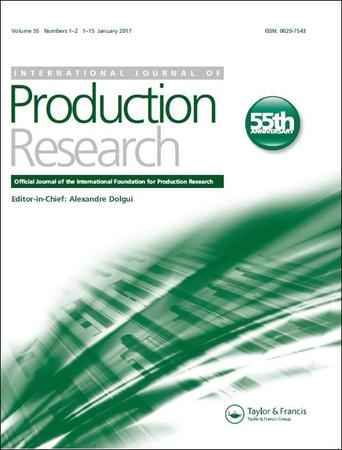
The International Journal of Production Research (IJPR), published since 1961, is a well-established, highly successful and leading journal reporting manufacturing, production and operations management research.
IJPR is published 24 times a year and includes papers on innovation management, design of products, manufacturing processes, production and logistics systems. Production economics, the essential behaviour of production resources and systems as well as the complex decision problems that arise in design, management and control of production and logistics systems are considered.
IJPR is a journal for researchers and professors in mechanical engineering, industrial and systems engineering, operations research and management science, and business. It is also an informative reference for industrial managers looking to improve the efficiency and effectiveness of their production systems.



 京公网安备 11010802042870号
京ICP备2023020795号-1
京公网安备 11010802042870号
京ICP备2023020795号-1

 分享
分享
 求助内容:
求助内容: 应助结果提醒方式:
 扫码关注我们
