A focus group study of therapists' views on using a novel neuroanimation virtual reality game to deliver intensive upper-limb rehabilitation early after stroke.
{"title":"A focus group study of therapists' views on using a novel neuroanimation virtual reality game to deliver intensive upper-limb rehabilitation early after stroke.","authors":"Rachel C Stockley, Danielle L Christian","doi":"10.1186/s40945-022-00139-0","DOIUrl":null,"url":null,"abstract":"<p><strong>Background: </strong>Intensive training can significantly reduce upper-limb impairments after stroke but delivering interventions of sufficiently high intensity is extremely difficult in routine practice. The MindPod Dolphin® system is a novel neuroanimation experience which provides motivating and intensive virtual reality based training for the upper-limb. However several studies report that health professionals have reservations about using technology in rehabilitation. Therefore, this study sought to explore the views of therapists who had used this novel neuroanimation therapy (NAT) in a clinical centre to deliver intensive for the upper-limb of people after stroke in a phase 2 trial (SMARTS2).</p><p><strong>Methods: </strong>Four therapists (three female, two physical and two occupational therapists) who delivered NAT participated in a focus group conducted by two independent researchers. The theoretical domains framework and COM-B behaviour change models informed the discussion schedule for the focus group. An inductive approach to content analysis was used. Recordings were transcribed, coded and thematically analysed. Generated key themes were cross-checked with participants.</p><p><strong>Results: </strong>Whilst therapists had some initial concerns about using NAT, these were reduced by training, reference materials and face-to-face technical support. Therapists noted several significant benefits to using NAT including multi-system involvement, carry-over to functional tasks and high levels of patient engagement.</p><p><strong>Conclusions: </strong>These findings illuminate key areas that clinicians, technology developers and researchers should consider when designing, developing and implementing NAT. Specifically, they highlight the importance of planning the implementation of rehabilitation technologies, ensuring technologies are robust and suggest a range of benefits that might be conferred to patients when using intensive NAT as part of rehabilitation for the upper-limb after stroke.</p>","PeriodicalId":2,"journal":{"name":"ACS Applied Bio Materials","volume":" ","pages":"15"},"PeriodicalIF":4.7000,"publicationDate":"2022-06-15","publicationTypes":"Journal Article","fieldsOfStudy":null,"isOpenAccess":false,"openAccessPdf":"https://www.ncbi.nlm.nih.gov/pmc/articles/PMC9199178/pdf/","citationCount":"0","resultStr":null,"platform":"Semanticscholar","paperid":null,"PeriodicalName":"ACS Applied Bio Materials","FirstCategoryId":"1085","ListUrlMain":"https://doi.org/10.1186/s40945-022-00139-0","RegionNum":0,"RegionCategory":null,"ArticlePicture":[],"TitleCN":null,"AbstractTextCN":null,"PMCID":null,"EPubDate":"","PubModel":"","JCR":"Q2","JCRName":"MATERIALS SCIENCE, BIOMATERIALS","Score":null,"Total":0}
引用次数: 0
Abstract
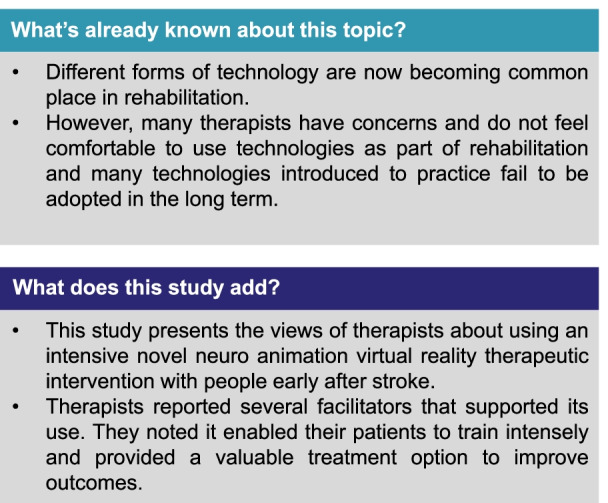
Background: Intensive training can significantly reduce upper-limb impairments after stroke but delivering interventions of sufficiently high intensity is extremely difficult in routine practice. The MindPod Dolphin® system is a novel neuroanimation experience which provides motivating and intensive virtual reality based training for the upper-limb. However several studies report that health professionals have reservations about using technology in rehabilitation. Therefore, this study sought to explore the views of therapists who had used this novel neuroanimation therapy (NAT) in a clinical centre to deliver intensive for the upper-limb of people after stroke in a phase 2 trial (SMARTS2).
Methods: Four therapists (three female, two physical and two occupational therapists) who delivered NAT participated in a focus group conducted by two independent researchers. The theoretical domains framework and COM-B behaviour change models informed the discussion schedule for the focus group. An inductive approach to content analysis was used. Recordings were transcribed, coded and thematically analysed. Generated key themes were cross-checked with participants.
Results: Whilst therapists had some initial concerns about using NAT, these were reduced by training, reference materials and face-to-face technical support. Therapists noted several significant benefits to using NAT including multi-system involvement, carry-over to functional tasks and high levels of patient engagement.
Conclusions: These findings illuminate key areas that clinicians, technology developers and researchers should consider when designing, developing and implementing NAT. Specifically, they highlight the importance of planning the implementation of rehabilitation technologies, ensuring technologies are robust and suggest a range of benefits that might be conferred to patients when using intensive NAT as part of rehabilitation for the upper-limb after stroke.
期刊介绍:
ACS Applied Bio Materials is an interdisciplinary journal publishing original research covering all aspects of biomaterials and biointerfaces including and beyond the traditional biosensing, biomedical and therapeutic applications.
The journal is devoted to reports of new and original experimental and theoretical research of an applied nature that integrates knowledge in the areas of materials, engineering, physics, bioscience, and chemistry into important bio applications. The journal is specifically interested in work that addresses the relationship between structure and function and assesses the stability and degradation of materials under relevant environmental and biological conditions.





 京公网安备 11010802042870号
京ICP备2023020795号-1
京公网安备 11010802042870号
京ICP备2023020795号-1

 分享
分享
 求助内容:
求助内容: 应助结果提醒方式:
 扫码关注我们
