Low-parameter linear model to activate the flexibility of the building thermal mass in energy system optimization

IF 5 Q2 ENERGY & FUELS Smart Energy Pub Date : 2023-02-01 DOI:10.1016/j.segy.2023.100094
Magnus Askeland , Laurent Georges , Magnus Korpås
{"title":"Low-parameter linear model to activate the flexibility of the building thermal mass in energy system optimization","authors":"Magnus Askeland ,&nbsp;Laurent Georges ,&nbsp;Magnus Korpås","doi":"10.1016/j.segy.2023.100094","DOIUrl":null,"url":null,"abstract":"<div><p>As buildings are becoming an integrated part of the energy system, the potential activation of the thermal mass as a source of flexibility needs to be considered in energy system modeling. Since energy system models represent larger and integrated systems, often as linear programs, the thermal mass activation of buildings needs to be formulated accordingly to be included as a flexibility asset in the energy system optimization problem. The article provides a linear model of the energy stored in the building thermal mass compared to a reference operation scenario without demand response. This formulation in relative terms significantly reduces the number of model parameters to be identified using field measurements and enables the analysis of the aggregated energy flexibility in energy system models. The thermal mass activation is demonstrated in a case study which also includes validation. In addition, a comparison of the thermal mass activation and batteries is made. It is concluded that the provided linear deviation-based formulation is appropriate for representing the potential of flexibility provision from the thermal mass in buildings for the purpose of energy system planning.</p></div>","PeriodicalId":34738,"journal":{"name":"Smart Energy","volume":"9 ","pages":"Article 100094"},"PeriodicalIF":5.0000,"publicationDate":"2023-02-01","publicationTypes":"Journal Article","fieldsOfStudy":null,"isOpenAccess":false,"openAccessPdf":"","citationCount":"1","resultStr":null,"platform":"Semanticscholar","paperid":null,"PeriodicalName":"Smart Energy","FirstCategoryId":"1085","ListUrlMain":"https://www.sciencedirect.com/science/article/pii/S2666955223000011","RegionNum":0,"RegionCategory":null,"ArticlePicture":[],"TitleCN":null,"AbstractTextCN":null,"PMCID":null,"EPubDate":"","PubModel":"","JCR":"Q2","JCRName":"ENERGY & FUELS","Score":null,"Total":0}
引用次数: 1

Abstract

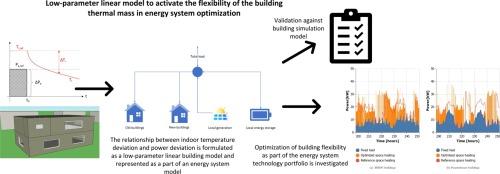
As buildings are becoming an integrated part of the energy system, the potential activation of the thermal mass as a source of flexibility needs to be considered in energy system modeling. Since energy system models represent larger and integrated systems, often as linear programs, the thermal mass activation of buildings needs to be formulated accordingly to be included as a flexibility asset in the energy system optimization problem. The article provides a linear model of the energy stored in the building thermal mass compared to a reference operation scenario without demand response. This formulation in relative terms significantly reduces the number of model parameters to be identified using field measurements and enables the analysis of the aggregated energy flexibility in energy system models. The thermal mass activation is demonstrated in a case study which also includes validation. In addition, a comparison of the thermal mass activation and batteries is made. It is concluded that the provided linear deviation-based formulation is appropriate for representing the potential of flexibility provision from the thermal mass in buildings for the purpose of energy system planning.

Abstract Image

查看原文
分享 分享
微信好友 朋友圈 QQ好友 复制链接
本刊更多论文
低参数线性模型在能源系统优化中激活建筑热质量的灵活性
随着建筑物成为能源系统的一个组成部分,在能源系统建模中需要考虑作为灵活性来源的热物质的潜在激活。由于能源系统模型代表更大的集成系统,通常是线性程序,因此需要相应地制定建筑物的热质量激活,以将其作为能源系统优化问题中的柔性资产。与没有需求响应的参考操作场景相比,本文提供了一个存储在建筑热质量中的能量的线性模型。这种相对公式显著减少了使用现场测量来识别的模型参数的数量,并能够分析能源系统模型中的总能量灵活性。热质量活化在一个案例研究中得到了验证。此外,还对热质量活化和电池进行了比较。得出的结论是,所提供的基于线性偏差的公式适用于表示出于能源系统规划目的从建筑物中的热质量提供灵活性的潜力。
本文章由计算机程序翻译,如有差异,请以英文原文为准。
求助全文
约1分钟内获得全文 去求助
来源期刊
Smart Energy
Smart Energy Engineering-Mechanical Engineering
CiteScore
9.20
自引率
0.00%
发文量
29
审稿时长
73 days
期刊最新文献
The future of Danish offshore wind: Integration and export strategies for energy hubs in the North Sea A mixed-integer linear programming model for BESS sizing optimization considering aging effects and emission costs Bridging theory and practice: Building a coordinated offshore grid in the North Sea and United States Eastern Seaboard Forecasting day-ahead hydropower bids in the colombian electricity market: A two-stage machine learning framework A methodological framework for identifying District Heating Networks in Germany by utilizing the census data
×
引用
GB/T 7714-2015
复制
MLA
复制
APA
复制
导出至
BibTeX EndNote RefMan NoteFirst NoteExpress
×
×
提示
您的信息不完整,为了账户安全,请先补充。
现在去补充
×
提示
您因"违规操作"
具体请查看互助需知
我知道了
×
提示
现在去查看 取消
×
提示
确定
0
微信
客服QQ
Book学术公众号 扫码关注我们
反馈
×
意见反馈
请填写您的意见或建议
请填写您的手机或邮箱
已复制链接
已复制链接
快去分享给好友吧!
我知道了
×
扫码分享
扫码分享
Book学术官方微信
Book学术文献互助
Book学术文献互助群
群 号:604180095
Book学术
文献互助 智能选刊 最新文献 互助须知 联系我们:info@booksci.cn
Book学术提供免费学术资源搜索服务,方便国内外学者检索中英文文献。致力于提供最便捷和优质的服务体验。
Copyright © 2023 Book学术 All rights reserved.
ghs 京公网安备 11010802042870号 京ICP备2023020795号-1





