Walking hand in hand: The role of affection-sharing in understanding the social network effect in same-sex, mixed-sex, and gender-diverse relationships.
{"title":"Walking hand in hand: The role of affection-sharing in understanding the social network effect in same-sex, mixed-sex, and gender-diverse relationships.","authors":"Karen L Blair, Chelsea Hudson, Diane Holmberg","doi":"10.1177/02654075231169786","DOIUrl":null,"url":null,"abstract":"<p><p>Individuals who perceive greater support or approval for their relationships from friends and family also report greater relationship stability and commitment and better mental and physical health (known as the \"social network effect\"). These associations have been explained, in part, through three cognitive-affective processes: uncertainty reduction, cognitive balance, and dyadic identity formation. However, we know less about cognitive-<i>behavioral</i> mechanisms that might help explain the social network effect. In this study, we propose and test a model in which physical affection-sharing acts as one such behavioral mechanism. In a sample of 1848 individuals in same-sex (<i>n</i> = 696), mixed-sex (<i>n</i> = 1045), and gender-diverse (<i>n</i> = 107) relationships, we found support for our overall model. Our findings suggest that perceived support for one's relationships is a significant predictor of perceived support for physical affection-sharing, which in turn predicts the frequency of affection-sharing in private and public contexts and, ultimately, relationship well-being. However, we also found that relationship type moderates these associations, highlighting how the experience of sharing affection with one's partner changes for many in marginalized relationships, especially in public. We conclude by discussing how our findings contribute to theories of social support for relationships, underscoring the importance of considering affective, cognitive, and behavioral factors relevant to the process. We also emphasize the understudied role of context in shaping affection-sharing experiences across all relationship types.</p>","PeriodicalId":2,"journal":{"name":"ACS Applied Bio Materials","volume":" ","pages":"3171-3194"},"PeriodicalIF":4.7000,"publicationDate":"2023-10-01","publicationTypes":"Journal Article","fieldsOfStudy":null,"isOpenAccess":false,"openAccessPdf":"https://www.ncbi.nlm.nih.gov/pmc/articles/PMC10632134/pdf/","citationCount":"1","resultStr":null,"platform":"Semanticscholar","paperid":null,"PeriodicalName":"ACS Applied Bio Materials","FirstCategoryId":"102","ListUrlMain":"https://doi.org/10.1177/02654075231169786","RegionNum":0,"RegionCategory":null,"ArticlePicture":[],"TitleCN":null,"AbstractTextCN":null,"PMCID":null,"EPubDate":"2023/4/13 0:00:00","PubModel":"Epub","JCR":"Q2","JCRName":"MATERIALS SCIENCE, BIOMATERIALS","Score":null,"Total":0}
引用次数: 1
Abstract
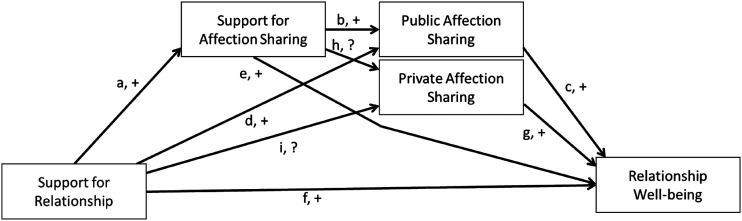
Individuals who perceive greater support or approval for their relationships from friends and family also report greater relationship stability and commitment and better mental and physical health (known as the "social network effect"). These associations have been explained, in part, through three cognitive-affective processes: uncertainty reduction, cognitive balance, and dyadic identity formation. However, we know less about cognitive-behavioral mechanisms that might help explain the social network effect. In this study, we propose and test a model in which physical affection-sharing acts as one such behavioral mechanism. In a sample of 1848 individuals in same-sex (n = 696), mixed-sex (n = 1045), and gender-diverse (n = 107) relationships, we found support for our overall model. Our findings suggest that perceived support for one's relationships is a significant predictor of perceived support for physical affection-sharing, which in turn predicts the frequency of affection-sharing in private and public contexts and, ultimately, relationship well-being. However, we also found that relationship type moderates these associations, highlighting how the experience of sharing affection with one's partner changes for many in marginalized relationships, especially in public. We conclude by discussing how our findings contribute to theories of social support for relationships, underscoring the importance of considering affective, cognitive, and behavioral factors relevant to the process. We also emphasize the understudied role of context in shaping affection-sharing experiences across all relationship types.
期刊介绍:
ACS Applied Bio Materials is an interdisciplinary journal publishing original research covering all aspects of biomaterials and biointerfaces including and beyond the traditional biosensing, biomedical and therapeutic applications.
The journal is devoted to reports of new and original experimental and theoretical research of an applied nature that integrates knowledge in the areas of materials, engineering, physics, bioscience, and chemistry into important bio applications. The journal is specifically interested in work that addresses the relationship between structure and function and assesses the stability and degradation of materials under relevant environmental and biological conditions.





 京公网安备 11010802042870号
京ICP备2023020795号-1
京公网安备 11010802042870号
京ICP备2023020795号-1

 分享
分享
 求助内容:
求助内容: 应助结果提醒方式:
 扫码关注我们
