Darren Beales, Yi Ki Ho, James Lewin, Bianca Wen-Qi Loh, Amirah Binte Yusof, Sharon Grieve, Sonia Ranelli, David Holthouse, Tim Mitchell, Helen Slater
{"title":"Participatory design of an infographic to help support the care of people living with complex regional pain syndrome.","authors":"Darren Beales, Yi Ki Ho, James Lewin, Bianca Wen-Qi Loh, Amirah Binte Yusof, Sharon Grieve, Sonia Ranelli, David Holthouse, Tim Mitchell, Helen Slater","doi":"10.1177/20494637231190587","DOIUrl":null,"url":null,"abstract":"<p><strong>Background: </strong>Complex regional pain syndrome (CRPS) can be a debilitating pain condition with enduring physical, psychological and social impacts. CRPS is often poorly understood by healthcare professionals and management needs to be tailored to each individual's presentation. People with lived experience express difficulty in accessing reliable and meaningful information about the condition. This study aimed to co-create a trustworthy infographic to share information about the lived experience of CRPS.</p><p><strong>Methods: </strong>We adopted a seven-phase, iterative, participatory methodology to co-create the infographic. Potential infographic content was obtained from qualitative work investigating the lived experience of CRPS. Online consumer engagement (people with doctor diagnosed CRPS/their family, <i>n</i>=20) was used to prioritise content to be included in the infographic and then potential designs were sourced. The research team narrowed the selections down to two designs which were presented to consumers online for final selection (<i>n</i>=25) and refinement (<i>n</i>=34).</p><p><strong>Results: </strong>An infographic for understanding the lived experience of CRPS was completed using participatory design, providing a resource aligned to the needs of people with this condition. Using the Patient Education Materials Assessment Tool, the final infographic rated highly for understandability (92%) and participants indicated significant willingness to share this infographic with others (93%).</p><p><strong>Conclusion: </strong>A process of participatory design was an effective and efficient process for translation of evidence gathered from qualitative research into a trustworthy resource for people with CRPS and their support people.</p>","PeriodicalId":1,"journal":{"name":"Accounts of Chemical Research","volume":" ","pages":"519-531"},"PeriodicalIF":17.7000,"publicationDate":"2023-12-01","publicationTypes":"Journal Article","fieldsOfStudy":null,"isOpenAccess":false,"openAccessPdf":"https://www.ncbi.nlm.nih.gov/pmc/articles/PMC10642498/pdf/","citationCount":"0","resultStr":null,"platform":"Semanticscholar","paperid":null,"PeriodicalName":"Accounts of Chemical Research","FirstCategoryId":"1085","ListUrlMain":"https://doi.org/10.1177/20494637231190587","RegionNum":1,"RegionCategory":"化学","ArticlePicture":[],"TitleCN":null,"AbstractTextCN":null,"PMCID":null,"EPubDate":"2023/7/28 0:00:00","PubModel":"Epub","JCR":"Q1","JCRName":"CHEMISTRY, MULTIDISCIPLINARY","Score":null,"Total":0}
引用次数: 0
Abstract
Background: Complex regional pain syndrome (CRPS) can be a debilitating pain condition with enduring physical, psychological and social impacts. CRPS is often poorly understood by healthcare professionals and management needs to be tailored to each individual's presentation. People with lived experience express difficulty in accessing reliable and meaningful information about the condition. This study aimed to co-create a trustworthy infographic to share information about the lived experience of CRPS.
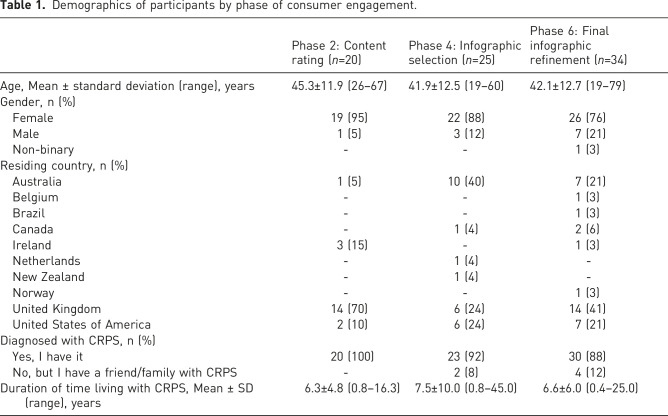
Methods: We adopted a seven-phase, iterative, participatory methodology to co-create the infographic. Potential infographic content was obtained from qualitative work investigating the lived experience of CRPS. Online consumer engagement (people with doctor diagnosed CRPS/their family, n=20) was used to prioritise content to be included in the infographic and then potential designs were sourced. The research team narrowed the selections down to two designs which were presented to consumers online for final selection (n=25) and refinement (n=34).
Results: An infographic for understanding the lived experience of CRPS was completed using participatory design, providing a resource aligned to the needs of people with this condition. Using the Patient Education Materials Assessment Tool, the final infographic rated highly for understandability (92%) and participants indicated significant willingness to share this infographic with others (93%).
Conclusion: A process of participatory design was an effective and efficient process for translation of evidence gathered from qualitative research into a trustworthy resource for people with CRPS and their support people.
期刊介绍:
Accounts of Chemical Research presents short, concise and critical articles offering easy-to-read overviews of basic research and applications in all areas of chemistry and biochemistry. These short reviews focus on research from the author’s own laboratory and are designed to teach the reader about a research project. In addition, Accounts of Chemical Research publishes commentaries that give an informed opinion on a current research problem. Special Issues online are devoted to a single topic of unusual activity and significance.
Accounts of Chemical Research replaces the traditional article abstract with an article "Conspectus." These entries synopsize the research affording the reader a closer look at the content and significance of an article. Through this provision of a more detailed description of the article contents, the Conspectus enhances the article's discoverability by search engines and the exposure for the research.






 京公网安备 11010802042870号
京ICP备2023020795号-1
京公网安备 11010802042870号
京ICP备2023020795号-1

 分享
分享
 求助内容:
求助内容: 应助结果提醒方式:
 扫码关注我们
