{"title":"Role of hydrogen-bond networks on the donor side of photosynthetic reaction centers from purple bacteria.","authors":"T Yu Fufina, L G Vasilieva","doi":"10.1007/s12551-023-01109-x","DOIUrl":null,"url":null,"abstract":"<p><p>For the last decades, significant progress has been made in studying the biological functions of H-bond networks in membrane proteins, proton transporters, receptors, and photosynthetic reaction centers. Increasing availability of the X-ray crystal and cryo-electron microscopy structures of photosynthetic complexes resolved with high atomic resolution provides a platform for their comparative analysis. It allows identifying structural factors that are ensuring the high quantum yield of the photochemical reactions and are responsible for the stability of the membrane complexes. The H-bond networks are known to be responsible for proton transport associated with electron transfer from the primary to the secondary quinone as well as in the processes of water oxidation in photosystem II. Participation of such networks in reactions proceeding on the periplasmic side of bacterial photosynthetic reaction centers is less studied. This review summarizes the current understanding of the role of H-bond networks on the donor side of photosynthetic reaction centers from purple bacteria. It is discussed that the networks may be involved in providing close association with mobile electron carriers, in light-induced proton transport, in regulation of the redox properties of bacteriochlorophyll cofactors, and in stabilization of the membrane protein structure at the interface of membrane and soluble phases.</p>","PeriodicalId":4,"journal":{"name":"ACS Applied Energy Materials","volume":" ","pages":"921-937"},"PeriodicalIF":5.5000,"publicationDate":"2023-08-18","publicationTypes":"Journal Article","fieldsOfStudy":null,"isOpenAccess":false,"openAccessPdf":"https://www.ncbi.nlm.nih.gov/pmc/articles/PMC10643783/pdf/","citationCount":"0","resultStr":null,"platform":"Semanticscholar","paperid":null,"PeriodicalName":"ACS Applied Energy Materials","FirstCategoryId":"1085","ListUrlMain":"https://doi.org/10.1007/s12551-023-01109-x","RegionNum":3,"RegionCategory":"材料科学","ArticlePicture":[],"TitleCN":null,"AbstractTextCN":null,"PMCID":null,"EPubDate":"2023/10/1 0:00:00","PubModel":"eCollection","JCR":"Q2","JCRName":"CHEMISTRY, PHYSICAL","Score":null,"Total":0}
引用次数: 0
Abstract
For the last decades, significant progress has been made in studying the biological functions of H-bond networks in membrane proteins, proton transporters, receptors, and photosynthetic reaction centers. Increasing availability of the X-ray crystal and cryo-electron microscopy structures of photosynthetic complexes resolved with high atomic resolution provides a platform for their comparative analysis. It allows identifying structural factors that are ensuring the high quantum yield of the photochemical reactions and are responsible for the stability of the membrane complexes. The H-bond networks are known to be responsible for proton transport associated with electron transfer from the primary to the secondary quinone as well as in the processes of water oxidation in photosystem II. Participation of such networks in reactions proceeding on the periplasmic side of bacterial photosynthetic reaction centers is less studied. This review summarizes the current understanding of the role of H-bond networks on the donor side of photosynthetic reaction centers from purple bacteria. It is discussed that the networks may be involved in providing close association with mobile electron carriers, in light-induced proton transport, in regulation of the redox properties of bacteriochlorophyll cofactors, and in stabilization of the membrane protein structure at the interface of membrane and soluble phases.
期刊介绍:
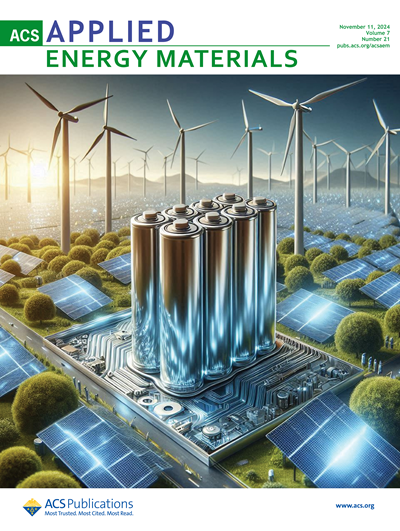
ACS Applied Energy Materials is an interdisciplinary journal publishing original research covering all aspects of materials, engineering, chemistry, physics and biology relevant to energy conversion and storage. The journal is devoted to reports of new and original experimental and theoretical research of an applied nature that integrate knowledge in the areas of materials, engineering, physics, bioscience, and chemistry into important energy applications.



 京公网安备 11010802042870号
京ICP备2023020795号-1
京公网安备 11010802042870号
京ICP备2023020795号-1

 分享
分享
 求助内容:
求助内容: 应助结果提醒方式:
 扫码关注我们
