Steve Culman, Anthony Fulford, Greg LaBarge, Harold Watters, Laura E. Lindsey, Anne Dorrance, Leonardo Deiss
{"title":"Probability of crop response to phosphorus and potassium fertilizer: Lessons from 45 years of Ohio trials","authors":"Steve Culman, Anthony Fulford, Greg LaBarge, Harold Watters, Laura E. Lindsey, Anne Dorrance, Leonardo Deiss","doi":"10.1002/saj2.20564","DOIUrl":null,"url":null,"abstract":"<p>Soil test phosphorus (P) and potassium (K) and the associated soil test critical values (CSTVs) are widely used as the primary diagnostic tool to determine if a crop needs P and K fertilizer. However, identifying robust and predictive CSTVs requires a large number of field trials in representative soils and environments to assess crop fertilizer responses. From 1976 to 2021, a total of 457 P trials and 458 K trials were conducted in corn (<i>Zea mays</i>), soybean (<i>Glycine max</i>), and wheat (<i>Triticum aestivum</i>) across 40 counties in Ohio. The trials consisted of both multi-rate, multi-year trials and single-year, single-rate and large strip trials. Across all crops, grain yield responded to P and K fertilizer in 23.4% and 25.3% of trials, with average yield increases of 8.8% and 11.0%, respectively. Corn yield was more responsive to P and K fertilizer (∼30% of P and K trials) than soybean yield (14% of P trials, 20% of K trials). Several models were run to identify CSTVs, but models imparted systematic bias in CSTVs, and a superior model was not identified due to poor model fit and indiscernible criteria to guide model selection. Instead of a single CSTV, data were classified into five discrete categories based on relative yields and Mehlich-3 soil test values. These classifications provided a useful and consistent framework for assessing the probability of crop response to P and K fertilizer. Ohio soils with Mehlich-3 values greater than 20 mg P kg<sup>−1</sup> and 130 mg K kg<sup>−1</sup> have a low probability of responding to P or K fertilizer application.</p>","PeriodicalId":101043,"journal":{"name":"Proceedings - Soil Science Society of America","volume":"87 5","pages":"1207-1220"},"PeriodicalIF":0.0000,"publicationDate":"2023-06-23","publicationTypes":"Journal Article","fieldsOfStudy":null,"isOpenAccess":false,"openAccessPdf":"https://onlinelibrary.wiley.com/doi/epdf/10.1002/saj2.20564","citationCount":"0","resultStr":null,"platform":"Semanticscholar","paperid":null,"PeriodicalName":"Proceedings - Soil Science Society of America","FirstCategoryId":"1085","ListUrlMain":"https://onlinelibrary.wiley.com/doi/10.1002/saj2.20564","RegionNum":0,"RegionCategory":null,"ArticlePicture":[],"TitleCN":null,"AbstractTextCN":null,"PMCID":null,"EPubDate":"","PubModel":"","JCR":"","JCRName":"","Score":null,"Total":0}
引用次数: 0
Abstract
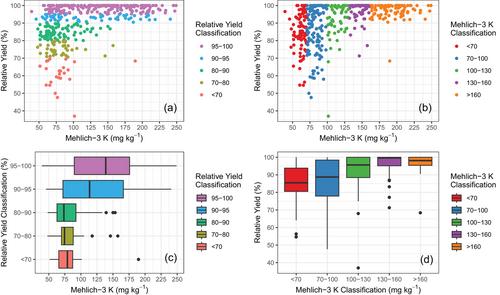
Soil test phosphorus (P) and potassium (K) and the associated soil test critical values (CSTVs) are widely used as the primary diagnostic tool to determine if a crop needs P and K fertilizer. However, identifying robust and predictive CSTVs requires a large number of field trials in representative soils and environments to assess crop fertilizer responses. From 1976 to 2021, a total of 457 P trials and 458 K trials were conducted in corn (Zea mays), soybean (Glycine max), and wheat (Triticum aestivum) across 40 counties in Ohio. The trials consisted of both multi-rate, multi-year trials and single-year, single-rate and large strip trials. Across all crops, grain yield responded to P and K fertilizer in 23.4% and 25.3% of trials, with average yield increases of 8.8% and 11.0%, respectively. Corn yield was more responsive to P and K fertilizer (∼30% of P and K trials) than soybean yield (14% of P trials, 20% of K trials). Several models were run to identify CSTVs, but models imparted systematic bias in CSTVs, and a superior model was not identified due to poor model fit and indiscernible criteria to guide model selection. Instead of a single CSTV, data were classified into five discrete categories based on relative yields and Mehlich-3 soil test values. These classifications provided a useful and consistent framework for assessing the probability of crop response to P and K fertilizer. Ohio soils with Mehlich-3 values greater than 20 mg P kg−1 and 130 mg K kg−1 have a low probability of responding to P or K fertilizer application.
土壤试验磷(P)和钾(K)及其相关的土壤试验临界值(CSTVs)被广泛用作确定作物是否需要磷钾肥的主要诊断工具。然而,确定可靠和可预测的cstv需要在具有代表性的土壤和环境中进行大量的田间试验,以评估作物肥料的反应。从1976年到2021年,在俄亥俄州40个县对玉米(Zea mays)、大豆(Glycine max)和小麦(Triticum aestivum)进行了457次P试验和458次K试验。试验包括多率、多年试验和单年、单率、大型条形试验。在所有作物中,23.4%和25.3%的试验对磷肥和钾肥有反应,平均产量分别提高8.8%和11.0%。玉米产量对磷钾肥(约30%磷钾试验)的响应强于大豆产量(14%磷肥试验,20%钾肥试验)。我们运行了几个模型来识别cstv,但模型在cstv中存在系统偏差,由于模型拟合不佳和指导模型选择的标准难以识别,因此无法识别出较好的模型。与单一的CSTV不同,数据根据相对产量和Mehlich-3土壤测试值被分为5个离散的类别。这些分类为评估作物对磷钾肥的响应概率提供了一个有用和一致的框架。俄亥俄州土壤中,Mehlich-3值大于20 mg P kg - 1和130 mg K kg - 1的土壤对磷肥或钾肥的响应概率较低。



 京公网安备 11010802042870号
京ICP备2023020795号-1
京公网安备 11010802042870号
京ICP备2023020795号-1

 分享
分享

 求助内容:
求助内容: 应助结果提醒方式:
 扫码关注我们
