Eliza Hartley, Lynda Moore, Aaron Knuckey, Henry von Doussa, Felicity Painter, Karen Story, Nick Barrington, Jeff Young, Jennifer McIntosh
{"title":"Walk-in Together: A pilot study of a walk-in online family therapy intervention","authors":"Eliza Hartley, Lynda Moore, Aaron Knuckey, Henry von Doussa, Felicity Painter, Karen Story, Nick Barrington, Jeff Young, Jennifer McIntosh","doi":"10.1002/anzf.1534","DOIUrl":null,"url":null,"abstract":"<p>Many Australians are requiring mental health care, including families, leading to long wait times in order to access support. Walk-in therapy reduces barriers to mental health support services by providing support at the time that families seek help. This paper presents a proof-of-concept study investigating the acceptability and short-term effectiveness of an online walk-in family therapy service, Walk-in Together (WIT). Part 1 of the paper describes the experiences of 44 family members from 22 families who presented to a public family therapy clinic for a virtual walk-in family therapy session. The session was conducted by a team of three experienced family therapists. Family members' experiences were sought pre-session, post-session, and at 6 weeks follow-up via survey and interview. Part 2 of the paper explores therapist perceptions (<i>n</i> = 7) of the WIT approach, through thematic analysis of semi-structured interview data. Post-session feedback showed 85% of family members found WIT to be helpful and 50% were optimistic about their future as a family after their WIT session. Six weeks post-session it was revealed that WIT supported planning for families in equipping them to move forward with 88% of family members reporting that they knew what to do after the session. All therapists uniformly experienced the model as offering a timely and beneficial service, suitable for diverse presentations and constellations of families. These preliminary results suggest the significant utility of this WIT intervention as a well-received and helpful service for families, who valued the easy access and rapid therapeutic response afforded by the online, walk-in delivery model. This proof-of-concept paper suggests the potential for further development and growth of WIT, as well as other mental health support services using a walk-in, telehealth model to meet the rising demand for therapeutic support for families in distress.</p>","PeriodicalId":74949,"journal":{"name":"","volume":"44 2","pages":"127-144"},"PeriodicalIF":0.0,"publicationDate":"2023-05-26","publicationTypes":"Journal Article","fieldsOfStudy":null,"isOpenAccess":false,"openAccessPdf":"https://onlinelibrary.wiley.com/doi/epdf/10.1002/anzf.1534","citationCount":"0","resultStr":null,"platform":"Semanticscholar","paperid":null,"PeriodicalName":"","FirstCategoryId":"102","ListUrlMain":"https://onlinelibrary.wiley.com/doi/10.1002/anzf.1534","RegionNum":0,"RegionCategory":null,"ArticlePicture":[],"TitleCN":null,"AbstractTextCN":null,"PMCID":null,"EPubDate":"","PubModel":"","JCR":"","JCRName":"","Score":null,"Total":0}
引用次数: 0
Abstract
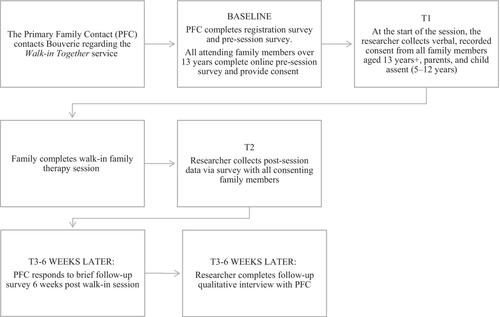
Many Australians are requiring mental health care, including families, leading to long wait times in order to access support. Walk-in therapy reduces barriers to mental health support services by providing support at the time that families seek help. This paper presents a proof-of-concept study investigating the acceptability and short-term effectiveness of an online walk-in family therapy service, Walk-in Together (WIT). Part 1 of the paper describes the experiences of 44 family members from 22 families who presented to a public family therapy clinic for a virtual walk-in family therapy session. The session was conducted by a team of three experienced family therapists. Family members' experiences were sought pre-session, post-session, and at 6 weeks follow-up via survey and interview. Part 2 of the paper explores therapist perceptions (n = 7) of the WIT approach, through thematic analysis of semi-structured interview data. Post-session feedback showed 85% of family members found WIT to be helpful and 50% were optimistic about their future as a family after their WIT session. Six weeks post-session it was revealed that WIT supported planning for families in equipping them to move forward with 88% of family members reporting that they knew what to do after the session. All therapists uniformly experienced the model as offering a timely and beneficial service, suitable for diverse presentations and constellations of families. These preliminary results suggest the significant utility of this WIT intervention as a well-received and helpful service for families, who valued the easy access and rapid therapeutic response afforded by the online, walk-in delivery model. This proof-of-concept paper suggests the potential for further development and growth of WIT, as well as other mental health support services using a walk-in, telehealth model to meet the rising demand for therapeutic support for families in distress.



 京公网安备 11010802042870号
京ICP备2023020795号-1
京公网安备 11010802042870号
京ICP备2023020795号-1

 分享
分享
 求助内容:
求助内容: 应助结果提醒方式:
 扫码关注我们
