Permesh Singh Dhillon, Emma Soo, Waleed Butt, Thanh N Nguyen, Emma Barrett, Anna Podlasek, Norman McConachie, Robert Lenthall, Sujit Nair, Luqman Malik, Chesvin Cheema, Pervinder Bhogal, Hegoda Levansri Dilrukshan Makalanda, Martin A James, Robert A Dineen, Timothy J England
{"title":"Comparison Between In-Hospital and Community-Onset Stroke Treated With Endovascular Thrombectomy: A Propensity Score-Matched Cohort Study.","authors":"Permesh Singh Dhillon, Emma Soo, Waleed Butt, Thanh N Nguyen, Emma Barrett, Anna Podlasek, Norman McConachie, Robert Lenthall, Sujit Nair, Luqman Malik, Chesvin Cheema, Pervinder Bhogal, Hegoda Levansri Dilrukshan Makalanda, Martin A James, Robert A Dineen, Timothy J England","doi":"10.1161/SVIN.122.000816","DOIUrl":null,"url":null,"abstract":"<p><strong>Background: </strong>Patients with acute ischemic stroke onset during hospital admission often have concurrent illnesses, increased underlying comorbidities and are often associated with a delayed recognition of stroke onset, compared with patients with stroke onset in the community (community-onset stroke [COS]). Endovascular thrombectomy (EVT) for large-vessel occlusion in acute ischemic stroke has been proven to be effective, though the safety and feasibility of EVT among patients with in-hospital stroke (IHS) onset remains undetermined. We aim to compare the workflow and clinical outcomes for patients undergoing EVT following IHS onset and COS.</p><p><strong>Methods: </strong>Using data from a national stroke registry, we used propensity score-matched individual-level data of patients who underwent EVT, following IHS and COS, between October 2015 and March 2020. Univariate analysis was performed to assess the procedural, functional, and safety outcomes.</p><p><strong>Results: </strong>We included 4353 patients (COS, 4104 [249 after propensity score matching]; IHS, 249 [249 after propensity score matching]). Compared with COS, patients with IHS had similar modified Rankin Scale on discharge (odds ratio [OR], 0.98 [95% CI, 0.72-1.34]; <i>P</i>=0.96) and at 6 months (OR, 1.25 [95% CI, 0.71-2.24]; <i>P</i>=0.48). No significant difference in achieving good functional outcome (modified Rankin Scale ≤ 2 at discharge; 31.3% [IHS] versus 29.3% [COS]; OR,=1.10 [95% CI 0.74-1.60]; <i>P</i>=0.61), successful reperfusion (modified Thrombolysis in Cerebral Infarction score of 2b-3), <i>P</i>=0.82; or safety outcomes of symptomatic intracranial hemorrhage (<i>P</i>=0.64) and in-hospital mortality (<i>P</i>=0.26) were demonstrated. Shorter time interval from stroke onset to imaging in the IHS group (IHS, 80±88 versus COS, 216±292 minutes) was observed. The imaging-to-arterial-puncture time was not significantly different between the groups (IHS, 160±140 versus COS, 162±184 minutes; <i>P</i>=0.85).</p><p><strong>Conclusions: </strong>EVT in patients with IHS is safe and feasible, with comparable functional and safety outcomes to patients with COS, in this national stroke registry. Continued efforts are required to improve the inpatient stroke workflow in recognizing stroke symptoms and initiating reperfusion treatment for eligible patients with IHS.</p>","PeriodicalId":74875,"journal":{"name":"Stroke (Hoboken, N.J.)","volume":" ","pages":"e000816"},"PeriodicalIF":2.8000,"publicationDate":"2023-04-25","publicationTypes":"Journal Article","fieldsOfStudy":null,"isOpenAccess":false,"openAccessPdf":"https://www.ncbi.nlm.nih.gov/pmc/articles/PMC12778670/pdf/","citationCount":"0","resultStr":null,"platform":"Semanticscholar","paperid":null,"PeriodicalName":"Stroke (Hoboken, N.J.)","FirstCategoryId":"1085","ListUrlMain":"https://doi.org/10.1161/SVIN.122.000816","RegionNum":0,"RegionCategory":null,"ArticlePicture":[],"TitleCN":null,"AbstractTextCN":null,"PMCID":null,"EPubDate":"2023/7/1 0:00:00","PubModel":"eCollection","JCR":"Q3","JCRName":"CLINICAL NEUROLOGY","Score":null,"Total":0}
引用次数: 0
Abstract
Background: Patients with acute ischemic stroke onset during hospital admission often have concurrent illnesses, increased underlying comorbidities and are often associated with a delayed recognition of stroke onset, compared with patients with stroke onset in the community (community-onset stroke [COS]). Endovascular thrombectomy (EVT) for large-vessel occlusion in acute ischemic stroke has been proven to be effective, though the safety and feasibility of EVT among patients with in-hospital stroke (IHS) onset remains undetermined. We aim to compare the workflow and clinical outcomes for patients undergoing EVT following IHS onset and COS.
Methods: Using data from a national stroke registry, we used propensity score-matched individual-level data of patients who underwent EVT, following IHS and COS, between October 2015 and March 2020. Univariate analysis was performed to assess the procedural, functional, and safety outcomes.
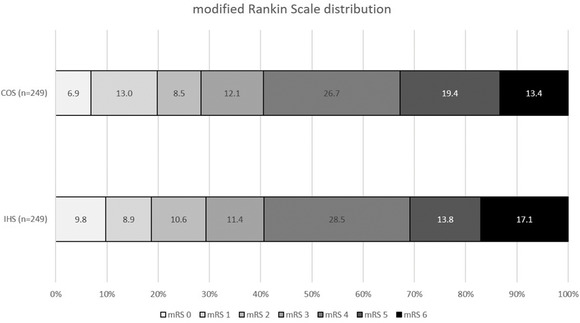
Results: We included 4353 patients (COS, 4104 [249 after propensity score matching]; IHS, 249 [249 after propensity score matching]). Compared with COS, patients with IHS had similar modified Rankin Scale on discharge (odds ratio [OR], 0.98 [95% CI, 0.72-1.34]; P=0.96) and at 6 months (OR, 1.25 [95% CI, 0.71-2.24]; P=0.48). No significant difference in achieving good functional outcome (modified Rankin Scale ≤ 2 at discharge; 31.3% [IHS] versus 29.3% [COS]; OR,=1.10 [95% CI 0.74-1.60]; P=0.61), successful reperfusion (modified Thrombolysis in Cerebral Infarction score of 2b-3), P=0.82; or safety outcomes of symptomatic intracranial hemorrhage (P=0.64) and in-hospital mortality (P=0.26) were demonstrated. Shorter time interval from stroke onset to imaging in the IHS group (IHS, 80±88 versus COS, 216±292 minutes) was observed. The imaging-to-arterial-puncture time was not significantly different between the groups (IHS, 160±140 versus COS, 162±184 minutes; P=0.85).
Conclusions: EVT in patients with IHS is safe and feasible, with comparable functional and safety outcomes to patients with COS, in this national stroke registry. Continued efforts are required to improve the inpatient stroke workflow in recognizing stroke symptoms and initiating reperfusion treatment for eligible patients with IHS.





 京公网安备 11010802042870号
京ICP备2023020795号-1
京公网安备 11010802042870号
京ICP备2023020795号-1

 分享
分享

 求助内容:
求助内容: 应助结果提醒方式:
 扫码关注我们
