{"title":"Artificial bone scaffolds and bone joints by additive manufacturing: A review","authors":"Khanish Gupta, Kusum Meena","doi":"10.1016/j.bprint.2023.e00268","DOIUrl":null,"url":null,"abstract":"<div><p><span>Patients with diseased/damaged bones are increasingly in need of bone replacement, tissue regeneration<span>, and organ repairs. The shape and size of the injury vary from person to person; thus the customized medical implant is a novel technique that has gained interest in recent times which offers personalized </span></span>implants<span><span> to each individual. Additive manufacturing<span> has considerable promise as an efficient fabrication technique for fabricating </span></span>customized implants<span><span><span><span><span> with complicated shapes or for fabricating implants for different sited inside the human body. Through cost-effectiveness, efficiency, and better patient outcomes, this method is expected to change healthcare in the near future. Researchers are using various biomaterials to fabricate orthopedic implants using different additive manufacturing techniques such as </span>fused deposition modelling (FDM), </span>stereolithography<span> (SLA), selective laser sintering (SLS), </span></span>selective laser melting<span> (SLM), selective electron beam melting<span> (SEBM), binder jetting printing (BJP), and direct energy deposition (DED) for the fabrication of the customized implants. The biomaterials and various additive manufacturing techniques employed in current </span></span></span>bone tissue engineering<span> implants are overviewed herein, along with their challenges and future direction. Moreover, multiple factors such as material compositions, surface properties, or process parameters are discussed, which significantly alters the properties of the fabricated scaffold<span>. Lastly, various commercially available products and devices available for bone and bone joint implants fabricated using conventional techniques have also been discussed in this study. No AM-based implant commercialized products are available in the market to date, which shows the incredible urge for research in such an area. Based on the finding of this study, additive manufacturing has demonstrated enormous potential for providing a pathway for the fabrication of customized implants. However, certain difficulties still need to be resolved to accelerate its translation into the clinics.</span></span></span></span></p></div>","PeriodicalId":72406,"journal":{"name":"","volume":"31 ","pages":"Article e00268"},"PeriodicalIF":0.0,"publicationDate":"2023-06-01","publicationTypes":"Journal Article","fieldsOfStudy":null,"isOpenAccess":false,"openAccessPdf":"","citationCount":"4","resultStr":null,"platform":"Semanticscholar","paperid":null,"PeriodicalName":"","FirstCategoryId":"1085","ListUrlMain":"https://www.sciencedirect.com/science/article/pii/S2405886623000118","RegionNum":0,"RegionCategory":null,"ArticlePicture":[],"TitleCN":null,"AbstractTextCN":null,"PMCID":null,"EPubDate":"2023/3/11 0:00:00","PubModel":"Epub","JCR":"","JCRName":"","Score":null,"Total":0}
引用次数: 4
Abstract
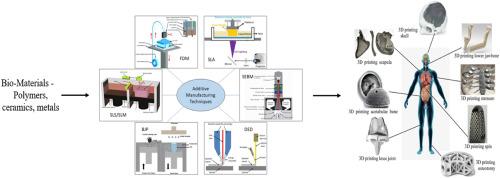
Patients with diseased/damaged bones are increasingly in need of bone replacement, tissue regeneration, and organ repairs. The shape and size of the injury vary from person to person; thus the customized medical implant is a novel technique that has gained interest in recent times which offers personalized implants to each individual. Additive manufacturing has considerable promise as an efficient fabrication technique for fabricating customized implants with complicated shapes or for fabricating implants for different sited inside the human body. Through cost-effectiveness, efficiency, and better patient outcomes, this method is expected to change healthcare in the near future. Researchers are using various biomaterials to fabricate orthopedic implants using different additive manufacturing techniques such as fused deposition modelling (FDM), stereolithography (SLA), selective laser sintering (SLS), selective laser melting (SLM), selective electron beam melting (SEBM), binder jetting printing (BJP), and direct energy deposition (DED) for the fabrication of the customized implants. The biomaterials and various additive manufacturing techniques employed in current bone tissue engineering implants are overviewed herein, along with their challenges and future direction. Moreover, multiple factors such as material compositions, surface properties, or process parameters are discussed, which significantly alters the properties of the fabricated scaffold. Lastly, various commercially available products and devices available for bone and bone joint implants fabricated using conventional techniques have also been discussed in this study. No AM-based implant commercialized products are available in the market to date, which shows the incredible urge for research in such an area. Based on the finding of this study, additive manufacturing has demonstrated enormous potential for providing a pathway for the fabrication of customized implants. However, certain difficulties still need to be resolved to accelerate its translation into the clinics.



 京公网安备 11010802042870号
京ICP备2023020795号-1
京公网安备 11010802042870号
京ICP备2023020795号-1

 分享
分享
 求助内容:
求助内容: 应助结果提醒方式:
 扫码关注我们
