Fei Huang, Zheng-wei Hu, Qiri Huang, Chunchen Liu, Ao Song, Lin Shao, Yuanqing Bai, Zhicheng Hu, Kai Zhang, Yong-Li Cao
{"title":"Donor-Acceptor Copolymers with Rationally Regulated Side Chains Orientation for Polymer Solar Cells Processed by Non-Halogenated Solvent","authors":"Fei Huang, Zheng-wei Hu, Qiri Huang, Chunchen Liu, Ao Song, Lin Shao, Yuanqing Bai, Zhicheng Hu, Kai Zhang, Yong-Li Cao","doi":"10.1055/a-1833-8668","DOIUrl":null,"url":null,"abstract":"A donor-acceptor (D-A) conjugated polymer PBTFO-T-1 consisting of 2,1,3-benzothiadiazole (BT) as A unit and thiophene (T) as D unit was facilely obtained by a straightforward three-step reaction. The BT unit is attached with a fluorine atom and an alkoxy chain to simultaneously endow the polymer with a deep highest occupied molecular orbital (HOMO) energy level and desirable solubility. The alkoxyl chains orientation on BT unit has been regulated and the polymer PBTFO-T-2 with regio-regularly oriented side chains was also developed to investigate the impact of the alkoxyl chains orientation on their optoelectronic properties. The PBTFO-T-1: Y6-BO polymer solar cells (PSCs) were processed with non-halogenated solvent and achieve an optimized power conversion efficiency (PCE) of 14.16%, significantly higher than 9.39% of PBTFO-T-2: Y6-BO counterpart. It has been demonstrated that PBTFO-T-1: Y6-BO film exhibits higher and more balanced charge transportation and superior film morphology, resulting in higher exciton generation and dissociation, less recombination and eventually the higher short current density (Jsc) and fill factor (FF). This study provides a possible strategy to develop polymer donors with low cost for future commercial applications of PSCs and gives some insights on regulating optoelectronic properties of polymer donors via rationally modifying their side chains orientation.","PeriodicalId":93348,"journal":{"name":"Organic Materials","volume":" ","pages":""},"PeriodicalIF":0.0000,"publicationDate":"2022-04-25","publicationTypes":"Journal Article","fieldsOfStudy":null,"isOpenAccess":false,"openAccessPdf":"","citationCount":"2","resultStr":null,"platform":"Semanticscholar","paperid":null,"PeriodicalName":"Organic Materials","FirstCategoryId":"1085","ListUrlMain":"https://doi.org/10.1055/a-1833-8668","RegionNum":0,"RegionCategory":null,"ArticlePicture":[],"TitleCN":null,"AbstractTextCN":null,"PMCID":null,"EPubDate":"","PubModel":"","JCR":"","JCRName":"","Score":null,"Total":0}
引用次数: 2
Abstract
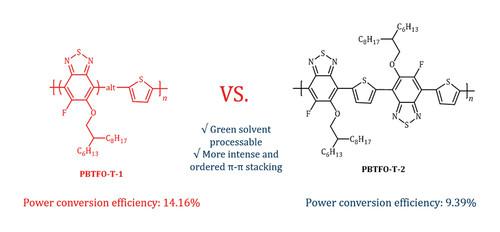
A donor-acceptor (D-A) conjugated polymer PBTFO-T-1 consisting of 2,1,3-benzothiadiazole (BT) as A unit and thiophene (T) as D unit was facilely obtained by a straightforward three-step reaction. The BT unit is attached with a fluorine atom and an alkoxy chain to simultaneously endow the polymer with a deep highest occupied molecular orbital (HOMO) energy level and desirable solubility. The alkoxyl chains orientation on BT unit has been regulated and the polymer PBTFO-T-2 with regio-regularly oriented side chains was also developed to investigate the impact of the alkoxyl chains orientation on their optoelectronic properties. The PBTFO-T-1: Y6-BO polymer solar cells (PSCs) were processed with non-halogenated solvent and achieve an optimized power conversion efficiency (PCE) of 14.16%, significantly higher than 9.39% of PBTFO-T-2: Y6-BO counterpart. It has been demonstrated that PBTFO-T-1: Y6-BO film exhibits higher and more balanced charge transportation and superior film morphology, resulting in higher exciton generation and dissociation, less recombination and eventually the higher short current density (Jsc) and fill factor (FF). This study provides a possible strategy to develop polymer donors with low cost for future commercial applications of PSCs and gives some insights on regulating optoelectronic properties of polymer donors via rationally modifying their side chains orientation.



 京公网安备 11010802042870号
京ICP备2023020795号-1
京公网安备 11010802042870号
京ICP备2023020795号-1

 分享
分享

 求助内容:
求助内容: 应助结果提醒方式:
 扫码关注我们
