{"title":"Managing Aotearoa New Zealand's greenhouse gas emissions from aviation.","authors":"Paul Callister, Robert I McLachlan","doi":"10.1080/03036758.2023.2212174","DOIUrl":null,"url":null,"abstract":"<p><p>Prior to COVID, the global aviation industry was growing rapidly. Growth has now resumed and is predicted to continue for at least the next three decades. Aotearoa New Zealand has particularly high aviation emissions and has been on a very rapid growth path that is incompatible with the Paris Agreement on climate change. Government, intergovernmental, nongovernmental, academic and industry sources have proposed technological innovations to address aviation emissions. These include sustainable aviation fuels, electric and hydrogen powered aircraft, and increases in efficiency. We review these and assess that none of them will lead to a significant reduction in emissions in the short to medium term. In addition, we demonstrate that even very aggressive uptake of new technology results in the New Zealand aviation sector exceeding its share of the carbon budget as determined by the Paris Agreement. Therefore, we examine the fundamental drivers of growth in aviation: the tourism and airport industries, emissions pricing and substitutes, and the distribution of air travel. Governance of this sector is challenging, but it is changing rapidly. We conclude that a national aviation action plan needs to be developed and implemented based on the 'Avoid/Shift/Improve' framework in use in other areas of transportation planning.</p>","PeriodicalId":2,"journal":{"name":"ACS Applied Bio Materials","volume":" ","pages":"412-432"},"PeriodicalIF":4.7000,"publicationDate":"2023-05-25","publicationTypes":"Journal Article","fieldsOfStudy":null,"isOpenAccess":false,"openAccessPdf":"https://www.ncbi.nlm.nih.gov/pmc/articles/PMC11573339/pdf/","citationCount":"0","resultStr":null,"platform":"Semanticscholar","paperid":null,"PeriodicalName":"ACS Applied Bio Materials","FirstCategoryId":"1085","ListUrlMain":"https://doi.org/10.1080/03036758.2023.2212174","RegionNum":0,"RegionCategory":null,"ArticlePicture":[],"TitleCN":null,"AbstractTextCN":null,"PMCID":null,"EPubDate":"2024/1/1 0:00:00","PubModel":"eCollection","JCR":"Q2","JCRName":"MATERIALS SCIENCE, BIOMATERIALS","Score":null,"Total":0}
引用次数: 0
Abstract
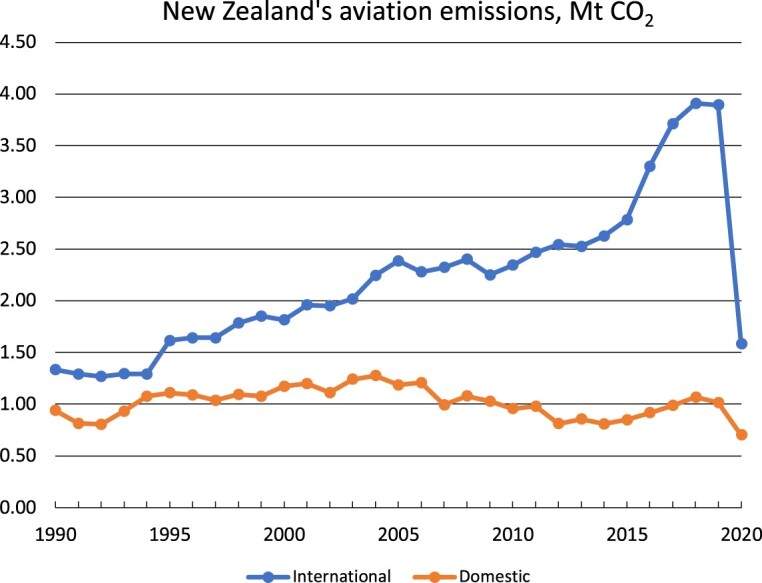
Prior to COVID, the global aviation industry was growing rapidly. Growth has now resumed and is predicted to continue for at least the next three decades. Aotearoa New Zealand has particularly high aviation emissions and has been on a very rapid growth path that is incompatible with the Paris Agreement on climate change. Government, intergovernmental, nongovernmental, academic and industry sources have proposed technological innovations to address aviation emissions. These include sustainable aviation fuels, electric and hydrogen powered aircraft, and increases in efficiency. We review these and assess that none of them will lead to a significant reduction in emissions in the short to medium term. In addition, we demonstrate that even very aggressive uptake of new technology results in the New Zealand aviation sector exceeding its share of the carbon budget as determined by the Paris Agreement. Therefore, we examine the fundamental drivers of growth in aviation: the tourism and airport industries, emissions pricing and substitutes, and the distribution of air travel. Governance of this sector is challenging, but it is changing rapidly. We conclude that a national aviation action plan needs to be developed and implemented based on the 'Avoid/Shift/Improve' framework in use in other areas of transportation planning.
期刊介绍:
ACS Applied Bio Materials is an interdisciplinary journal publishing original research covering all aspects of biomaterials and biointerfaces including and beyond the traditional biosensing, biomedical and therapeutic applications.
The journal is devoted to reports of new and original experimental and theoretical research of an applied nature that integrates knowledge in the areas of materials, engineering, physics, bioscience, and chemistry into important bio applications. The journal is specifically interested in work that addresses the relationship between structure and function and assesses the stability and degradation of materials under relevant environmental and biological conditions.






 京公网安备 11010802042870号
京ICP备2023020795号-1
京公网安备 11010802042870号
京ICP备2023020795号-1

 分享
分享
 求助内容:
求助内容: 应助结果提醒方式:
 扫码关注我们
