Junhyung Kim, Hyun-Ghang Jeong, Moon-Soo Lee, Seung-Hoon Lee, Sang-Won Jeon, Changsu Han
{"title":"Reliability and Validity of the Korean Version of the Brief Resilience Scale.","authors":"Junhyung Kim, Hyun-Ghang Jeong, Moon-Soo Lee, Seung-Hoon Lee, Sang-Won Jeon, Changsu Han","doi":"10.9758/cpn.23.1049","DOIUrl":null,"url":null,"abstract":"<p><strong>Objective: </strong>: To translate the Brief Resilience Scale into Korean and evaluate its reliability and validity.</p><p><strong>Methods: </strong>: To investigate the factor structure of the Brief Resilience Scale, we examined a two-factor model comprising positively and negatively worded items. Congruent and divergent validity of the Brief Resilience Scale were investigated using correlation analysis between the Brief Resilience Scale and resilience, depression, and perceived stress. By conducting an analysis of variance among groups classified by suicidality (no suicidality, only suicidal ideation, and suicidal ideation or suicidal plan groups), we evaluated how well the Brief Resilience Scale could detect people with a high risk of suicide.</p><p><strong>Results: </strong>: Confirmatory factor analysis results supported the construct validity of the Brief Resilience Scale using a two-factor model. Cronbach's alpha (0.91) and McDonald's omega (0.91) scores indicated high internal consistency. Correlation analysis showed that the Brief Resilience Scale scores were strongly associated with a questionnaire evaluating resilience, depression, and perceived stress. Analysis of variance and post-hoc tests showed that he Brief Resilience Scale scores were highest in the no suicidality group (<i>p</i> < 0.001).</p><p><strong>Conclusion: </strong>: The Korean version of the Brief Resilience Scale is a valid and reliable instrument for evaluating resilience as the capacity to recover from adversity and endure obstacles or stress. This study also provides important evidence regarding the sensitivity of the Brief Resilience Scale to suicidal risk.</p>","PeriodicalId":2,"journal":{"name":"ACS Applied Bio Materials","volume":" ","pages":"732-741"},"PeriodicalIF":4.7000,"publicationDate":"2023-11-30","publicationTypes":"Journal Article","fieldsOfStudy":null,"isOpenAccess":false,"openAccessPdf":"https://ftp.ncbi.nlm.nih.gov/pub/pmc/oa_pdf/35/c5/cpn-21-4-732.PMC10591158.pdf","citationCount":"0","resultStr":null,"platform":"Semanticscholar","paperid":null,"PeriodicalName":"ACS Applied Bio Materials","FirstCategoryId":"3","ListUrlMain":"https://doi.org/10.9758/cpn.23.1049","RegionNum":0,"RegionCategory":null,"ArticlePicture":[],"TitleCN":null,"AbstractTextCN":null,"PMCID":null,"EPubDate":"2023/5/22 0:00:00","PubModel":"Epub","JCR":"Q2","JCRName":"MATERIALS SCIENCE, BIOMATERIALS","Score":null,"Total":0}
引用次数: 0
Abstract
Objective: : To translate the Brief Resilience Scale into Korean and evaluate its reliability and validity.
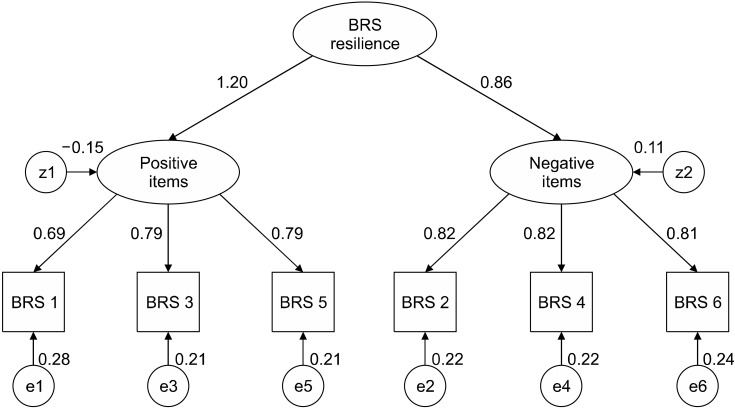
Methods: : To investigate the factor structure of the Brief Resilience Scale, we examined a two-factor model comprising positively and negatively worded items. Congruent and divergent validity of the Brief Resilience Scale were investigated using correlation analysis between the Brief Resilience Scale and resilience, depression, and perceived stress. By conducting an analysis of variance among groups classified by suicidality (no suicidality, only suicidal ideation, and suicidal ideation or suicidal plan groups), we evaluated how well the Brief Resilience Scale could detect people with a high risk of suicide.
Results: : Confirmatory factor analysis results supported the construct validity of the Brief Resilience Scale using a two-factor model. Cronbach's alpha (0.91) and McDonald's omega (0.91) scores indicated high internal consistency. Correlation analysis showed that the Brief Resilience Scale scores were strongly associated with a questionnaire evaluating resilience, depression, and perceived stress. Analysis of variance and post-hoc tests showed that he Brief Resilience Scale scores were highest in the no suicidality group (p < 0.001).
Conclusion: : The Korean version of the Brief Resilience Scale is a valid and reliable instrument for evaluating resilience as the capacity to recover from adversity and endure obstacles or stress. This study also provides important evidence regarding the sensitivity of the Brief Resilience Scale to suicidal risk.
期刊介绍:
ACS Applied Bio Materials is an interdisciplinary journal publishing original research covering all aspects of biomaterials and biointerfaces including and beyond the traditional biosensing, biomedical and therapeutic applications.
The journal is devoted to reports of new and original experimental and theoretical research of an applied nature that integrates knowledge in the areas of materials, engineering, physics, bioscience, and chemistry into important bio applications. The journal is specifically interested in work that addresses the relationship between structure and function and assesses the stability and degradation of materials under relevant environmental and biological conditions.




 京公网安备 11010802042870号
京ICP备2023020795号-1
京公网安备 11010802042870号
京ICP备2023020795号-1

 分享
分享
 求助内容:
求助内容: 应助结果提醒方式:
 扫码关注我们
