Roopa Sachidananda, Latha V Petkar, Milon V Mitragotri, Alisha Malipatil
{"title":"Comparison of standard weight-based and thenar eminence dimension-based selection of I-gel in pediatric patients - A randomized controlled study.","authors":"Roopa Sachidananda, Latha V Petkar, Milon V Mitragotri, Alisha Malipatil","doi":"10.4103/joacp.joacp_215_22","DOIUrl":null,"url":null,"abstract":"<p><strong>Background and aim: </strong>Supraglottic airway devices are increasingly being used for airway management. I-gel is being widely used even for pediatric patients. Although the weight-based selection of the size of the device seems to be the standard technique, this method may not be possible in all patients. The aim of the study was to compare the standard weight-based method with the thenar eminence dimension-based method for I-gel selection.</p><p><strong>Material and methods: </strong>A prospective randomized study was conducted on 74 pediatric patients of either sex, aged between 6 months and 15 years, belonging to American Society of Anesthesiologists (ASA) physical status I, II, and III and who were posted for various surgical procedures under general anesthesia. The study population was divided into two groups of 37 patients each. I-gel was inserted based on weight in group A patients and based on thenar eminence size in group B patients. Parameters like first attempt success rate, ease of insertion, and complications were compared between the two groups using Student's <i>t</i>-test and Chi-square test.</p><p><strong>Results: </strong>The demographic values between the groups were comparable. The first attempt success rate was 97.4% in group A and 91.7% in group B (<i>P</i> = 0.358). Insertion of I-gel was unsuccessful in two patients in group B. Two patients of group B had blood staining of the device. None of the patients had complications related to insertion.</p><p><strong>Conclusion: </strong>The thenar eminence dimension can be used instead of weight while choosing the size of I-gel in pediatric patients. None of the patients had complications related to device insertion.</p>","PeriodicalId":1,"journal":{"name":"Accounts of Chemical Research","volume":" ","pages":"642-647"},"PeriodicalIF":17.7000,"publicationDate":"2023-10-01","publicationTypes":"Journal Article","fieldsOfStudy":null,"isOpenAccess":false,"openAccessPdf":"https://www.ncbi.nlm.nih.gov/pmc/articles/PMC10805226/pdf/","citationCount":"0","resultStr":null,"platform":"Semanticscholar","paperid":null,"PeriodicalName":"Accounts of Chemical Research","FirstCategoryId":"1085","ListUrlMain":"https://doi.org/10.4103/joacp.joacp_215_22","RegionNum":1,"RegionCategory":"化学","ArticlePicture":[],"TitleCN":null,"AbstractTextCN":null,"PMCID":null,"EPubDate":"2023/2/21 0:00:00","PubModel":"Epub","JCR":"Q1","JCRName":"CHEMISTRY, MULTIDISCIPLINARY","Score":null,"Total":0}
引用次数: 0
Abstract
Background and aim: Supraglottic airway devices are increasingly being used for airway management. I-gel is being widely used even for pediatric patients. Although the weight-based selection of the size of the device seems to be the standard technique, this method may not be possible in all patients. The aim of the study was to compare the standard weight-based method with the thenar eminence dimension-based method for I-gel selection.
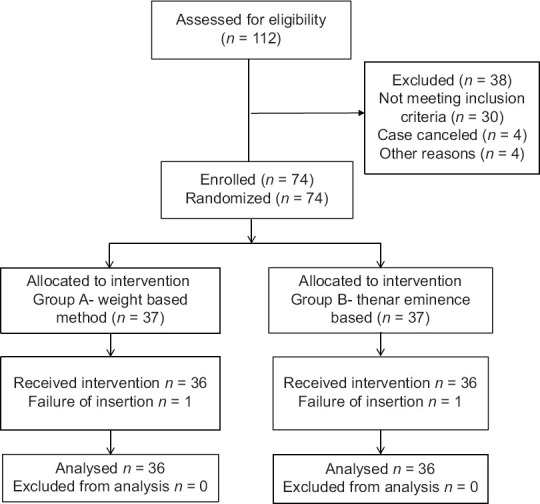
Material and methods: A prospective randomized study was conducted on 74 pediatric patients of either sex, aged between 6 months and 15 years, belonging to American Society of Anesthesiologists (ASA) physical status I, II, and III and who were posted for various surgical procedures under general anesthesia. The study population was divided into two groups of 37 patients each. I-gel was inserted based on weight in group A patients and based on thenar eminence size in group B patients. Parameters like first attempt success rate, ease of insertion, and complications were compared between the two groups using Student's t-test and Chi-square test.
Results: The demographic values between the groups were comparable. The first attempt success rate was 97.4% in group A and 91.7% in group B (P = 0.358). Insertion of I-gel was unsuccessful in two patients in group B. Two patients of group B had blood staining of the device. None of the patients had complications related to insertion.
Conclusion: The thenar eminence dimension can be used instead of weight while choosing the size of I-gel in pediatric patients. None of the patients had complications related to device insertion.
期刊介绍:
Accounts of Chemical Research presents short, concise and critical articles offering easy-to-read overviews of basic research and applications in all areas of chemistry and biochemistry. These short reviews focus on research from the author’s own laboratory and are designed to teach the reader about a research project. In addition, Accounts of Chemical Research publishes commentaries that give an informed opinion on a current research problem. Special Issues online are devoted to a single topic of unusual activity and significance.
Accounts of Chemical Research replaces the traditional article abstract with an article "Conspectus." These entries synopsize the research affording the reader a closer look at the content and significance of an article. Through this provision of a more detailed description of the article contents, the Conspectus enhances the article's discoverability by search engines and the exposure for the research.






 京公网安备 11010802042870号
京ICP备2023020795号-1
京公网安备 11010802042870号
京ICP备2023020795号-1

 分享
分享
 求助内容:
求助内容: 应助结果提醒方式:
 扫码关注我们
