Erika Westling, Julie C Rusby, Ryann Crowley, John M Light
{"title":"A Longitudinal Study of E-Cigarette, Cigarette, and Marijuana Use Sequence in Youth.","authors":"Erika Westling, Julie C Rusby, Ryann Crowley, John M Light","doi":"10.1177/1179173X221101813","DOIUrl":null,"url":null,"abstract":"<p><strong>Objective: </strong>There is evidence linking youth use of electronic (e-) cigarettes to subsequent cigarette and marijuana use, raising public health concerns. We examined the sequence of use of e-cigarettes, conventional cigarettes, and marijuana in a longitudinal sample of adolescents, to determine if use of e-cigarettes often preceded use of other substances.</p><p><strong>Methods: </strong>We collected self-reports from 1123 Oregon adolescents (52% female; 37% Hispanic) longitudinally from 8<sup>th</sup> to 11<sup>th</sup> grade (8 total surveys) regarding their lifetime (ever use) and current use (last 30 days) of e-cigarettes, cigarettes, and marijuana. If applicable, students also reported the delivery method of their current marijuana use.</p><p><strong>Results: </strong>Almost 10% of adolescents reported using e-cigarettes prior to use of cigarettes or marijuana, and the majority of these youth initiated use of marijuana, cigarettes, or both by 11<sup>th</sup> grade. More youth transitioned from e-cigarette use to marijuana use then from e-cigarettes to use of conventional cigarettes. Participants who were co-using e-cigarettes and marijuana in 11<sup>th</sup> grade had an increased likelihood of consuming marijuana via vaping, dabbing, and edibles, compared to those who were only using marijuana.</p><p><strong>Discussion: </strong>E-cigarettes were often the first substance used in this longitudinal sample, and more of these youth subsequently used marijuana compared to cigarettes. While research has focused on the progression from e-cigarettes to cigarettes in youth, these findings indicate that more attention should be focused on the subsequent initiation of marijuana.</p>","PeriodicalId":2,"journal":{"name":"ACS Applied Bio Materials","volume":" ","pages":"1179173X221101813"},"PeriodicalIF":4.7000,"publicationDate":"2022-05-11","publicationTypes":"Journal Article","fieldsOfStudy":null,"isOpenAccess":false,"openAccessPdf":"https://www.ncbi.nlm.nih.gov/pmc/articles/PMC9112298/pdf/","citationCount":"0","resultStr":null,"platform":"Semanticscholar","paperid":null,"PeriodicalName":"ACS Applied Bio Materials","FirstCategoryId":"1085","ListUrlMain":"https://doi.org/10.1177/1179173X221101813","RegionNum":0,"RegionCategory":null,"ArticlePicture":[],"TitleCN":null,"AbstractTextCN":null,"PMCID":null,"EPubDate":"2022/1/1 0:00:00","PubModel":"eCollection","JCR":"Q2","JCRName":"MATERIALS SCIENCE, BIOMATERIALS","Score":null,"Total":0}
引用次数: 0
Abstract
Objective: There is evidence linking youth use of electronic (e-) cigarettes to subsequent cigarette and marijuana use, raising public health concerns. We examined the sequence of use of e-cigarettes, conventional cigarettes, and marijuana in a longitudinal sample of adolescents, to determine if use of e-cigarettes often preceded use of other substances.
Methods: We collected self-reports from 1123 Oregon adolescents (52% female; 37% Hispanic) longitudinally from 8th to 11th grade (8 total surveys) regarding their lifetime (ever use) and current use (last 30 days) of e-cigarettes, cigarettes, and marijuana. If applicable, students also reported the delivery method of their current marijuana use.
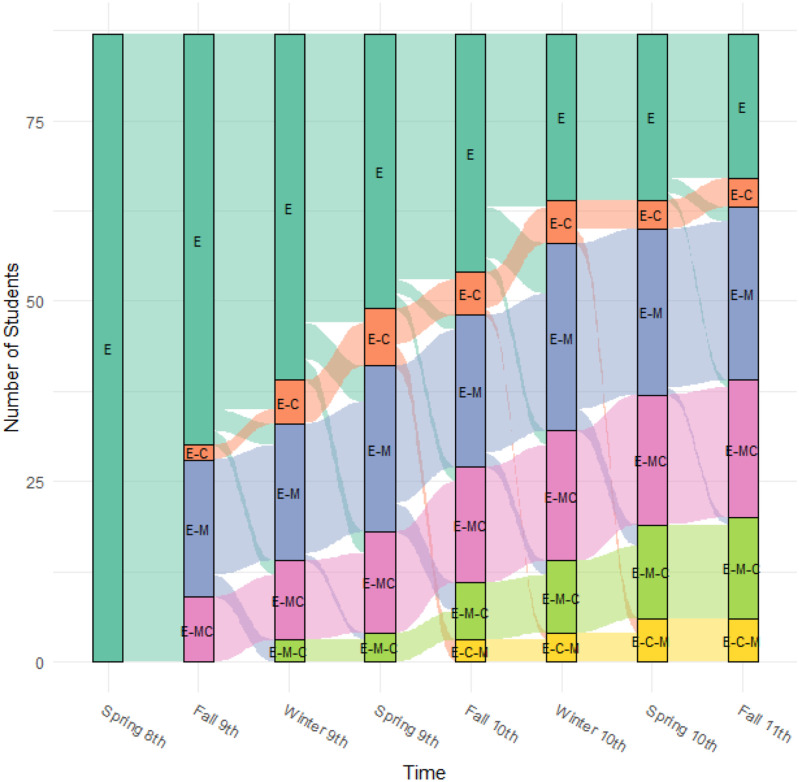
Results: Almost 10% of adolescents reported using e-cigarettes prior to use of cigarettes or marijuana, and the majority of these youth initiated use of marijuana, cigarettes, or both by 11th grade. More youth transitioned from e-cigarette use to marijuana use then from e-cigarettes to use of conventional cigarettes. Participants who were co-using e-cigarettes and marijuana in 11th grade had an increased likelihood of consuming marijuana via vaping, dabbing, and edibles, compared to those who were only using marijuana.
Discussion: E-cigarettes were often the first substance used in this longitudinal sample, and more of these youth subsequently used marijuana compared to cigarettes. While research has focused on the progression from e-cigarettes to cigarettes in youth, these findings indicate that more attention should be focused on the subsequent initiation of marijuana.
期刊介绍:
ACS Applied Bio Materials is an interdisciplinary journal publishing original research covering all aspects of biomaterials and biointerfaces including and beyond the traditional biosensing, biomedical and therapeutic applications.
The journal is devoted to reports of new and original experimental and theoretical research of an applied nature that integrates knowledge in the areas of materials, engineering, physics, bioscience, and chemistry into important bio applications. The journal is specifically interested in work that addresses the relationship between structure and function and assesses the stability and degradation of materials under relevant environmental and biological conditions.






 京公网安备 11010802042870号
京ICP备2023020795号-1
京公网安备 11010802042870号
京ICP备2023020795号-1

 分享
分享
 求助内容:
求助内容: 应助结果提醒方式:
 扫码关注我们
