Anna Volkova , Stefan Reuter , Stefan Puschnigg , Hanne Kauko , Ralf-Roman Schmidt , Benedikt Leitner , Simon Moser
{"title":"Cascade sub-low temperature district heating networks in existing district heating systems","authors":"Anna Volkova , Stefan Reuter , Stefan Puschnigg , Hanne Kauko , Ralf-Roman Schmidt , Benedikt Leitner , Simon Moser","doi":"10.1016/j.segy.2022.100064","DOIUrl":null,"url":null,"abstract":"<div><p>Existing district heating networks (DHNs) are often designed for relatively high temperatures, typically 80–120 °C supply and 40–60 °C return. The transformation of such high-temperature DHNs (HTDHNs) into more efficient low-temperature DHNs (LTDHN) and towards the 4th generation DHNs is associated with great complexity and effort. This paper discusses the integration of sub-LTDHNs into the return flow of existing HTDHNs, thereby creating an energy cascade and thus lowering the overall system temperatures of the HTDHN. The technical barriers and drivers of such sub-LTDHNs were analysed through literature research, expert interviews, and a questionnaire. Their technical design was investigated, and a techno-economic analysis was conducted for several configurations in terms of the supply and return temperatures in the sub-LTDHN, various temperatures of the HTDHN and potential connecting points. This analysis was also conducted for a planned residential area in a Nordic city. In addition, their operating dynamics resulting from different HTDHN load conditions were analysed in terms of the effects on the sub-LTDHN. It was found that, on the one hand, the connection point with its prevailing conditions (mass flow and temperature) is the key parameter to ensure that the heat demand is met. On the other hand, the savings in the HTDHN due to lower return system temperatures resulting from the sub-LTDHN integration in the return pipeline are significantly higher if the use of combustion technologies is minimized.</p></div>","PeriodicalId":34738,"journal":{"name":"Smart Energy","volume":"5 ","pages":"Article 100064"},"PeriodicalIF":5.0000,"publicationDate":"2022-02-01","publicationTypes":"Journal Article","fieldsOfStudy":null,"isOpenAccess":false,"openAccessPdf":"https://www.sciencedirect.com/science/article/pii/S2666955222000028/pdfft?md5=15b2e62fc71beb6cc31c00a7a82d6afd&pid=1-s2.0-S2666955222000028-main.pdf","citationCount":"8","resultStr":null,"platform":"Semanticscholar","paperid":null,"PeriodicalName":"Smart Energy","FirstCategoryId":"1085","ListUrlMain":"https://www.sciencedirect.com/science/article/pii/S2666955222000028","RegionNum":0,"RegionCategory":null,"ArticlePicture":[],"TitleCN":null,"AbstractTextCN":null,"PMCID":null,"EPubDate":"","PubModel":"","JCR":"Q2","JCRName":"ENERGY & FUELS","Score":null,"Total":0}
引用次数: 8
Abstract
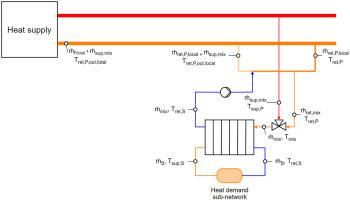
Existing district heating networks (DHNs) are often designed for relatively high temperatures, typically 80–120 °C supply and 40–60 °C return. The transformation of such high-temperature DHNs (HTDHNs) into more efficient low-temperature DHNs (LTDHN) and towards the 4th generation DHNs is associated with great complexity and effort. This paper discusses the integration of sub-LTDHNs into the return flow of existing HTDHNs, thereby creating an energy cascade and thus lowering the overall system temperatures of the HTDHN. The technical barriers and drivers of such sub-LTDHNs were analysed through literature research, expert interviews, and a questionnaire. Their technical design was investigated, and a techno-economic analysis was conducted for several configurations in terms of the supply and return temperatures in the sub-LTDHN, various temperatures of the HTDHN and potential connecting points. This analysis was also conducted for a planned residential area in a Nordic city. In addition, their operating dynamics resulting from different HTDHN load conditions were analysed in terms of the effects on the sub-LTDHN. It was found that, on the one hand, the connection point with its prevailing conditions (mass flow and temperature) is the key parameter to ensure that the heat demand is met. On the other hand, the savings in the HTDHN due to lower return system temperatures resulting from the sub-LTDHN integration in the return pipeline are significantly higher if the use of combustion technologies is minimized.



 京公网安备 11010802042870号
京ICP备2023020795号-1
京公网安备 11010802042870号
京ICP备2023020795号-1

 分享
分享
 求助内容:
求助内容: 应助结果提醒方式:
 扫码关注我们
