{"title":"Nanotechnology Approaches for Rapid Detection and Theranostics of Antimicrobial Resistant Bacterial Infections","authors":"Survanshu Saxena, Kapil Punjabi, Nadim Ahamad*, Subhasini Singh, Prachi Bendale and Rinti Banerjee, ","doi":"10.1021/acsbiomaterials.1c01516","DOIUrl":null,"url":null,"abstract":"<p >As declared by WHO, antimicrobial resistance (AMR) is a high priority issue with a pressing need to develop impactful technologies to curb it. The rampant and inappropriate use of antibiotics due to the lack of adequate and timely diagnosis is a leading cause behind AMR evolution. Unfortunately, populations with poor economic status and those residing in densely populated areas are the most affected ones, frequently leading to emergence of AMR pathogens. Classical approaches for AMR diagnostics like phenotypic methods, biochemical assays, and molecular techniques are cumbersome and resource-intensive and involve a long turnaround time to yield confirmatory results. In contrast, recent emergence of nanotechnology-assisted approaches helps to overcome challenges in classical approaches and offer simpler, more sensitive, faster, and more affordable solutions for AMR diagnostics. Nanomaterial platforms (metallic, quantum-dot, carbon-based, upconversion, etc.), nanoparticle-based rapid point-of-care platforms, nano-biosensors (optical, mechanical, electrochemical), microfluidic-assisted devices, and importantly, nanotheranostic devices for diagnostics with treatment of AMR infections are examples of rapidly growing nanotechnology approaches used for AMR management. This review comprehensively summarizes the past 10 years of research progress on nanotechnology approaches for AMR diagnostics and for estimating antimicrobial susceptibility against commonly used antibiotics. This review also highlights several bottlenecks in nanotechnology approaches that need to be addressed prior to considering their translation to clinics.</p>","PeriodicalId":8,"journal":{"name":"ACS Biomaterials Science & Engineering","volume":"8 6","pages":"2232–2257"},"PeriodicalIF":5.5000,"publicationDate":"2022-05-12","publicationTypes":"Journal Article","fieldsOfStudy":null,"isOpenAccess":false,"openAccessPdf":"","citationCount":"3","resultStr":null,"platform":"Semanticscholar","paperid":null,"PeriodicalName":"ACS Biomaterials Science & Engineering","FirstCategoryId":"5","ListUrlMain":"https://pubs.acs.org/doi/10.1021/acsbiomaterials.1c01516","RegionNum":2,"RegionCategory":"医学","ArticlePicture":[],"TitleCN":null,"AbstractTextCN":null,"PMCID":null,"EPubDate":"","PubModel":"","JCR":"Q2","JCRName":"MATERIALS SCIENCE, BIOMATERIALS","Score":null,"Total":0}
引用次数: 3
Abstract
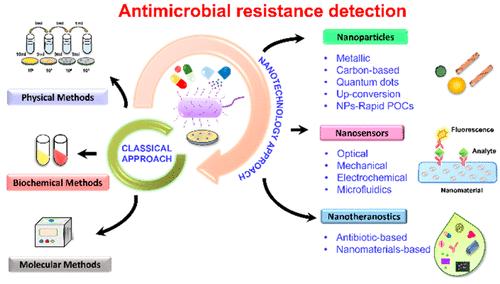
As declared by WHO, antimicrobial resistance (AMR) is a high priority issue with a pressing need to develop impactful technologies to curb it. The rampant and inappropriate use of antibiotics due to the lack of adequate and timely diagnosis is a leading cause behind AMR evolution. Unfortunately, populations with poor economic status and those residing in densely populated areas are the most affected ones, frequently leading to emergence of AMR pathogens. Classical approaches for AMR diagnostics like phenotypic methods, biochemical assays, and molecular techniques are cumbersome and resource-intensive and involve a long turnaround time to yield confirmatory results. In contrast, recent emergence of nanotechnology-assisted approaches helps to overcome challenges in classical approaches and offer simpler, more sensitive, faster, and more affordable solutions for AMR diagnostics. Nanomaterial platforms (metallic, quantum-dot, carbon-based, upconversion, etc.), nanoparticle-based rapid point-of-care platforms, nano-biosensors (optical, mechanical, electrochemical), microfluidic-assisted devices, and importantly, nanotheranostic devices for diagnostics with treatment of AMR infections are examples of rapidly growing nanotechnology approaches used for AMR management. This review comprehensively summarizes the past 10 years of research progress on nanotechnology approaches for AMR diagnostics and for estimating antimicrobial susceptibility against commonly used antibiotics. This review also highlights several bottlenecks in nanotechnology approaches that need to be addressed prior to considering their translation to clinics.
期刊介绍:
ACS Biomaterials Science & Engineering is the leading journal in the field of biomaterials, serving as an international forum for publishing cutting-edge research and innovative ideas on a broad range of topics:
Applications and Health – implantable tissues and devices, prosthesis, health risks, toxicology
Bio-interactions and Bio-compatibility – material-biology interactions, chemical/morphological/structural communication, mechanobiology, signaling and biological responses, immuno-engineering, calcification, coatings, corrosion and degradation of biomaterials and devices, biophysical regulation of cell functions
Characterization, Synthesis, and Modification – new biomaterials, bioinspired and biomimetic approaches to biomaterials, exploiting structural hierarchy and architectural control, combinatorial strategies for biomaterials discovery, genetic biomaterials design, synthetic biology, new composite systems, bionics, polymer synthesis
Controlled Release and Delivery Systems – biomaterial-based drug and gene delivery, bio-responsive delivery of regulatory molecules, pharmaceutical engineering
Healthcare Advances – clinical translation, regulatory issues, patient safety, emerging trends
Imaging and Diagnostics – imaging agents and probes, theranostics, biosensors, monitoring
Manufacturing and Technology – 3D printing, inks, organ-on-a-chip, bioreactor/perfusion systems, microdevices, BioMEMS, optics and electronics interfaces with biomaterials, systems integration
Modeling and Informatics Tools – scaling methods to guide biomaterial design, predictive algorithms for structure-function, biomechanics, integrating bioinformatics with biomaterials discovery, metabolomics in the context of biomaterials
Tissue Engineering and Regenerative Medicine – basic and applied studies, cell therapies, scaffolds, vascularization, bioartificial organs, transplantation and functionality, cellular agriculture



 京公网安备 11010802042870号
京ICP备2023020795号-1
京公网安备 11010802042870号
京ICP备2023020795号-1

 分享
分享
 求助内容:
求助内容: 应助结果提醒方式:
 扫码关注我们
