Talisi E. Meyer, Kevin Zhijian Jiang, Ching Chun Peng, Quynh P. Sam, Minsoo Kang, Reilly P. Lynch, Jonathan L. Rowell, Judy Cha and Richard D. Robinson*,
{"title":"Scalable Route to Colloidal NixCo3–xS4 Nanoparticles with Low Dispersity Using Amino Acids","authors":"Talisi E. Meyer, Kevin Zhijian Jiang, Ching Chun Peng, Quynh P. Sam, Minsoo Kang, Reilly P. Lynch, Jonathan L. Rowell, Judy Cha and Richard D. Robinson*, ","doi":"10.1021/acsmaterialsau.3c00016","DOIUrl":null,"url":null,"abstract":"<p >The thiospinel group of nickel cobalt sulfides (Ni<sub><i>x</i></sub>Co<sub>3–<i>x</i></sub>S<sub>4</sub>) are promising materials for energy applications such as supercapacitors, fuel cells, and solar cells. Solution-processible nanoparticles of Ni<sub><i>x</i></sub>Co<sub>3–<i>x</i></sub>S<sub>4</sub> have advantages of low cost and fabrication of high-performance energy devices due to their high surface-to-volume ratio, which increases the electrochemically active surface area and shortens the ionic diffusion path. The current approaches to synthesize Ni<sub><i>x</i></sub>Co<sub>3–<i>x</i></sub>S<sub>4</sub> nanoparticles are often based on hydrothermal or solvothermal methods that are difficult to scale up safely and efficiently and that preclude monitoring the reaction through aliquots, making optimization of size and dispersity challenging, typically resulting in aggregated nanoparticles with polydisperse sizes. In this work, we report a scalable “heat-up” method to colloidally synthesize Ni<sub><i>x</i></sub>Co<sub>3–<i>x</i></sub>S<sub>4</sub> nanoparticles that are smaller than 15 nm in diameter with less than 15% in size dispersion, using two inexpensive, earth-abundant sulfur sources. Our method provides a reliable synthetic pathway to produce phase-pure, low-dispersity, gram-scale nanoparticles of ternary metal sulfides. This method enhances the current capabilities of Ni<sub><i>x</i></sub>Co<sub>3–<i>x</i></sub>S<sub>4</sub> nanoparticles to meet the performance demands to improve renewable energy technologies.</p>","PeriodicalId":29798,"journal":{"name":"ACS Materials Au","volume":"3 5","pages":"501–513"},"PeriodicalIF":6.5000,"publicationDate":"2023-07-10","publicationTypes":"Journal Article","fieldsOfStudy":null,"isOpenAccess":false,"openAccessPdf":"https://pubs.acs.org/doi/epdf/10.1021/acsmaterialsau.3c00016","citationCount":"0","resultStr":null,"platform":"Semanticscholar","paperid":null,"PeriodicalName":"ACS Materials Au","FirstCategoryId":"1085","ListUrlMain":"https://pubs.acs.org/doi/10.1021/acsmaterialsau.3c00016","RegionNum":0,"RegionCategory":null,"ArticlePicture":[],"TitleCN":null,"AbstractTextCN":null,"PMCID":null,"EPubDate":"","PubModel":"","JCR":"Q2","JCRName":"CHEMISTRY, PHYSICAL","Score":null,"Total":0}
引用次数: 0
Abstract
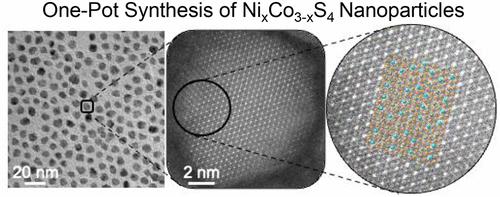
The thiospinel group of nickel cobalt sulfides (NixCo3–xS4) are promising materials for energy applications such as supercapacitors, fuel cells, and solar cells. Solution-processible nanoparticles of NixCo3–xS4 have advantages of low cost and fabrication of high-performance energy devices due to their high surface-to-volume ratio, which increases the electrochemically active surface area and shortens the ionic diffusion path. The current approaches to synthesize NixCo3–xS4 nanoparticles are often based on hydrothermal or solvothermal methods that are difficult to scale up safely and efficiently and that preclude monitoring the reaction through aliquots, making optimization of size and dispersity challenging, typically resulting in aggregated nanoparticles with polydisperse sizes. In this work, we report a scalable “heat-up” method to colloidally synthesize NixCo3–xS4 nanoparticles that are smaller than 15 nm in diameter with less than 15% in size dispersion, using two inexpensive, earth-abundant sulfur sources. Our method provides a reliable synthetic pathway to produce phase-pure, low-dispersity, gram-scale nanoparticles of ternary metal sulfides. This method enhances the current capabilities of NixCo3–xS4 nanoparticles to meet the performance demands to improve renewable energy technologies.
期刊介绍:
ACS Materials Au is an open access journal publishing letters articles reviews and perspectives describing high-quality research at the forefront of fundamental and applied research and at the interface between materials and other disciplines such as chemistry engineering and biology. Papers that showcase multidisciplinary and innovative materials research addressing global challenges are especially welcome. Areas of interest include but are not limited to:Design synthesis characterization and evaluation of forefront and emerging materialsUnderstanding structure property performance relationships and their underlying mechanismsDevelopment of materials for energy environmental biomedical electronic and catalytic applications



 京公网安备 11010802042870号
京ICP备2023020795号-1
京公网安备 11010802042870号
京ICP备2023020795号-1

 分享
分享
 求助内容:
求助内容: 应助结果提醒方式:
 扫码关注我们
