{"title":"Exceptional endemicity of Aotearoa New Zealand biota shows how taxa dispersal traits, but not phylogeny, correlate with global species richness.","authors":"Mark John Costello","doi":"10.1080/03036758.2023.2198722","DOIUrl":null,"url":null,"abstract":"<p><p>Species' with more limited dispersal and consequently less gene flow are more likely to form new spatially segregated species and thus contribute disproportionally to endemic biota and global species richness. Aotearoa New Zealand has exceptional endemicity, with 52% of its 54,000 named species endemic, including 32%, 39% and 68% for freshwater, marine and terrestrial environments respectively. The lower endemicity of freshwater biota (excluding insects) is attributed to their need to disperse between habitats that are temporary on evolutionary timescales. The percent endemicity of higher taxa (Order to Kingdom), a measure of phylogenetic relationships, was not correlated with regional and global species richness. However, there was a positive correlation between endemicity and species richness across dispersal trait groups based on their environment, typical body size, mobility (including flight), and if marine, whether pelagic or benthic. Typically flighted taxa had high endemicity contrary to the dispersal-endemicity hypothesis, but reflecting exceptional isolation by distance and time, and reduced flight ability as occurs on islands. It is proposed that the high richness and endemicity of mobile macrofauna is caused by a combination of niche specialisation opportunities and predation limiting dispersal respectively. Thus, dispersal traits better predicted endemicity and global species richness than phylogeny.</p>","PeriodicalId":2,"journal":{"name":"ACS Applied Bio Materials","volume":" ","pages":"144-159"},"PeriodicalIF":4.7000,"publicationDate":"2023-04-20","publicationTypes":"Journal Article","fieldsOfStudy":null,"isOpenAccess":false,"openAccessPdf":"https://www.ncbi.nlm.nih.gov/pmc/articles/PMC11459800/pdf/","citationCount":"0","resultStr":null,"platform":"Semanticscholar","paperid":null,"PeriodicalName":"ACS Applied Bio Materials","FirstCategoryId":"103","ListUrlMain":"https://doi.org/10.1080/03036758.2023.2198722","RegionNum":0,"RegionCategory":null,"ArticlePicture":[],"TitleCN":null,"AbstractTextCN":null,"PMCID":null,"EPubDate":"2024/1/1 0:00:00","PubModel":"eCollection","JCR":"Q2","JCRName":"MATERIALS SCIENCE, BIOMATERIALS","Score":null,"Total":0}
引用次数: 0
Abstract
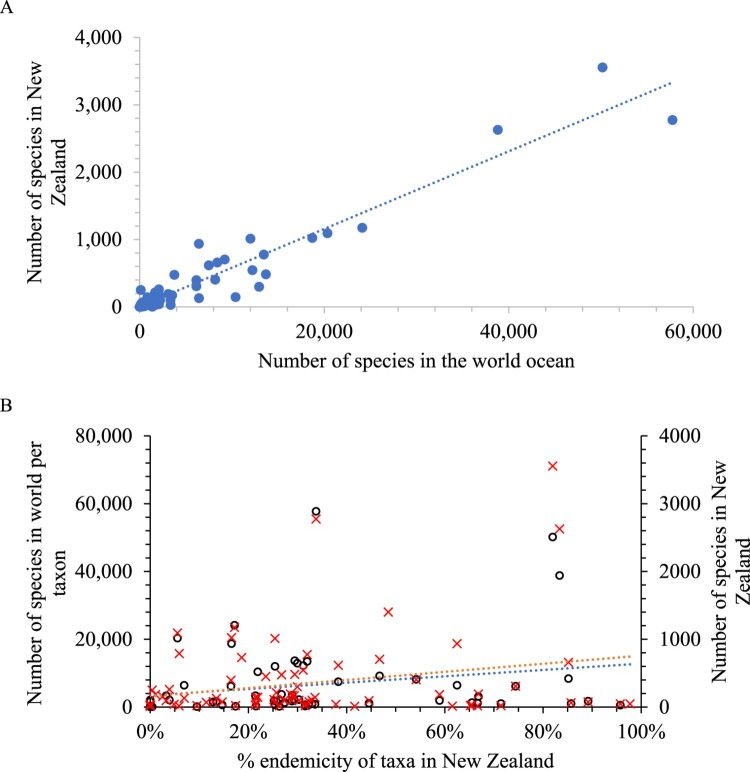
Species' with more limited dispersal and consequently less gene flow are more likely to form new spatially segregated species and thus contribute disproportionally to endemic biota and global species richness. Aotearoa New Zealand has exceptional endemicity, with 52% of its 54,000 named species endemic, including 32%, 39% and 68% for freshwater, marine and terrestrial environments respectively. The lower endemicity of freshwater biota (excluding insects) is attributed to their need to disperse between habitats that are temporary on evolutionary timescales. The percent endemicity of higher taxa (Order to Kingdom), a measure of phylogenetic relationships, was not correlated with regional and global species richness. However, there was a positive correlation between endemicity and species richness across dispersal trait groups based on their environment, typical body size, mobility (including flight), and if marine, whether pelagic or benthic. Typically flighted taxa had high endemicity contrary to the dispersal-endemicity hypothesis, but reflecting exceptional isolation by distance and time, and reduced flight ability as occurs on islands. It is proposed that the high richness and endemicity of mobile macrofauna is caused by a combination of niche specialisation opportunities and predation limiting dispersal respectively. Thus, dispersal traits better predicted endemicity and global species richness than phylogeny.
期刊介绍:
ACS Applied Bio Materials is an interdisciplinary journal publishing original research covering all aspects of biomaterials and biointerfaces including and beyond the traditional biosensing, biomedical and therapeutic applications.
The journal is devoted to reports of new and original experimental and theoretical research of an applied nature that integrates knowledge in the areas of materials, engineering, physics, bioscience, and chemistry into important bio applications. The journal is specifically interested in work that addresses the relationship between structure and function and assesses the stability and degradation of materials under relevant environmental and biological conditions.




 京公网安备 11010802042870号
京ICP备2023020795号-1
京公网安备 11010802042870号
京ICP备2023020795号-1

 分享
分享
 求助内容:
求助内容: 应助结果提醒方式:
 扫码关注我们
