A taxonomically complex catfish group from an underrepresented geographic area: Systematics and species limits in Hypostomus Lacépède, 1803 (Siluriformes, Loricariidae) from Eastern South America
Marcia da Silva Anjos, Luiz Jardim de Queiroz, Iago de Souza Penido, Jamille de Araújo Bitencourt, Silvia Britto Barreto, Luisa Maria Sarmento-Soares, Henrique Batalha-Filho, Paulo Roberto Antunes de Mello Affonso
{"title":"A taxonomically complex catfish group from an underrepresented geographic area: Systematics and species limits in Hypostomus Lacépède, 1803 (Siluriformes, Loricariidae) from Eastern South America","authors":"Marcia da Silva Anjos, Luiz Jardim de Queiroz, Iago de Souza Penido, Jamille de Araújo Bitencourt, Silvia Britto Barreto, Luisa Maria Sarmento-Soares, Henrique Batalha-Filho, Paulo Roberto Antunes de Mello Affonso","doi":"10.1111/jzs.12572","DOIUrl":null,"url":null,"abstract":"<p><i>Hypostomus</i> Lacépède, 1803, is a species-rich and widespread fish genus from the Neotropical region, but its evolutionary history and systematics remain largely unclear. In addition, species from regions with high levels of species richness and endemism such as the Northeastern Mata Atlântica (NMA) and São Francisco (SF) hydrographic freshwater ecoregions are underrepresented in phylogenetic studies so far. In this study, we performed a broad sampling of <i>Hypostomus</i> in NMA and SF to investigate the interspecific boundaries and phylogenetic relationships using a multilocus approach based on one mitochondrial and three nuclear markers. Seven genetic groups were found for both ecoregions, in addition to one lineage exclusive to the SF represented by populations of the species <i>Hypostomus</i> <i>velhochico</i>. Moreover, multilocus analyses validated 16 formally described species and two new lineages for the NMA and SF ecoregions, as well as putative cases of species complexes. In general, lineages with independent evolutionary histories were revealed within the same ecoregion alongside genetically related groups between NMA, SF, and other ecoregions. These data reinforce the intricate scenario of this group of Neotropical fish and are useful to outline further phylogeographic studies in <i>Hypostomus</i>.</p>","PeriodicalId":91350,"journal":{"name":"","volume":"59 8","pages":"1994-2009"},"PeriodicalIF":0.0,"publicationDate":"2021-12-06","publicationTypes":"Journal Article","fieldsOfStudy":null,"isOpenAccess":false,"openAccessPdf":"","citationCount":"3","resultStr":null,"platform":"Semanticscholar","paperid":null,"PeriodicalName":"","FirstCategoryId":"99","ListUrlMain":"https://onlinelibrary.wiley.com/doi/10.1111/jzs.12572","RegionNum":0,"RegionCategory":null,"ArticlePicture":[],"TitleCN":null,"AbstractTextCN":null,"PMCID":null,"EPubDate":"","PubModel":"","JCR":"","JCRName":"","Score":null,"Total":0}
引用次数: 3
Abstract
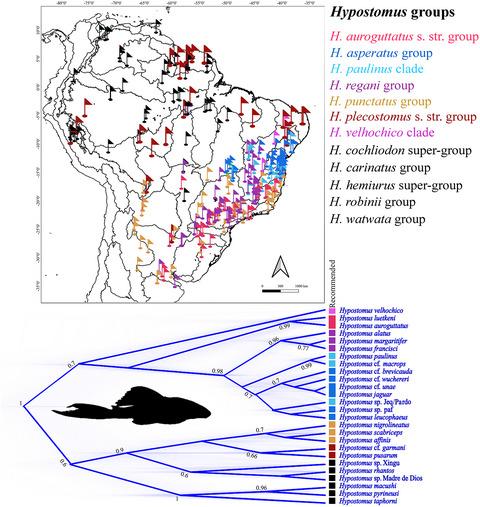
Hypostomus Lacépède, 1803, is a species-rich and widespread fish genus from the Neotropical region, but its evolutionary history and systematics remain largely unclear. In addition, species from regions with high levels of species richness and endemism such as the Northeastern Mata Atlântica (NMA) and São Francisco (SF) hydrographic freshwater ecoregions are underrepresented in phylogenetic studies so far. In this study, we performed a broad sampling of Hypostomus in NMA and SF to investigate the interspecific boundaries and phylogenetic relationships using a multilocus approach based on one mitochondrial and three nuclear markers. Seven genetic groups were found for both ecoregions, in addition to one lineage exclusive to the SF represented by populations of the species Hypostomusvelhochico. Moreover, multilocus analyses validated 16 formally described species and two new lineages for the NMA and SF ecoregions, as well as putative cases of species complexes. In general, lineages with independent evolutionary histories were revealed within the same ecoregion alongside genetically related groups between NMA, SF, and other ecoregions. These data reinforce the intricate scenario of this group of Neotropical fish and are useful to outline further phylogeographic studies in Hypostomus.



 京公网安备 11010802042870号
京ICP备2023020795号-1
京公网安备 11010802042870号
京ICP备2023020795号-1

 分享
分享
 求助内容:
求助内容: 应助结果提醒方式:
 扫码关注我们
