Yaobaixue Qu, Zhao-Guang Yang, Haipu Li, Jie Yao, Bo Qiu
{"title":"Ultrasound-Assisted Enzymatic Extraction Method for Multi-element Analysis of Rice","authors":"Yaobaixue Qu, Zhao-Guang Yang, Haipu Li, Jie Yao, Bo Qiu","doi":"10.1007/s12161-020-01779-3","DOIUrl":null,"url":null,"abstract":"<p>An ultrasound-assisted enzymatic extraction followed by a diluted acid washing was introduced into the multi-element analysis of rice samples. The recoveries of the elements including As, Cd, Mn, and Zn were evaluated by inductively coupled plasma mass spectrometry. The experimental parameters including enzyme type, enzyme dosage, ultrasound power, and duration of ultrasonication were investigated. The optimized condition was pancreatin with the dosage of 6.75 mg enzyme to 30-mg rice and ultrasonication for 5 min with the power of 800 W. The whole extraction procedure can be accomplished in 20 min. Three certified reference rice samples (GBW (E) 100348, GBW10043, and GBW10044) were used for method verification. The recoveries of As, Cd, Mn, and Zn ranged from 82.2 to 97.3%. The relative standard deviations of the four elements were all lower than 10%. Finally, the present method was successfully applied in the multi-element analysis of real samples.</p>","PeriodicalId":561,"journal":{"name":"Food Analytical Methods","volume":"13 8","pages":"1549 - 1555"},"PeriodicalIF":3.0000,"publicationDate":"2020-05-24","publicationTypes":"Journal Article","fieldsOfStudy":null,"isOpenAccess":false,"openAccessPdf":"https://sci-hub-pdf.com/10.1007/s12161-020-01779-3","citationCount":"2","resultStr":null,"platform":"Semanticscholar","paperid":null,"PeriodicalName":"Food Analytical Methods","FirstCategoryId":"97","ListUrlMain":"https://link.springer.com/article/10.1007/s12161-020-01779-3","RegionNum":3,"RegionCategory":"农林科学","ArticlePicture":[],"TitleCN":null,"AbstractTextCN":null,"PMCID":null,"EPubDate":"","PubModel":"","JCR":"Q2","JCRName":"FOOD SCIENCE & TECHNOLOGY","Score":null,"Total":0}
引用次数: 2
Abstract
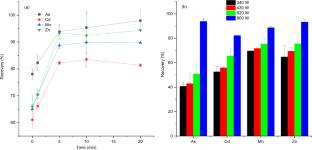
An ultrasound-assisted enzymatic extraction followed by a diluted acid washing was introduced into the multi-element analysis of rice samples. The recoveries of the elements including As, Cd, Mn, and Zn were evaluated by inductively coupled plasma mass spectrometry. The experimental parameters including enzyme type, enzyme dosage, ultrasound power, and duration of ultrasonication were investigated. The optimized condition was pancreatin with the dosage of 6.75 mg enzyme to 30-mg rice and ultrasonication for 5 min with the power of 800 W. The whole extraction procedure can be accomplished in 20 min. Three certified reference rice samples (GBW (E) 100348, GBW10043, and GBW10044) were used for method verification. The recoveries of As, Cd, Mn, and Zn ranged from 82.2 to 97.3%. The relative standard deviations of the four elements were all lower than 10%. Finally, the present method was successfully applied in the multi-element analysis of real samples.
期刊介绍:
Food Analytical Methods publishes original articles, review articles, and notes on novel and/or state-of-the-art analytical methods or issues to be solved, as well as significant improvements or interesting applications to existing methods. These include analytical technology and methodology for food microbial contaminants, food chemistry and toxicology, food quality, food authenticity and food traceability. The journal covers fundamental and specific aspects of the development, optimization, and practical implementation in routine laboratories, and validation of food analytical methods for the monitoring of food safety and quality.



 京公网安备 11010802042870号
京ICP备2023020795号-1
京公网安备 11010802042870号
京ICP备2023020795号-1

 分享
分享
 求助内容:
求助内容: 应助结果提醒方式:
 扫码关注我们
