{"title":"TREAT-AIS: A Multicenter National Registry.","authors":"Sung-Chun Tang, Yi-Chen Hsieh, Chun-Jen Lin, Yu-Wei Chen, Kuan-Hung Lin, Pi-Shan Sung, Meng-Tsang Hsieh, Chih-Wei Tang, Hai-Jui Chu, Kun-Chang Tsai, Chao-Liang Chou, Cheng-Yu Wei, Shang-Yih Yen, Po-Lin Chen, Hsu-Ling Yeh, Lung Chan, Sheng-Feng Sung, Hon-Man Liu, Ching-Huang Lin, Chung-Wei Lee, I-Hui Lee, Chi-Jen Chen, Chien-Jen Lin, Yu-Ming Chang, Chang-Hsien Ou, Yen-Jun Lai, Cheng-Huai Lin, Chih-Hao Chen, Chung-Hsing Chou, Li-Ming Lien, Hung-Yi Chiou, Jiunn-Tay Lee, Jiann-Shing Jeng","doi":"10.1161/SVIN.123.000861","DOIUrl":null,"url":null,"abstract":"<p><strong>Background: </strong>Endovascular thrombectomy (EVT) is the standard therapy for patients with acute ischemic stroke secondary to large-artery occlusion. In January 2019, the Taiwan Stroke Society established a nationwide TREAT-AIS (Taiwan Registry of Endovascular Thrombectomy for Acute Ischemic Stroke). Here, we provide the study design, current progress, and baseline data of TREAT-AIS.</p><p><strong>Methods: </strong>TREAT-AIS is a multicenter prospective registration program in Taiwan. Patients aged ≥20 years who underwent EVT for acute ischemic stroke were recruited. The key items on the registration form were divided into general stroke demographics and EVT-related sections. The main outcome of effectiveness was functional independence (modified Rankin Scale score, 0-2) at 3 months. The influence of sex on post-EVT outcomes was also analyzed in the presented study.</p><p><strong>Results: </strong>By the end of June 2022, there were 10 medical centers and 9 community hospitals participating in the TREAT-AIS and a total of 1522 patients (mean±SD age, 71.2±13.6 years; men, 55.6%) being enrolled. The median National Institutes of Health Stroke Scale score on admission was 18 (interquartile range, 12-23). The major cause of stroke was cardioembolism (43.6%), followed by large-artery atherosclerosis (36.8%) and an undetermined cause (15.4%). Functional independence at 3 months poststroke was achieved in 36.2% of the patients. Male patients were more likely to have functional independence at 3 months compared with female patients (40.4% versus 30.8%; <i>P</i><0.001). However, the sex difference in functional independence became nonsignificant (odds ratio, 1.12 [95% CI, 0.96-1.46] in men compared with women) after adjusting for age, National Institutes of Health Stroke Scale score at admission, and recanalization status after EVT.</p><p><strong>Conclusions: </strong>This study demonstrated the current progress of the TREAT-AIS in capturing real-world EVT data in Taiwan. The TREAT-AIS will provide valuable insights into the real-world practice of EVT in patients with acute stroke and the related quality of care in Asian patients.</p>","PeriodicalId":74875,"journal":{"name":"Stroke (Hoboken, N.J.)","volume":" ","pages":"e000861"},"PeriodicalIF":2.8000,"publicationDate":"2023-08-16","publicationTypes":"Journal Article","fieldsOfStudy":null,"isOpenAccess":false,"openAccessPdf":"https://www.ncbi.nlm.nih.gov/pmc/articles/PMC12778707/pdf/","citationCount":"0","resultStr":null,"platform":"Semanticscholar","paperid":null,"PeriodicalName":"Stroke (Hoboken, N.J.)","FirstCategoryId":"1085","ListUrlMain":"https://doi.org/10.1161/SVIN.123.000861","RegionNum":0,"RegionCategory":null,"ArticlePicture":[],"TitleCN":null,"AbstractTextCN":null,"PMCID":null,"EPubDate":"2023/9/1 0:00:00","PubModel":"eCollection","JCR":"Q3","JCRName":"CLINICAL NEUROLOGY","Score":null,"Total":0}
引用次数: 0
Abstract
Background: Endovascular thrombectomy (EVT) is the standard therapy for patients with acute ischemic stroke secondary to large-artery occlusion. In January 2019, the Taiwan Stroke Society established a nationwide TREAT-AIS (Taiwan Registry of Endovascular Thrombectomy for Acute Ischemic Stroke). Here, we provide the study design, current progress, and baseline data of TREAT-AIS.
Methods: TREAT-AIS is a multicenter prospective registration program in Taiwan. Patients aged ≥20 years who underwent EVT for acute ischemic stroke were recruited. The key items on the registration form were divided into general stroke demographics and EVT-related sections. The main outcome of effectiveness was functional independence (modified Rankin Scale score, 0-2) at 3 months. The influence of sex on post-EVT outcomes was also analyzed in the presented study.
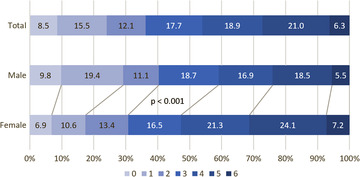
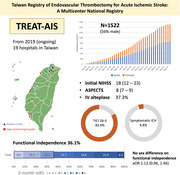
Results: By the end of June 2022, there were 10 medical centers and 9 community hospitals participating in the TREAT-AIS and a total of 1522 patients (mean±SD age, 71.2±13.6 years; men, 55.6%) being enrolled. The median National Institutes of Health Stroke Scale score on admission was 18 (interquartile range, 12-23). The major cause of stroke was cardioembolism (43.6%), followed by large-artery atherosclerosis (36.8%) and an undetermined cause (15.4%). Functional independence at 3 months poststroke was achieved in 36.2% of the patients. Male patients were more likely to have functional independence at 3 months compared with female patients (40.4% versus 30.8%; P<0.001). However, the sex difference in functional independence became nonsignificant (odds ratio, 1.12 [95% CI, 0.96-1.46] in men compared with women) after adjusting for age, National Institutes of Health Stroke Scale score at admission, and recanalization status after EVT.
Conclusions: This study demonstrated the current progress of the TREAT-AIS in capturing real-world EVT data in Taiwan. The TREAT-AIS will provide valuable insights into the real-world practice of EVT in patients with acute stroke and the related quality of care in Asian patients.





 京公网安备 11010802042870号
京ICP备2023020795号-1
京公网安备 11010802042870号
京ICP备2023020795号-1

 分享
分享

 求助内容:
求助内容: 应助结果提醒方式:
 扫码关注我们
