Biochar and kinetics studies on the reduction of sodium bromate by a cobaloxime in an aqueous media: How we can remove a toxic substance from our environment
Elizabeth A. Tonsel-White , Michael J. Celestine , Criszcele M. Tano , Brianne S. Nunez , Sandeep Kumar , Alvin A. Holder
{"title":"Biochar and kinetics studies on the reduction of sodium bromate by a cobaloxime in an aqueous media: How we can remove a toxic substance from our environment","authors":"Elizabeth A. Tonsel-White , Michael J. Celestine , Criszcele M. Tano , Brianne S. Nunez , Sandeep Kumar , Alvin A. Holder","doi":"10.1016/j.ica.2020.119697","DOIUrl":null,"url":null,"abstract":"<div><p>The reduction of sodium bromate (NaBrO<sub>3</sub>) by [Co(dmgBF<sub>2</sub>)<sub>2</sub>(OH<sub>2</sub>)<sub>2</sub>] (where dmgBF<sub>2</sub> = difluoroboryldimethylglyoximato) was investigated in hydrochloric and nitric acids. Analytical studies were carried out via gravimetric analysis and UV–visible spectrophotometry. Gravimetric analysis proved that sodium bromate was reduced to from quantitative amounts of sodium bromide in the presence of hydrochloric acid. Biochar was used to sequester the complex from the reaction mixture and to neutralize the acidic media. The UV–visible data confirmed the sequestration of the complex from the reaction mixture after exposure to the biochar. The collected pH data proved a direct relationship between pH and the amount of biochar used in the form of a titration curve. Kinetic studies were also carried out to ascertain the mechanism of the oxidation of [Co(dmgBF<sub>2</sub>)<sub>2</sub>(OH<sub>2</sub>)<sub>2</sub>] by NaBrO<sub>3</sub>. The oxidation of [Co(dmgBF<sub>2</sub>)<sub>2</sub>(OH<sub>2</sub>)<sub>2</sub>] by NaBrO<sub>3</sub> was carried out by stopped-flow spectrophotometry at 450 nm by varying temperature and over the range of 1.00 mM ≤ [HCl] ≤ 11.00 mM, at a constant ionic strength of 0.60 M (NaCl). From the data, a mechanism for the reaction was proposed. From the mechanism the following rate expression was derived, <span><math><mrow><msub><mtext>k</mtext><mtext>obs</mtext></msub><mo>=</mo><mfrac><mrow><mfenced><mrow><mrow><msub><mtext>k</mtext><mn>2</mn></msub><msub><mtext>K</mtext><mtext>a</mtext></msub><mtext>\\;</mtext><mo>+</mo><mtext>\\;k</mtext><msub><mtext>\\;</mtext><mn>1</mn></msub><mrow><mfenced><mrow><msup><mrow><mtext>H</mtext></mrow><mo>+</mo></msup></mrow></mfenced></mrow></mrow></mrow></mfenced><msub><mrow><mfenced><mrow><msubsup><mtext>BrO</mtext><mn>3</mn><mo>-</mo></msubsup></mrow></mfenced></mrow><mtext>T</mtext></msub></mrow><mrow><mrow><mo>[</mo><msup><mrow><mtext>H</mtext></mrow><mo>+</mo></msup><mo>]</mo></mrow><mtext>\\;</mtext><mo>+</mo><mtext>\\;</mtext><msub><mtext>K</mtext><mtext>a</mtext></msub></mrow></mfrac></mrow></math></span>, where k<sub>1</sub> was calculated to be 4.2 × 10<sup>4</sup> M<sup>−1</sup> s<sup>−1</sup> at 25 °C, and the activation parameters (ΔH<sup>‡</sup> and ΔS<sup>‡</sup>) were calculated as 57 ± 1 kJ mol<sup>−1</sup> and 34 ± 4 J mol<sup>−1</sup> K<sup>−1</sup>, respectively.</p></div>","PeriodicalId":13599,"journal":{"name":"Inorganica Chimica Acta","volume":"510 ","pages":"Article 119697"},"PeriodicalIF":3.2000,"publicationDate":"2020-09-24","publicationTypes":"Journal Article","fieldsOfStudy":null,"isOpenAccess":false,"openAccessPdf":"https://sci-hub-pdf.com/10.1016/j.ica.2020.119697","citationCount":"0","resultStr":null,"platform":"Semanticscholar","paperid":null,"PeriodicalName":"Inorganica Chimica Acta","FirstCategoryId":"92","ListUrlMain":"https://www.sciencedirect.com/science/article/pii/S0020169319318791","RegionNum":3,"RegionCategory":"化学","ArticlePicture":[],"TitleCN":null,"AbstractTextCN":null,"PMCID":null,"EPubDate":"2020/4/25 0:00:00","PubModel":"Epub","JCR":"Q2","JCRName":"CHEMISTRY, INORGANIC & NUCLEAR","Score":null,"Total":0}
引用次数: 0
Abstract
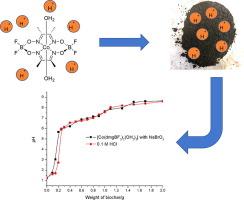
The reduction of sodium bromate (NaBrO3) by [Co(dmgBF2)2(OH2)2] (where dmgBF2 = difluoroboryldimethylglyoximato) was investigated in hydrochloric and nitric acids. Analytical studies were carried out via gravimetric analysis and UV–visible spectrophotometry. Gravimetric analysis proved that sodium bromate was reduced to from quantitative amounts of sodium bromide in the presence of hydrochloric acid. Biochar was used to sequester the complex from the reaction mixture and to neutralize the acidic media. The UV–visible data confirmed the sequestration of the complex from the reaction mixture after exposure to the biochar. The collected pH data proved a direct relationship between pH and the amount of biochar used in the form of a titration curve. Kinetic studies were also carried out to ascertain the mechanism of the oxidation of [Co(dmgBF2)2(OH2)2] by NaBrO3. The oxidation of [Co(dmgBF2)2(OH2)2] by NaBrO3 was carried out by stopped-flow spectrophotometry at 450 nm by varying temperature and over the range of 1.00 mM ≤ [HCl] ≤ 11.00 mM, at a constant ionic strength of 0.60 M (NaCl). From the data, a mechanism for the reaction was proposed. From the mechanism the following rate expression was derived, , where k1 was calculated to be 4.2 × 10⁴ M−1 s−1 at 25 °C, and the activation parameters (ΔH‡ and ΔS‡) were calculated as 57 ± 1 kJ mol−1 and 34 ± 4 J mol−1 K−1, respectively.
期刊介绍:
Inorganica Chimica Acta is an established international forum for all aspects of advanced Inorganic Chemistry. Original papers of high scientific level and interest are published in the form of Articles and Reviews.
Topics covered include:
• chemistry of the main group elements and the d- and f-block metals, including the synthesis, characterization and reactivity of coordination, organometallic, biomimetic, supramolecular coordination compounds, including associated computational studies;
• synthesis, physico-chemical properties, applications of molecule-based nano-scaled clusters and nanomaterials designed using the principles of coordination chemistry, as well as coordination polymers (CPs), metal-organic frameworks (MOFs), metal-organic polyhedra (MPOs);
• reaction mechanisms and physico-chemical investigations computational studies of metalloenzymes and their models;
• applications of inorganic compounds, metallodrugs and molecule-based materials.
Papers composed primarily of structural reports will typically not be considered for publication.



 京公网安备 11010802042870号
京ICP备2023020795号-1
京公网安备 11010802042870号
京ICP备2023020795号-1

 分享
分享
 求助内容:
求助内容: 应助结果提醒方式:
 扫码关注我们
