{"title":"Myxobolus dumerilii sp. n. (Myxozoa: Myxobolidae) infecting the brain of Chinese longsnout catfish Tachysurus dumerili (Bleeker) in China.","authors":"Xiaojing Zhao, Liwen Xu, Ren Shisi, Qiang Wei, Qi Yin, Yijing Yang, Jinyong Zhang, Jianguo Xiang, Jianbo Yu, Deliang Li, Xinhua Liu","doi":"10.1007/s11230-023-10119-y","DOIUrl":null,"url":null,"abstract":"<p><p>During an investigation of Myxobolus diversity in the Chinese longsnout catfish Tachysurus dumerili (Bleeker), a new species infecting the intracranial epidermis of the host was discovered. Upon opening the cranial cavity, several round whitish plasmodia measuring 0.55-0.80 mm in diameter were observed. Fresh spores (n= 50) were pyriform in the frontal view and fusiform in the sutural view, with a length of 15.4±0.6 (13.9-16.5) μm, width of 9.1±0.4 (8.3-9.8) μm, and thickness of 7.0±0.4 (6.3-7.9) μm. The spores had smooth shell surfaces and transparent membrane sheaths in the posterior. No folds, intercapsular appendix, and caudal appendages were observed. Two equal polar capsules were pyriform and measured 7.5±0.5 (6.7-8.7) μm in length and 3.2±0.3 (2.5-3.6) μm in width. The polar filaments were coiled with five to six turns and perpendicular to the polar capsule length. A BLAST search indicated M. dumerilii sp. n. was closely related to five Myxobolus species (with sequences similarities ranging from 90.54% to 96.52%) found in different organs of yellow catfish Tachysurus fulvidraco (Richardson), rather than the T. dumerili-infecting species M. branchiola Dong and Zhao, 2014 (with 90.5% sequence similarity). Phylogenetic analysis showed that M. dumerilii sp. n. didn't form sister clade with brain-infecting Myxobolus spp, but clustered with M. jianlinensis Gao et Zhao, 2020 and M. voremkhai Akhmerov, 1960 within the Siluriformes-clade with highly supported values, indicating that the host specificity may play a stronger signal than site infections during the evolution of Myxobolus species. Based on the morphological, ecological, and molecular differences observed between the newly discovered species and other available Myxobolus species, M. dumerilii sp. n., is proposed and described in this study.</p>","PeriodicalId":54436,"journal":{"name":"Systematic Parasitology","volume":" ","pages":"715-723"},"PeriodicalIF":1.2000,"publicationDate":"2023-12-01","publicationTypes":"Journal Article","fieldsOfStudy":null,"isOpenAccess":false,"openAccessPdf":"","citationCount":"0","resultStr":null,"platform":"Semanticscholar","paperid":null,"PeriodicalName":"Systematic Parasitology","FirstCategoryId":"3","ListUrlMain":"https://doi.org/10.1007/s11230-023-10119-y","RegionNum":4,"RegionCategory":"医学","ArticlePicture":[],"TitleCN":null,"AbstractTextCN":null,"PMCID":null,"EPubDate":"2023/10/18 0:00:00","PubModel":"Epub","JCR":"Q4","JCRName":"PARASITOLOGY","Score":null,"Total":0}
引用次数: 0
Abstract
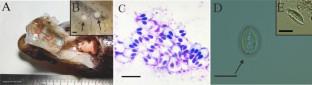
During an investigation of Myxobolus diversity in the Chinese longsnout catfish Tachysurus dumerili (Bleeker), a new species infecting the intracranial epidermis of the host was discovered. Upon opening the cranial cavity, several round whitish plasmodia measuring 0.55-0.80 mm in diameter were observed. Fresh spores (n= 50) were pyriform in the frontal view and fusiform in the sutural view, with a length of 15.4±0.6 (13.9-16.5) μm, width of 9.1±0.4 (8.3-9.8) μm, and thickness of 7.0±0.4 (6.3-7.9) μm. The spores had smooth shell surfaces and transparent membrane sheaths in the posterior. No folds, intercapsular appendix, and caudal appendages were observed. Two equal polar capsules were pyriform and measured 7.5±0.5 (6.7-8.7) μm in length and 3.2±0.3 (2.5-3.6) μm in width. The polar filaments were coiled with five to six turns and perpendicular to the polar capsule length. A BLAST search indicated M. dumerilii sp. n. was closely related to five Myxobolus species (with sequences similarities ranging from 90.54% to 96.52%) found in different organs of yellow catfish Tachysurus fulvidraco (Richardson), rather than the T. dumerili-infecting species M. branchiola Dong and Zhao, 2014 (with 90.5% sequence similarity). Phylogenetic analysis showed that M. dumerilii sp. n. didn't form sister clade with brain-infecting Myxobolus spp, but clustered with M. jianlinensis Gao et Zhao, 2020 and M. voremkhai Akhmerov, 1960 within the Siluriformes-clade with highly supported values, indicating that the host specificity may play a stronger signal than site infections during the evolution of Myxobolus species. Based on the morphological, ecological, and molecular differences observed between the newly discovered species and other available Myxobolus species, M. dumerilii sp. n., is proposed and described in this study.
期刊介绍:
Systematic Parasitology publishes papers on the systematics, taxonomy and nomenclature of the following groups: Nematoda (including plant-parasitic), Monogenea, Digenea, Cestoda, Acanthocephala, Aspidogastrea, Cestodaria, Arthropoda (parasitic copepods, hymenopterans, mites, ticks, etc.), Protozoa (parasitic groups), and parasitic genera in other groups, such as Mollusca, Turbelleria, etc. Systematic Parasitology publishes fully illustrated research papers, brief communications, and fully illustrated major revisions. In order to maintain high standards, all contributors describing new taxa are asked to state clearly where the holotype is deposited and to make paratypes available for examination by the referees. It is recognized that, in some cases, this may cause problems for the authors, but it is hoped that by adhering to this rule authors may be protected against rapid synonymy of their taxa, and the types will be preserved for posterity.



 京公网安备 11010802042870号
京ICP备2023020795号-1
京公网安备 11010802042870号
京ICP备2023020795号-1

 分享
分享
 求助内容:
求助内容: 应助结果提醒方式:
 扫码关注我们
