{"title":"Optimized PCL/CNF bio-nanocomposites for medical bio-plotted applications: Rheological, structural, and thermomechanical aspects","authors":"Nectarios Vidakis , Markos Petousis , Nikolaos Michailidis , Constantine David , Nikolaos Mountakis , Vassilis Papadakis , Evangelos Sfakiotakis , Dimitrios Sagris , Mariza Spiridaki , Apostolos Argyros","doi":"10.1016/j.bprint.2023.e00311","DOIUrl":null,"url":null,"abstract":"<div><p><span><span><span><span>The use of bioabsorbable and biodegradable composites in the medical field has experienced significant growth. Cellulose<span> nanofibers (CNF) have been employed to reinforce medical-grade poly[ε-caprolactone], enhancing both its load-bearing capacity and stiffness compared to pure polycaprolactone PCL. The </span></span>manufacturing process<span> involved a series of steps applied to five different grades of PCL/CNF filaments. Initially, melt extrusion and </span></span>pelletization were performed on the filament, followed by 3D bioplotting to create the specimens. The influence of CNF reinforcement on poly[ε-caprolactone] was evaluated through a range of tests, including rheological, thermomechanical, and in situ micromechanical assessments. To further characterize the samples, Micro-Computed </span>Tomography<span> and Scanning Electron Microscopy fractography were employed for the microstructural and morphological analyses, respectively. The </span></span>mechanical properties<span> of poly[ε-caprolactone]/CNF composites with 6 wt % CNF content exhibited a 23.8% increase in tensile strength<span> and a 19.1% increase in flexural strength compared to the pure matrix, while also displaying minimal porosity.</span></span></p></div>","PeriodicalId":72406,"journal":{"name":"","volume":"36 ","pages":"Article e00311"},"PeriodicalIF":0.0,"publicationDate":"2023-09-29","publicationTypes":"Journal Article","fieldsOfStudy":null,"isOpenAccess":false,"openAccessPdf":"","citationCount":"0","resultStr":null,"platform":"Semanticscholar","paperid":null,"PeriodicalName":"","FirstCategoryId":"1085","ListUrlMain":"https://www.sciencedirect.com/science/article/pii/S2405886623000544","RegionNum":0,"RegionCategory":null,"ArticlePicture":[],"TitleCN":null,"AbstractTextCN":null,"PMCID":null,"EPubDate":"","PubModel":"","JCR":"","JCRName":"","Score":null,"Total":0}
引用次数: 0
Abstract
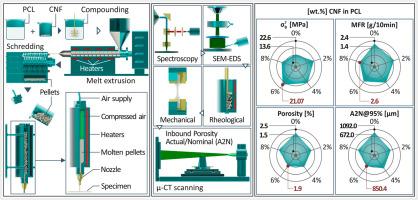
The use of bioabsorbable and biodegradable composites in the medical field has experienced significant growth. Cellulose nanofibers (CNF) have been employed to reinforce medical-grade poly[ε-caprolactone], enhancing both its load-bearing capacity and stiffness compared to pure polycaprolactone PCL. The manufacturing process involved a series of steps applied to five different grades of PCL/CNF filaments. Initially, melt extrusion and pelletization were performed on the filament, followed by 3D bioplotting to create the specimens. The influence of CNF reinforcement on poly[ε-caprolactone] was evaluated through a range of tests, including rheological, thermomechanical, and in situ micromechanical assessments. To further characterize the samples, Micro-Computed Tomography and Scanning Electron Microscopy fractography were employed for the microstructural and morphological analyses, respectively. The mechanical properties of poly[ε-caprolactone]/CNF composites with 6 wt % CNF content exhibited a 23.8% increase in tensile strength and a 19.1% increase in flexural strength compared to the pure matrix, while also displaying minimal porosity.



 京公网安备 11010802042870号
京ICP备2023020795号-1
京公网安备 11010802042870号
京ICP备2023020795号-1

 分享
分享
 求助内容:
求助内容: 应助结果提醒方式:
 扫码关注我们
