{"title":"Towards clean water: Managing risk of arsenic-contaminated groundwater for human consumption","authors":"Abhijit Mukherjee , Soumyajit Sarkar , Poulomee Coomar , Prosun Bhattacharya","doi":"10.1016/j.coesh.2023.100509","DOIUrl":null,"url":null,"abstract":"<div><p>The human health risk associated with the ingestion of arsenic (As) contaminated groundwater as drinking water has been highlighted as the “largest mass-poisoning in human history.” Recently, secondary As exposure pathways have been identified through food and cattle products. Broad-based epidemiological estimation of the populations at risk is only available through statistical calculations, however, proper management needs community-level risk identification. Management strategies involve detection and monitoring, predictions, mitigations by standard and innovative technologies, and nature-based solutions for community drinking water supplies. Impacts of recent technological advancement in terms of real-time sensors and predictive modeling have outlined potential future possibilities. However, successful management would need to explore the nexus between 3-D contaminant occurrence over time, socio-economy, policy, and human behavior in delineating sustainable, clean water sources for sustainable development.</p></div>","PeriodicalId":52296,"journal":{"name":"Current Opinion in Environmental Science and Health","volume":"36 ","pages":"Article 100509"},"PeriodicalIF":6.6000,"publicationDate":"2023-12-01","publicationTypes":"Journal Article","fieldsOfStudy":null,"isOpenAccess":false,"openAccessPdf":"","citationCount":"0","resultStr":null,"platform":"Semanticscholar","paperid":null,"PeriodicalName":"Current Opinion in Environmental Science and Health","FirstCategoryId":"1085","ListUrlMain":"https://www.sciencedirect.com/science/article/pii/S2468584423000697","RegionNum":0,"RegionCategory":null,"ArticlePicture":[],"TitleCN":null,"AbstractTextCN":null,"PMCID":null,"EPubDate":"2023/9/16 0:00:00","PubModel":"Epub","JCR":"Q1","JCRName":"ENVIRONMENTAL SCIENCES","Score":null,"Total":0}
引用次数: 0
Abstract
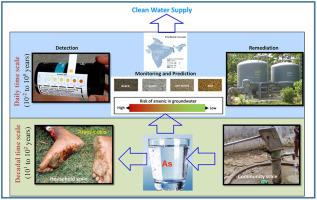
The human health risk associated with the ingestion of arsenic (As) contaminated groundwater as drinking water has been highlighted as the “largest mass-poisoning in human history.” Recently, secondary As exposure pathways have been identified through food and cattle products. Broad-based epidemiological estimation of the populations at risk is only available through statistical calculations, however, proper management needs community-level risk identification. Management strategies involve detection and monitoring, predictions, mitigations by standard and innovative technologies, and nature-based solutions for community drinking water supplies. Impacts of recent technological advancement in terms of real-time sensors and predictive modeling have outlined potential future possibilities. However, successful management would need to explore the nexus between 3-D contaminant occurrence over time, socio-economy, policy, and human behavior in delineating sustainable, clean water sources for sustainable development.



 京公网安备 11010802042870号
京ICP备2023020795号-1
京公网安备 11010802042870号
京ICP备2023020795号-1

 分享
分享
 求助内容:
求助内容: 应助结果提醒方式:
 扫码关注我们
