Kishor R. Tardalkar , Leena R. Chaudhari , Mrunal N. Damle , Akshay A. Kawale , Nilesh C. Bhamare , Jeevitaa R. Kshersagar , Tanvee S. Kulkarni , Meghnad G. Joshi
{"title":"Extracellular-matrix Composite Bioink for 3D bioprinting and molding of small diameter vascular grafts","authors":"Kishor R. Tardalkar , Leena R. Chaudhari , Mrunal N. Damle , Akshay A. Kawale , Nilesh C. Bhamare , Jeevitaa R. Kshersagar , Tanvee S. Kulkarni , Meghnad G. Joshi","doi":"10.1016/j.bprint.2023.e00300","DOIUrl":null,"url":null,"abstract":"<div><p><span>Vascular grafts<span> are used in numerous vascular surgeries<span><span><span> around the world, although these procedures are constrained by vascular graft-related problems and size inconsistencies. This study developed and characterized vascular grafts using tissue engineering and </span>3D printing technology. To overcome vascular graft-related problems and size inconsistencies, this study developed a composite bio-ink using </span>ECM<span> of blood vessels, polyvinyl alcohol, and gelatin. Small-diameter vascular grafts were developed by Extrusion-based 3D printing and by molding techniques. The bioink was characterized in several aspects, followed by surface modification of a 3D vascular graft. The vascular grafts were evaluated for cytotoxicity and mechanical stability, which were found to be satisfactory. An </span></span></span></span><em>in vivo</em><span><span><span><span> biocompatibility and transplantation study showed cellular recruitment, </span>elastin<span> fibers, GAG as well as ECM (collagen) were retained. It was assessed by hematoxylin<span><span> and eosin (H&E), </span>alcian blue, and Masson's </span></span></span>trichrome staining. Recellularization and well-structured ECM were seen in </span>SEM<span> images. In immunohistochemistry<span>, positive vWF, α-SMA, and VEGF expression cells showed recruitment of endothelial and smooth muscle cells<span>. In conclusion, tissue specific bio-ink shows promise for further translational research and clinical application.</span></span></span></span></p></div>","PeriodicalId":72406,"journal":{"name":"","volume":"34 ","pages":"Article e00300"},"PeriodicalIF":0.0,"publicationDate":"2023-10-01","publicationTypes":"Journal Article","fieldsOfStudy":null,"isOpenAccess":false,"openAccessPdf":"","citationCount":"0","resultStr":null,"platform":"Semanticscholar","paperid":null,"PeriodicalName":"","FirstCategoryId":"1085","ListUrlMain":"https://www.sciencedirect.com/science/article/pii/S240588662300043X","RegionNum":0,"RegionCategory":null,"ArticlePicture":[],"TitleCN":null,"AbstractTextCN":null,"PMCID":null,"EPubDate":"","PubModel":"","JCR":"","JCRName":"","Score":null,"Total":0}
引用次数: 0
Abstract
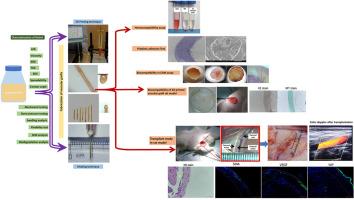
Vascular grafts are used in numerous vascular surgeries around the world, although these procedures are constrained by vascular graft-related problems and size inconsistencies. This study developed and characterized vascular grafts using tissue engineering and 3D printing technology. To overcome vascular graft-related problems and size inconsistencies, this study developed a composite bio-ink using ECM of blood vessels, polyvinyl alcohol, and gelatin. Small-diameter vascular grafts were developed by Extrusion-based 3D printing and by molding techniques. The bioink was characterized in several aspects, followed by surface modification of a 3D vascular graft. The vascular grafts were evaluated for cytotoxicity and mechanical stability, which were found to be satisfactory. An in vivo biocompatibility and transplantation study showed cellular recruitment, elastin fibers, GAG as well as ECM (collagen) were retained. It was assessed by hematoxylin and eosin (H&E), alcian blue, and Masson's trichrome staining. Recellularization and well-structured ECM were seen in SEM images. In immunohistochemistry, positive vWF, α-SMA, and VEGF expression cells showed recruitment of endothelial and smooth muscle cells. In conclusion, tissue specific bio-ink shows promise for further translational research and clinical application.



 京公网安备 11010802042870号
京ICP备2023020795号-1
京公网安备 11010802042870号
京ICP备2023020795号-1

 分享
分享
 求助内容:
求助内容: 应助结果提醒方式:
 扫码关注我们
