The structure of a Bacteroides thetaiotaomicron carbohydrate-binding module provides new insight into the recognition of complex pectic polysaccharides by the human microbiome
Filipa Trovão , Viviana G. Correia , Frederico M. Lourenço , Diana O. Ribeiro , Ana Luísa Carvalho , Angelina S. Palma , Benedita A. Pinheiro
{"title":"The structure of a Bacteroides thetaiotaomicron carbohydrate-binding module provides new insight into the recognition of complex pectic polysaccharides by the human microbiome","authors":"Filipa Trovão , Viviana G. Correia , Frederico M. Lourenço , Diana O. Ribeiro , Ana Luísa Carvalho , Angelina S. Palma , Benedita A. Pinheiro","doi":"10.1016/j.yjsbx.2022.100084","DOIUrl":null,"url":null,"abstract":"<div><p>The<!--> <em>Bacteroides thetaiotaomicron</em> <!-->has developed a consortium of enzymes capable of overcoming steric constraints and degrading, in a sequential manner, the complex rhamnogalacturonan II (RG-II) polysaccharide. BT0996 protein acts in the initial stages of the RG-II depolymerisation, where its two catalytic modules remove the terminal monosaccharides from RG-II side chains A and B. BT0996 is modular and has three putative carbohydrate-binding modules (CBMs) for which the roles in the RG-II degradation are unknown. Here, we present the characterisation of the module at the C-terminal domain, which we designated BT0996-C. The high-resolution structure obtained by X-ray crystallography reveals that the protein displays a typical β-sandwich fold with structural similarity to CBMs assigned to families 6 and 35. The distinctive features are: 1) the presence of several charged residues at the BT0996-C surface creating a large, broad positive lysine-rich patch that encompasses the putative binding site; and 2) the absence of the highly conserved binding-site signatures observed in CBMs from families 6 and 35, such as region A tryptophan and region C asparagine. These findings hint at a binding mode of BT0996-C not yet observed in its homologues. In line with this, carbohydrate microarrays and microscale thermophoresis show the ability of BT0996-C to bind α1-4-linked polygalacturonic acid, and that electrostatic interactions are essential for the recognition of the anionic polysaccharide. The results support the hypothesis that BT0996-C may have evolved to potentiate the action of BT0996 catalytic modules on the complex structure of RG-II by binding to the polygalacturonic acid backbone sequence.</p></div>","PeriodicalId":17238,"journal":{"name":"Journal of Structural Biology: X","volume":"7 ","pages":"Article 100084"},"PeriodicalIF":5.1000,"publicationDate":"2023-01-01","publicationTypes":"Journal Article","fieldsOfStudy":null,"isOpenAccess":false,"openAccessPdf":"","citationCount":"0","resultStr":null,"platform":"Semanticscholar","paperid":null,"PeriodicalName":"Journal of Structural Biology: X","FirstCategoryId":"1085","ListUrlMain":"https://www.sciencedirect.com/science/article/pii/S2590152422000253","RegionNum":0,"RegionCategory":null,"ArticlePicture":[],"TitleCN":null,"AbstractTextCN":null,"PMCID":null,"EPubDate":"2023/1/2 0:00:00","PubModel":"Epub","JCR":"Q2","JCRName":"BIOCHEMISTRY & MOLECULAR BIOLOGY","Score":null,"Total":0}
引用次数: 0
Abstract
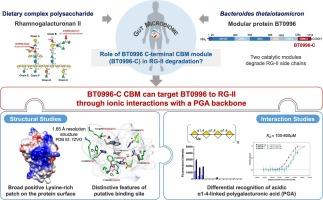
The Bacteroides thetaiotaomicron has developed a consortium of enzymes capable of overcoming steric constraints and degrading, in a sequential manner, the complex rhamnogalacturonan II (RG-II) polysaccharide. BT0996 protein acts in the initial stages of the RG-II depolymerisation, where its two catalytic modules remove the terminal monosaccharides from RG-II side chains A and B. BT0996 is modular and has three putative carbohydrate-binding modules (CBMs) for which the roles in the RG-II degradation are unknown. Here, we present the characterisation of the module at the C-terminal domain, which we designated BT0996-C. The high-resolution structure obtained by X-ray crystallography reveals that the protein displays a typical β-sandwich fold with structural similarity to CBMs assigned to families 6 and 35. The distinctive features are: 1) the presence of several charged residues at the BT0996-C surface creating a large, broad positive lysine-rich patch that encompasses the putative binding site; and 2) the absence of the highly conserved binding-site signatures observed in CBMs from families 6 and 35, such as region A tryptophan and region C asparagine. These findings hint at a binding mode of BT0996-C not yet observed in its homologues. In line with this, carbohydrate microarrays and microscale thermophoresis show the ability of BT0996-C to bind α1-4-linked polygalacturonic acid, and that electrostatic interactions are essential for the recognition of the anionic polysaccharide. The results support the hypothesis that BT0996-C may have evolved to potentiate the action of BT0996 catalytic modules on the complex structure of RG-II by binding to the polygalacturonic acid backbone sequence.



 京公网安备 11010802042870号
京ICP备2023020795号-1
京公网安备 11010802042870号
京ICP备2023020795号-1

 分享
分享
 求助内容:
求助内容: 应助结果提醒方式:
 扫码关注我们
