Gereziher Sibhat, Getu Kahsay, Ann Van Schepdael, Erwin Adams
{"title":"Fast RP-HPLC Method for Analysis of Glucosinolates and Phenolics in Moringa stenopetala Leaf Powder Preparations","authors":"Gereziher Sibhat, Getu Kahsay, Ann Van Schepdael, Erwin Adams","doi":"10.1007/s10337-023-04256-1","DOIUrl":null,"url":null,"abstract":"<div><p><i>Moringa stenopetala</i> (<i>M. stenopetala</i>) leaf powder is extensively used as food, for preparation of nutraceuticals and herbal medicines in many developing countries. Glucosinolates and phenolics are known to be important bioactive constituents of these preparations. In this study, a selective and fast RP-HPLC method was developed and validated for simultaneous determination of intact glucosinolates and phenolics in <i>M. stenopetala</i> leaf powders. The developed method was linear with a coefficient of determination (<i>r</i><sup>2</sup>) ≥ 0.998, precision ≤ 1.5%, and recovery values close to 100%. The method was also sensitive with detection and quantification limits below 1.5 µg/mL and 5 µg/mL, respectively. Besides the use of external standards, quantitative analysis of multicomponents by a single marker (QAMS) was developed and applied to commercial Moringa samples. The correlation coefficient (<i>r</i> ≥ 0.9993) between the QAMS and the external standard method proved the consistency and the strength of the relationship between the two methods. Rutin was used as single marker for the determination of five bioactive components in <i>M. stenopetala</i> leaf samples. Furthermore, a radar plot was used to differentiate samples collected from different geographical origin. Analysis results of the commercial samples revealed that rutin was found to be the constituent with the highest concentration (varying from 6.6 mg/g to 18.8 mg/g) among the phenolics while glucomoringin (0.2–4.2 mg/g) was the most common glucosinolate.</p></div>","PeriodicalId":518,"journal":{"name":"Chromatographia","volume":"86 6","pages":"425 - 435"},"PeriodicalIF":1.3000,"publicationDate":"2023-04-26","publicationTypes":"Journal Article","fieldsOfStudy":null,"isOpenAccess":false,"openAccessPdf":"https://link.springer.com/content/pdf/10.1007/s10337-023-04256-1.pdf","citationCount":"0","resultStr":null,"platform":"Semanticscholar","paperid":null,"PeriodicalName":"Chromatographia","FirstCategoryId":"92","ListUrlMain":"https://link.springer.com/article/10.1007/s10337-023-04256-1","RegionNum":4,"RegionCategory":"化学","ArticlePicture":[],"TitleCN":null,"AbstractTextCN":null,"PMCID":null,"EPubDate":"","PubModel":"","JCR":"Q4","JCRName":"BIOCHEMICAL RESEARCH METHODS","Score":null,"Total":0}
引用次数: 0
Abstract
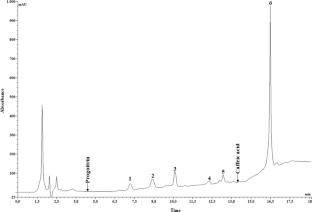
Moringa stenopetala (M. stenopetala) leaf powder is extensively used as food, for preparation of nutraceuticals and herbal medicines in many developing countries. Glucosinolates and phenolics are known to be important bioactive constituents of these preparations. In this study, a selective and fast RP-HPLC method was developed and validated for simultaneous determination of intact glucosinolates and phenolics in M. stenopetala leaf powders. The developed method was linear with a coefficient of determination (r2) ≥ 0.998, precision ≤ 1.5%, and recovery values close to 100%. The method was also sensitive with detection and quantification limits below 1.5 µg/mL and 5 µg/mL, respectively. Besides the use of external standards, quantitative analysis of multicomponents by a single marker (QAMS) was developed and applied to commercial Moringa samples. The correlation coefficient (r ≥ 0.9993) between the QAMS and the external standard method proved the consistency and the strength of the relationship between the two methods. Rutin was used as single marker for the determination of five bioactive components in M. stenopetala leaf samples. Furthermore, a radar plot was used to differentiate samples collected from different geographical origin. Analysis results of the commercial samples revealed that rutin was found to be the constituent with the highest concentration (varying from 6.6 mg/g to 18.8 mg/g) among the phenolics while glucomoringin (0.2–4.2 mg/g) was the most common glucosinolate.
期刊介绍:
Separation sciences, in all their various forms such as chromatography, field-flow fractionation, and electrophoresis, provide some of the most powerful techniques in analytical chemistry and are applied within a number of important application areas, including archaeology, biotechnology, clinical, environmental, food, medical, petroleum, pharmaceutical, polymer and biopolymer research. Beyond serving analytical purposes, separation techniques are also used for preparative and process-scale applications. The scope and power of separation sciences is significantly extended by combination with spectroscopic detection methods (e.g., laser-based approaches, nuclear-magnetic resonance, Raman, chemiluminescence) and particularly, mass spectrometry, to create hyphenated techniques. In addition to exciting new developments in chromatography, such as ultra high-pressure systems, multidimensional separations, and high-temperature approaches, there have also been great advances in hybrid methods combining chromatography and electro-based separations, especially on the micro- and nanoscale. Integrated biological procedures (e.g., enzymatic, immunological, receptor-based assays) can also be part of the overall analytical process.



 京公网安备 11010802042870号
京ICP备2023020795号-1
京公网安备 11010802042870号
京ICP备2023020795号-1

 分享
分享
 求助内容:
求助内容: 应助结果提醒方式:
 扫码关注我们
