Bojun Wang, Tianbin Song, Chun Zhang, Jie Lu, Zhigang Liang
{"title":"Extranodal involvement of posttransplant lymphoproliferative disorder detected on 18F-fluorodeoxyglucose-positron emission tomography/computed tomography","authors":"Bojun Wang, Tianbin Song, Chun Zhang, Jie Lu, Zhigang Liang","doi":"10.1002/ird3.14","DOIUrl":null,"url":null,"abstract":"<p>A 69-year-old man with a history of kidney transplantation presented with ring-enhancing lesions in the left frontal lobe, thalamus, and right insula (Figure 1a) on magnetic resonance imaging. He was hospitalized with a diagnosis of cytomegalovirus encephalitis and had taken anti-inflammatory therapy. Follow up imaging showed a decrease in lesion size in the left frontal lobe and thalamus; however, the right insular lesion increased in size and new ones were identified in the corpus callosum and periventricular white matter (Figure 1a). The tumor markers CA125, CYFRA21-1, CEA, PSA, and fPSA were all positive on blood testing. Because anti-inflammatory therapy was ineffective and malignant tumor could not be excluded on imaging alone, whole-body <sup>18</sup>F-fluorodeoxyglucose (FDG)-positron emission tomography (PET)/computed tomography (CT) was performed (Figure 1b). Body imaging showed multiple hypermetabolic nodular lesions in the thoracic and abdominal superficial soft tissue (maximum standardized uptake value, 13.06), which suggested malignancy. Head imaging showed decreased activity in the brain lesions. A diagnosis of lymphoma was suspected. Punch biopsy of a superficial soft tissue nodule was consistent with B cell-derived posttransplant lymphoproliferative disorder (PTLD) (Figure 1c,d).</p><p>PTLD is a rare group of heterogeneous lymphoproliferative conditions that occur after solid organ or hematopoietic transplantation [<span>1, 2</span>]. With allograft transplantation, the anatomic site of PTLD involvement usually depends on the type of transplant [<span>3</span>]. Reported incidence rates of involvement of the central nervous system range between 10% and 15% [<span>4</span>, <span>5</span>]. However, simultaneous involvement of the central nervous system [<span>6</span>] and superficial soft tissue [<span>7</span>] are rare. To date, only two cases of PTLD soft tissue nodules have been reported [<span>4</span>]. Characteristics of PTLD on magnetic resonance imaging are not specific; however, PTLD can be detected on <sup>18</sup>F-FDG-PET with an overall sensitivity and specificity of approximately 90% [<span>8, 9</span>]. PTLD should be considered when multiple hypermetabolic superficial soft tissue nodules and central nervous system lesions are encountered in transplantation patients. Whole-body<sup>18</sup>F-FDG-PET/CT is more effective than single-site imaging for diagnosing or staging PTLD.</p><p><b>Bojun Wang</b>: Data curation (lead); Writing – original draft (lead). <b>Tianbin Song</b>: Conceptualization (equal); Writing – review & editing (equal). <b>Chun Zhang</b>: Conceptualization (equal); Supervision (equal). <b>Jie Lu</b>: Supervision (equal). <b>Zhigang Liang</b>: Supervision (equal); Writing – review & editing (equal).</p><p>All the authors declare that they have no conflict or potential conflict of interest.</p><p>This article does not contain any studies with animals performed by any of the authors. All procedures performed in studies involving human participants were in accordance with the ethical standards of the institutional and/or national research committee and with the principles of the 1964 Declaration of Helsinki and its later amendments or comparable ethical standards.</p><p>Informed consent was obtained from the patient and his parents for the anonymous use of his clinical, imaging, and histologic data for publication.</p>","PeriodicalId":73508,"journal":{"name":"iRadiology","volume":"1 2","pages":"195-197"},"PeriodicalIF":0.0000,"publicationDate":"2023-06-01","publicationTypes":"Journal Article","fieldsOfStudy":null,"isOpenAccess":false,"openAccessPdf":"https://onlinelibrary.wiley.com/doi/epdf/10.1002/ird3.14","citationCount":"0","resultStr":null,"platform":"Semanticscholar","paperid":null,"PeriodicalName":"iRadiology","FirstCategoryId":"1085","ListUrlMain":"https://onlinelibrary.wiley.com/doi/10.1002/ird3.14","RegionNum":0,"RegionCategory":null,"ArticlePicture":[],"TitleCN":null,"AbstractTextCN":null,"PMCID":null,"EPubDate":"","PubModel":"","JCR":"","JCRName":"","Score":null,"Total":0}
引用次数: 0
Abstract
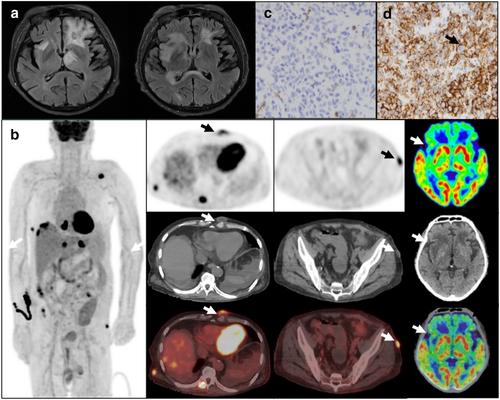
A 69-year-old man with a history of kidney transplantation presented with ring-enhancing lesions in the left frontal lobe, thalamus, and right insula (Figure 1a) on magnetic resonance imaging. He was hospitalized with a diagnosis of cytomegalovirus encephalitis and had taken anti-inflammatory therapy. Follow up imaging showed a decrease in lesion size in the left frontal lobe and thalamus; however, the right insular lesion increased in size and new ones were identified in the corpus callosum and periventricular white matter (Figure 1a). The tumor markers CA125, CYFRA21-1, CEA, PSA, and fPSA were all positive on blood testing. Because anti-inflammatory therapy was ineffective and malignant tumor could not be excluded on imaging alone, whole-body 18F-fluorodeoxyglucose (FDG)-positron emission tomography (PET)/computed tomography (CT) was performed (Figure 1b). Body imaging showed multiple hypermetabolic nodular lesions in the thoracic and abdominal superficial soft tissue (maximum standardized uptake value, 13.06), which suggested malignancy. Head imaging showed decreased activity in the brain lesions. A diagnosis of lymphoma was suspected. Punch biopsy of a superficial soft tissue nodule was consistent with B cell-derived posttransplant lymphoproliferative disorder (PTLD) (Figure 1c,d).
PTLD is a rare group of heterogeneous lymphoproliferative conditions that occur after solid organ or hematopoietic transplantation [1, 2]. With allograft transplantation, the anatomic site of PTLD involvement usually depends on the type of transplant [3]. Reported incidence rates of involvement of the central nervous system range between 10% and 15% [4, 5]. However, simultaneous involvement of the central nervous system [6] and superficial soft tissue [7] are rare. To date, only two cases of PTLD soft tissue nodules have been reported [4]. Characteristics of PTLD on magnetic resonance imaging are not specific; however, PTLD can be detected on 18F-FDG-PET with an overall sensitivity and specificity of approximately 90% [8, 9]. PTLD should be considered when multiple hypermetabolic superficial soft tissue nodules and central nervous system lesions are encountered in transplantation patients. Whole-body18F-FDG-PET/CT is more effective than single-site imaging for diagnosing or staging PTLD.
Bojun Wang: Data curation (lead); Writing – original draft (lead). Tianbin Song: Conceptualization (equal); Writing – review & editing (equal). Chun Zhang: Conceptualization (equal); Supervision (equal). Jie Lu: Supervision (equal). Zhigang Liang: Supervision (equal); Writing – review & editing (equal).
All the authors declare that they have no conflict or potential conflict of interest.
This article does not contain any studies with animals performed by any of the authors. All procedures performed in studies involving human participants were in accordance with the ethical standards of the institutional and/or national research committee and with the principles of the 1964 Declaration of Helsinki and its later amendments or comparable ethical standards.
Informed consent was obtained from the patient and his parents for the anonymous use of his clinical, imaging, and histologic data for publication.



 京公网安备 11010802042870号
京ICP备2023020795号-1
京公网安备 11010802042870号
京ICP备2023020795号-1

 分享
分享

 求助内容:
求助内容: 应助结果提醒方式:
 扫码关注我们
