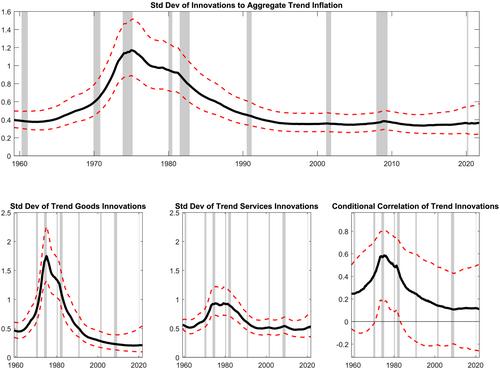
{"title":"Understanding trend inflation through the lens of the goods and services sectors","authors":"Yunjong Eo, Luis Uzeda, Benjamin Wong","doi":"10.1002/jae.2975","DOIUrl":null,"url":null,"abstract":"<p>We distinguish between the goods and services sectors in an unobserved components model of U.S. inflation. We find that prior to the early 1990s, both sectors contributed to volatility of aggregate trend inflation, while since then, this has been predominantly driven by the services sector, with the trend in goods inflation being essentially flat. We document that the large reduction in the volatility of the trend for goods inflation has been the most important driver of the decline in the volatility in aggregate trend inflation reported by Stock and Watson (2007). Our results appear robust to COVID-19 inflation developments.</p>","PeriodicalId":73603,"journal":{"name":"","volume":"38 5","pages":"751-766"},"PeriodicalIF":0.0,"publicationDate":"2023-04-05","publicationTypes":"Journal Article","fieldsOfStudy":null,"isOpenAccess":false,"openAccessPdf":"https://onlinelibrary.wiley.com/doi/epdf/10.1002/jae.2975","citationCount":"0","resultStr":null,"platform":"Semanticscholar","paperid":null,"PeriodicalName":"","FirstCategoryId":"96","ListUrlMain":"https://onlinelibrary.wiley.com/doi/10.1002/jae.2975","RegionNum":0,"RegionCategory":null,"ArticlePicture":[],"TitleCN":null,"AbstractTextCN":null,"PMCID":null,"EPubDate":"","PubModel":"","JCR":"","JCRName":"","Score":null,"Total":0}
引用次数: 0
Abstract
We distinguish between the goods and services sectors in an unobserved components model of U.S. inflation. We find that prior to the early 1990s, both sectors contributed to volatility of aggregate trend inflation, while since then, this has been predominantly driven by the services sector, with the trend in goods inflation being essentially flat. We document that the large reduction in the volatility of the trend for goods inflation has been the most important driver of the decline in the volatility in aggregate trend inflation reported by Stock and Watson (2007). Our results appear robust to COVID-19 inflation developments.



 京公网安备 11010802042870号
京ICP备2023020795号-1
京公网安备 11010802042870号
京ICP备2023020795号-1

 分享
分享
 求助内容:
求助内容: 应助结果提醒方式:
 扫码关注我们
