{"title":"Effectiveness of informational interviewing for facilitating networking self-efficacy in university students","authors":"Adam M. Kanar","doi":"10.1002/cdq.12318","DOIUrl":null,"url":null,"abstract":"<p>Networking helps people explore careers and find jobs. To date, the scientific literature has described few evidence-based techniques for boosting networking self-efficacy in university students. Here, two studies assessed the effectiveness of informational interviewing as a theory-based technique for improving networking self-efficacy. Study 1 (<i>n</i> = 90) used a pre–post, quasi-experimental design and found participants who conducted a virtual informational interview with business professionals reported higher networking self-efficacy at posttest than participants in a comparison condition. Study 2 (<i>n</i> = 72) used a single-group design with three measurement occasions and found self-reported learning during an in-person informational interview moderated the relationship between participants’ pre- and posttest networking self-efficacy. Results suggest that informational interviewing can be an effective technique for increasing networking self-efficacy among university students.</p>","PeriodicalId":85664,"journal":{"name":"","volume":"71 2","pages":"147-159"},"PeriodicalIF":0.0,"publicationDate":"2023-03-22","publicationTypes":"Journal Article","fieldsOfStudy":null,"isOpenAccess":false,"openAccessPdf":"https://onlinelibrary.wiley.com/doi/epdf/10.1002/cdq.12318","citationCount":"0","resultStr":null,"platform":"Semanticscholar","paperid":null,"PeriodicalName":"","FirstCategoryId":"102","ListUrlMain":"https://onlinelibrary.wiley.com/doi/10.1002/cdq.12318","RegionNum":0,"RegionCategory":null,"ArticlePicture":[],"TitleCN":null,"AbstractTextCN":null,"PMCID":null,"EPubDate":"","PubModel":"","JCR":"","JCRName":"","Score":null,"Total":0}
引用次数: 0
Abstract
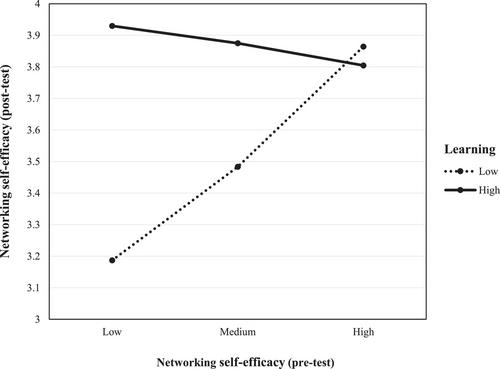
Networking helps people explore careers and find jobs. To date, the scientific literature has described few evidence-based techniques for boosting networking self-efficacy in university students. Here, two studies assessed the effectiveness of informational interviewing as a theory-based technique for improving networking self-efficacy. Study 1 (n = 90) used a pre–post, quasi-experimental design and found participants who conducted a virtual informational interview with business professionals reported higher networking self-efficacy at posttest than participants in a comparison condition. Study 2 (n = 72) used a single-group design with three measurement occasions and found self-reported learning during an in-person informational interview moderated the relationship between participants’ pre- and posttest networking self-efficacy. Results suggest that informational interviewing can be an effective technique for increasing networking self-efficacy among university students.



 京公网安备 11010802042870号
京ICP备2023020795号-1
京公网安备 11010802042870号
京ICP备2023020795号-1

 分享
分享
 求助内容:
求助内容: 应助结果提醒方式:
 扫码关注我们
