Third-line or above anlotinib in relapsed and refractory small cell lung cancer patients with brain metastases: A post hoc analysis of ALTER1202, a randomized, double-blind phase 2 study
Ying Cheng, Qiming Wang, Kai Li, Jianhua Shi, Baohui Han, Lin Wu, Gongyan Chen, Jianxing He, Jie Wang, Haifeng Qin, Xiaoling Li
{"title":"Third-line or above anlotinib in relapsed and refractory small cell lung cancer patients with brain metastases: A post hoc analysis of ALTER1202, a randomized, double-blind phase 2 study","authors":"Ying Cheng, Qiming Wang, Kai Li, Jianhua Shi, Baohui Han, Lin Wu, Gongyan Chen, Jianxing He, Jie Wang, Haifeng Qin, Xiaoling Li","doi":"10.1002/cai2.43","DOIUrl":null,"url":null,"abstract":"<div>\n \n \n <section>\n \n <h3> Background</h3>\n \n <p>The prognosis of patients with small cell lung cancer (SCLC) and brain metastases (BM) was poor. This study aimed to explore the efficacy and safety of anlotinib as third-line or above treatment in SCLC with BM.</p>\n </section>\n \n <section>\n \n <h3> Methods</h3>\n \n <p>This was a subgroup analysis of the ALTER1202 trial, which was a randomized, placebo-controlled trial aimed to evaluate the role of anlotinib as third-line treatment or above in patients with SCLC. This study included patients with BM at baseline. The efficacy and safety outcomes included progression-free survival (PFS), overall survival (OS), central nervous system (CNS), objective response rate (ORR), CNS disease control rate (DCR), time to CNS progression, and adverse events (AEs).</p>\n </section>\n \n <section>\n \n <h3> Results</h3>\n \n <p>Twenty-one and nine patients with BM were included in the anlotinib and placebo groups, respectively. The median PFS and OS were 3.8 months (95% confidence interval [CI]: 1.8–6.1) and 6.1 months (95% CI: 4.1–8.0) in the anlotinib group. Anlotinib was associated with a significant improvement in PFS (hazard ratio [HR] = 0.15, 95% CI: 0.04–0.51, <i>p</i> = 0.0005) and OS (HR = 0.26, 95% CI: 0.09–0.73, <i>p</i> = 0.0061) than placebo. Anlotinib significantly prolonged the time to CNS progression (<i>p</i> < 0.0001). The anlotinib group had a higher CNS DCR than placebo (95.2% vs. 22.2%, <i>p</i> = 0.0001). The most common grade 3 or higher AEs were increased lipase (19.0%), hypertension (14.3%), and hyponatremia (14.3%) in the anlotinib group.</p>\n </section>\n \n <section>\n \n <h3> Conclusions</h3>\n \n <p>Anlotinib proved to have potential CNS activity and a manageable toxicity profile in patients with SCLC and BM, significantly delaying CNS progression.</p>\n </section>\n </div>","PeriodicalId":100212,"journal":{"name":"Cancer Innovation","volume":"2 3","pages":"181-190"},"PeriodicalIF":2.0000,"publicationDate":"2023-01-17","publicationTypes":"Journal Article","fieldsOfStudy":null,"isOpenAccess":false,"openAccessPdf":"https://onlinelibrary.wiley.com/doi/epdf/10.1002/cai2.43","citationCount":"0","resultStr":null,"platform":"Semanticscholar","paperid":null,"PeriodicalName":"Cancer Innovation","FirstCategoryId":"1085","ListUrlMain":"https://onlinelibrary.wiley.com/doi/10.1002/cai2.43","RegionNum":0,"RegionCategory":null,"ArticlePicture":[],"TitleCN":null,"AbstractTextCN":null,"PMCID":null,"EPubDate":"","PubModel":"","JCR":"","JCRName":"","Score":null,"Total":0}
引用次数: 0
Abstract
Background
The prognosis of patients with small cell lung cancer (SCLC) and brain metastases (BM) was poor. This study aimed to explore the efficacy and safety of anlotinib as third-line or above treatment in SCLC with BM.
Methods
This was a subgroup analysis of the ALTER1202 trial, which was a randomized, placebo-controlled trial aimed to evaluate the role of anlotinib as third-line treatment or above in patients with SCLC. This study included patients with BM at baseline. The efficacy and safety outcomes included progression-free survival (PFS), overall survival (OS), central nervous system (CNS), objective response rate (ORR), CNS disease control rate (DCR), time to CNS progression, and adverse events (AEs).
Results
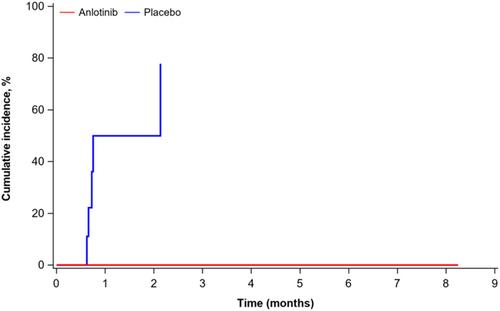
Twenty-one and nine patients with BM were included in the anlotinib and placebo groups, respectively. The median PFS and OS were 3.8 months (95% confidence interval [CI]: 1.8–6.1) and 6.1 months (95% CI: 4.1–8.0) in the anlotinib group. Anlotinib was associated with a significant improvement in PFS (hazard ratio [HR] = 0.15, 95% CI: 0.04–0.51, p = 0.0005) and OS (HR = 0.26, 95% CI: 0.09–0.73, p = 0.0061) than placebo. Anlotinib significantly prolonged the time to CNS progression (p < 0.0001). The anlotinib group had a higher CNS DCR than placebo (95.2% vs. 22.2%, p = 0.0001). The most common grade 3 or higher AEs were increased lipase (19.0%), hypertension (14.3%), and hyponatremia (14.3%) in the anlotinib group.
Conclusions
Anlotinib proved to have potential CNS activity and a manageable toxicity profile in patients with SCLC and BM, significantly delaying CNS progression.



 京公网安备 11010802042870号
京ICP备2023020795号-1
京公网安备 11010802042870号
京ICP备2023020795号-1

 分享
分享

 求助内容:
求助内容: 应助结果提醒方式:
 扫码关注我们
