Cui Ouyang , Jianwei Li , Yaqi Qu , Song Hong , Songbo He
{"title":"Oxidation of benzene to phenol with N2O over a hierarchical Fe/ZSM-5 catalyst","authors":"Cui Ouyang , Jianwei Li , Yaqi Qu , Song Hong , Songbo He","doi":"10.1016/j.gee.2022.01.007","DOIUrl":null,"url":null,"abstract":"<div><p>Catalytic oxidation of benzene with N<sub>2</sub>O to phenol over the hierarchical and microporous Fe/ZSM-5-based catalysts in a continuous fixed-bed reactor was investigated. The spent catalyst was <em>in-situ</em> regenerated by an oxidative treatment using N<sub>2</sub>O and in total 10 reaction-regeneration cycles were performed. A 100% N<sub>2</sub>O conversion, 93.3% phenol selectivity, and high initial phenol formation rate of 16.49 ± 0.06 mmol<sub>phenol</sub> g<sub>catalyst</sub><sup>−1</sup> h<sup>−1</sup> at time on stream (TOS) of 5 min, and a good phenol productivity of 147.06 mmol<sub>phenol</sub> g<sub>catalyst</sub><sup>−1</sup> during catalyst life-time of 1800 min were obtained on a fresh hierarchical Fe/ZSM-5-Hi2.8 catalyst. With the reaction-regeneration cycle, N<sub>2</sub>O conversion is fully recovered within TOS of 3 h, moreover, the phenol productivity was decreased <em>ca.</em> 2.2 ± 0.8% after each cycle, leading to a total phenol productivity of <em>ca</em>. 0.44 ton<sub>phenol</sub> kg<sub>catalyst</sub><sup>−1</sup> estimated for 300 cycles. Catalyst characterizations imply that the coke is rapidly deposited on catalyst surface in the initial TOS of 3 h (0.28 mg<sub>c</sub> g<sub>catalyst</sub><sup>−1</sup> min<sup>−1</sup>) and gradually becomes graphitic during the TOS of 30 h with a slow formation rate of 0.06 mg<sub>c</sub> g<sub>catalyst</sub><sup>−1</sup> min<sup>−1</sup>. Among others (e.g., the decrease of textural property and acidity), the nearly complete coverage of the active Fe-O-Al sites by coke accounts for the main catalyst deactivation. Besides these reversible deactivation characteristics related to coking, the irreversible catalyst deactivation is also observed with the reaction-regeneration cycle. The latter is reflected by a further decreased amount of the active Fe-O-Al sites, which agglomerate on catalyst surface with the cycle, likely associated with the hard coke residue that is not completely removed by the regeneration.</p></div>","PeriodicalId":12744,"journal":{"name":"Green Energy & Environment","volume":"8 4","pages":"Pages 1161-1173"},"PeriodicalIF":14.6000,"publicationDate":"2023-08-01","publicationTypes":"Journal Article","fieldsOfStudy":null,"isOpenAccess":false,"openAccessPdf":"","citationCount":"2","resultStr":null,"platform":"Semanticscholar","paperid":null,"PeriodicalName":"Green Energy & Environment","FirstCategoryId":"5","ListUrlMain":"https://www.sciencedirect.com/science/article/pii/S2468025722000073","RegionNum":1,"RegionCategory":"工程技术","ArticlePicture":[],"TitleCN":null,"AbstractTextCN":null,"PMCID":null,"EPubDate":"","PubModel":"","JCR":"Q1","JCRName":"CHEMISTRY, PHYSICAL","Score":null,"Total":0}
引用次数: 2
Abstract
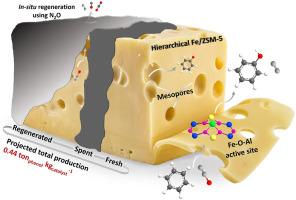
Catalytic oxidation of benzene with N2O to phenol over the hierarchical and microporous Fe/ZSM-5-based catalysts in a continuous fixed-bed reactor was investigated. The spent catalyst was in-situ regenerated by an oxidative treatment using N2O and in total 10 reaction-regeneration cycles were performed. A 100% N2O conversion, 93.3% phenol selectivity, and high initial phenol formation rate of 16.49 ± 0.06 mmolphenol gcatalyst−1 h−1 at time on stream (TOS) of 5 min, and a good phenol productivity of 147.06 mmolphenol gcatalyst−1 during catalyst life-time of 1800 min were obtained on a fresh hierarchical Fe/ZSM-5-Hi2.8 catalyst. With the reaction-regeneration cycle, N2O conversion is fully recovered within TOS of 3 h, moreover, the phenol productivity was decreased ca. 2.2 ± 0.8% after each cycle, leading to a total phenol productivity of ca. 0.44 tonphenol kgcatalyst−1 estimated for 300 cycles. Catalyst characterizations imply that the coke is rapidly deposited on catalyst surface in the initial TOS of 3 h (0.28 mgc gcatalyst−1 min−1) and gradually becomes graphitic during the TOS of 30 h with a slow formation rate of 0.06 mgc gcatalyst−1 min−1. Among others (e.g., the decrease of textural property and acidity), the nearly complete coverage of the active Fe-O-Al sites by coke accounts for the main catalyst deactivation. Besides these reversible deactivation characteristics related to coking, the irreversible catalyst deactivation is also observed with the reaction-regeneration cycle. The latter is reflected by a further decreased amount of the active Fe-O-Al sites, which agglomerate on catalyst surface with the cycle, likely associated with the hard coke residue that is not completely removed by the regeneration.
期刊介绍:
Green Energy & Environment (GEE) is an internationally recognized journal that undergoes a rigorous peer-review process. It focuses on interdisciplinary research related to green energy and the environment, covering a wide range of topics including biofuel and bioenergy, energy storage and networks, catalysis for sustainable processes, and materials for energy and the environment. GEE has a broad scope and encourages the submission of original and innovative research in both fundamental and engineering fields. Additionally, GEE serves as a platform for discussions, summaries, reviews, and previews of the impact of green energy on the eco-environment.



 京公网安备 11010802042870号
京ICP备2023020795号-1
京公网安备 11010802042870号
京ICP备2023020795号-1

 分享
分享
 求助内容:
求助内容: 应助结果提醒方式:
 扫码关注我们
