Matteo Rizzo , Matteo Marcuzzo , Alessandro Zangari , Andrea Gasparetto , Andrea Albarelli
{"title":"Fruit ripeness classification: A survey","authors":"Matteo Rizzo , Matteo Marcuzzo , Alessandro Zangari , Andrea Gasparetto , Andrea Albarelli","doi":"10.1016/j.aiia.2023.02.004","DOIUrl":null,"url":null,"abstract":"<div><p>Fruit is a key crop in worldwide agriculture feeding millions of people. The standard supply chain of fruit products involves quality checks to guarantee freshness, taste, and, most of all, safety. An important factor that determines fruit quality is its stage of ripening. This is usually manually classified by field experts, making it a labor-intensive and error-prone process. Thus, there is an arising need for automation in fruit ripeness classification. Many automatic methods have been proposed that employ a variety of feature descriptors for the food item to be graded. Machine learning and deep learning techniques dominate the top-performing methods. Furthermore, deep learning can operate on raw data and thus relieve the users from having to compute complex engineered features, which are often crop-specific. In this survey, we review the latest methods proposed in the literature to automatize fruit ripeness classification, highlighting the most common feature descriptors they operate on.</p></div>","PeriodicalId":52814,"journal":{"name":"Artificial Intelligence in Agriculture","volume":"7 ","pages":"Pages 44-57"},"PeriodicalIF":12.4000,"publicationDate":"2023-03-01","publicationTypes":"Journal Article","fieldsOfStudy":null,"isOpenAccess":false,"openAccessPdf":"","citationCount":"0","resultStr":null,"platform":"Semanticscholar","paperid":null,"PeriodicalName":"Artificial Intelligence in Agriculture","FirstCategoryId":"1087","ListUrlMain":"https://www.sciencedirect.com/science/article/pii/S2589721723000065","RegionNum":0,"RegionCategory":null,"ArticlePicture":[],"TitleCN":null,"AbstractTextCN":null,"PMCID":null,"EPubDate":"","PubModel":"","JCR":"Q1","JCRName":"AGRICULTURE, MULTIDISCIPLINARY","Score":null,"Total":0}
引用次数: 0
Abstract
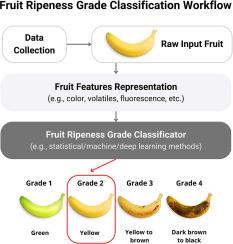
Fruit is a key crop in worldwide agriculture feeding millions of people. The standard supply chain of fruit products involves quality checks to guarantee freshness, taste, and, most of all, safety. An important factor that determines fruit quality is its stage of ripening. This is usually manually classified by field experts, making it a labor-intensive and error-prone process. Thus, there is an arising need for automation in fruit ripeness classification. Many automatic methods have been proposed that employ a variety of feature descriptors for the food item to be graded. Machine learning and deep learning techniques dominate the top-performing methods. Furthermore, deep learning can operate on raw data and thus relieve the users from having to compute complex engineered features, which are often crop-specific. In this survey, we review the latest methods proposed in the literature to automatize fruit ripeness classification, highlighting the most common feature descriptors they operate on.




 京公网安备 11010802042870号
京ICP备2023020795号-1
京公网安备 11010802042870号
京ICP备2023020795号-1

 分享
分享
 求助内容:
求助内容: 应助结果提醒方式:
 扫码关注我们
