{"title":"Characterisation of protein-polyphenol interactions in beer during forced aging","authors":"Sisse Jongberg, Mogens L. Andersen, Marianne N. Lund","doi":"10.1002/jib.623","DOIUrl":null,"url":null,"abstract":"<p>Proteins and proteinaceous material were extracted by acetone precipitation of beer that had undergone forced aging through 0 (control), 5 (medium) or 10 (high) heat/chill cycles (60°C 48h/0°C 24h). Size exclusion chromatography analysis of the crude beer extract showed that forced ageing led to a significant increase in binding of phenolic compounds to Protein Z and especially to lipid transfer protein 1 (LTP1). Protein-polyphenol conjugates were also present in high molecular weight (> 100 kDa) and low molecular weight fractions (< 5 kDa), but these conjugates were already present in the fresh beer and were not affected by the forced aging. Treatment of the crude beer extract with sulphite (2 M) dissociated the protein-polyphenol bindings in LTP1 and Protein Z that had been generated during medium forced aging. Identification and quantification of the free, the non-covalently, and the covalently bound phenolic compounds were performed by UHPLC after extraction by methanol, acetic acid, and sulphite, respectively. The amounts of vanillic acid and caffeic acid decreased in the free polyphenol fraction, indicating binding to proteins during forced aging. Epicatechin and quercetin-3-O-glucoside were found to be non-covalently bound during forced aging. Finally, gallic acid, epicatechin, protocatechuic acid, and astragalin were found to be covalently bound already in the fresh beer. © 2020 The Institute of Brewing & Distilling</p>","PeriodicalId":93032,"journal":{"name":"","volume":"126 4","pages":"371-381"},"PeriodicalIF":0.0,"publicationDate":"2020-08-31","publicationTypes":"Journal Article","fieldsOfStudy":null,"isOpenAccess":false,"openAccessPdf":"https://sci-hub-pdf.com/10.1002/jib.623","citationCount":"9","resultStr":null,"platform":"Semanticscholar","paperid":null,"PeriodicalName":"","FirstCategoryId":"97","ListUrlMain":"https://onlinelibrary.wiley.com/doi/10.1002/jib.623","RegionNum":0,"RegionCategory":null,"ArticlePicture":[],"TitleCN":null,"AbstractTextCN":null,"PMCID":null,"EPubDate":"","PubModel":"","JCR":"","JCRName":"","Score":null,"Total":0}
引用次数: 9
Abstract
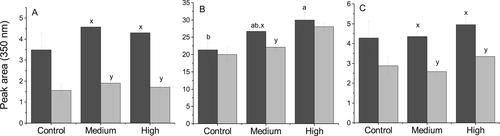
Proteins and proteinaceous material were extracted by acetone precipitation of beer that had undergone forced aging through 0 (control), 5 (medium) or 10 (high) heat/chill cycles (60°C 48h/0°C 24h). Size exclusion chromatography analysis of the crude beer extract showed that forced ageing led to a significant increase in binding of phenolic compounds to Protein Z and especially to lipid transfer protein 1 (LTP1). Protein-polyphenol conjugates were also present in high molecular weight (> 100 kDa) and low molecular weight fractions (< 5 kDa), but these conjugates were already present in the fresh beer and were not affected by the forced aging. Treatment of the crude beer extract with sulphite (2 M) dissociated the protein-polyphenol bindings in LTP1 and Protein Z that had been generated during medium forced aging. Identification and quantification of the free, the non-covalently, and the covalently bound phenolic compounds were performed by UHPLC after extraction by methanol, acetic acid, and sulphite, respectively. The amounts of vanillic acid and caffeic acid decreased in the free polyphenol fraction, indicating binding to proteins during forced aging. Epicatechin and quercetin-3-O-glucoside were found to be non-covalently bound during forced aging. Finally, gallic acid, epicatechin, protocatechuic acid, and astragalin were found to be covalently bound already in the fresh beer. © 2020 The Institute of Brewing & Distilling
啤酒强制陈酿过程中蛋白质-多酚相互作用的表征
通过0(对照)、5(中)或10(高)热/冷循环(60°C 48h/0°C 24h)对啤酒进行强制老化,丙酮沉淀提取蛋白质和蛋白质物质。粗啤酒提取物的尺寸排除色谱分析表明,强迫老化导致酚类化合物与蛋白Z的结合显著增加,特别是与脂质转移蛋白1 (LTP1)的结合。蛋白质-多酚偶联物也存在于高分子量(>100 kDa)和低分子量组分(<5 kDa),但这些共轭物已经存在于新鲜啤酒中,不受强制陈酿的影响。用亚硫酸盐(2 M)处理粗啤酒提取物可以解离在中等强制老化过程中产生的LTP1和Protein Z中的蛋白质-多酚结合。甲醇提取、乙酸提取、亚硫酸盐提取后,分别用UHPLC对游离、非共价和共价结合的酚类化合物进行鉴定和定量。游离多酚部分中香草酸和咖啡酸的含量下降,表明在强迫老化过程中与蛋白质结合。在强迫衰老过程中发现表儿茶素和槲皮素-3- o -葡萄糖苷是非共价结合的。最后,在新鲜啤酒中发现没食子酸、表儿茶素、原儿茶酸和黄芪苷已共价结合。©2020 The Institute of Brewing;蒸馏
本文章由计算机程序翻译,如有差异,请以英文原文为准。



 京公网安备 11010802042870号
京ICP备2023020795号-1
京公网安备 11010802042870号
京ICP备2023020795号-1

 分享
分享
 求助内容:
求助内容: 应助结果提醒方式:
 扫码关注我们
