M. Ganji, H. Yousefnia, Z. S. Seyedraoufi, Y. Shajari
{"title":"The corrosion behavior of Ni–Fe and Ni–Fe–TiC nanoparticles deposited using pulse electrodeposition on low-carbon steel","authors":"M. Ganji, H. Yousefnia, Z. S. Seyedraoufi, Y. Shajari","doi":"10.1007/s41779-022-00747-w","DOIUrl":null,"url":null,"abstract":"<div><p>In this study, the nickel–iron–titanium carbide (Ni–Fe–TiC) nanocomposite was applied on the St14 low-carbon steel via pulse electrodeposition. Electroplating was applied on the substrate with different values of current density, frequency, duty cycle, electroplating time (t) and concentration of TiC nanoparticles, and the properties of the applied coatings were evaluated. To the study the microstructure and morphology of the applied coatings, field emission electron microscope (FESEM) was used. The amount of deposited elements in the coating was determined by energy-dispersive spectroscopy (EDS). To evaluate the corrosion resistance of the coatings, potentiodynamic polarization and electrochemical impedance (EIS) tests were carried out in 3.5% NaCl solution as a corrosive environment. The optimum coating was obtained at the current density (J) of 30 mA/cm<sup>2</sup>, duty cycle (<span>\\(\\gamma\\)</span>) of 60%, frequency (f) of 20 Hz and 2 g/L concentration of TiC nanoparticles. The optimum coating increased the corrosion potential from -0.675 V to -0.332 V and decreased the corrosion current density from 157.200μA/cm<sup>2</sup> to 0.790μA/cm<sup>2</sup>. The presence of TiC nanoparticles in the coating reduced the corrosion current density from 2.130μA/cm<sup>2</sup> (Ni–Fe coating) to 0.790μA/cm<sup>2</sup> (Ni–Fe–TiC nanocomposite coating).</p></div>","PeriodicalId":49042,"journal":{"name":"Journal of the Australian Ceramic Society","volume":"58 4","pages":"1283 - 1295"},"PeriodicalIF":2.1000,"publicationDate":"2022-04-29","publicationTypes":"Journal Article","fieldsOfStudy":null,"isOpenAccess":false,"openAccessPdf":"https://link.springer.com/content/pdf/10.1007/s41779-022-00747-w.pdf","citationCount":"4","resultStr":null,"platform":"Semanticscholar","paperid":null,"PeriodicalName":"Journal of the Australian Ceramic Society","FirstCategoryId":"88","ListUrlMain":"https://link.springer.com/article/10.1007/s41779-022-00747-w","RegionNum":4,"RegionCategory":"材料科学","ArticlePicture":[],"TitleCN":null,"AbstractTextCN":null,"PMCID":null,"EPubDate":"","PubModel":"","JCR":"Q3","JCRName":"Materials Science","Score":null,"Total":0}
引用次数: 4
Abstract
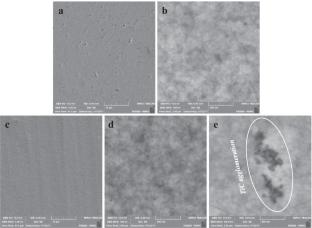
In this study, the nickel–iron–titanium carbide (Ni–Fe–TiC) nanocomposite was applied on the St14 low-carbon steel via pulse electrodeposition. Electroplating was applied on the substrate with different values of current density, frequency, duty cycle, electroplating time (t) and concentration of TiC nanoparticles, and the properties of the applied coatings were evaluated. To the study the microstructure and morphology of the applied coatings, field emission electron microscope (FESEM) was used. The amount of deposited elements in the coating was determined by energy-dispersive spectroscopy (EDS). To evaluate the corrosion resistance of the coatings, potentiodynamic polarization and electrochemical impedance (EIS) tests were carried out in 3.5% NaCl solution as a corrosive environment. The optimum coating was obtained at the current density (J) of 30 mA/cm2, duty cycle (\(\gamma\)) of 60%, frequency (f) of 20 Hz and 2 g/L concentration of TiC nanoparticles. The optimum coating increased the corrosion potential from -0.675 V to -0.332 V and decreased the corrosion current density from 157.200μA/cm2 to 0.790μA/cm2. The presence of TiC nanoparticles in the coating reduced the corrosion current density from 2.130μA/cm2 (Ni–Fe coating) to 0.790μA/cm2 (Ni–Fe–TiC nanocomposite coating).
在本研究中,采用脉冲电沉积的方法将Ni-Fe-TiC纳米复合材料应用于St14低碳钢上。在不同的电流密度、频率、占空比、电镀时间(t)和TiC纳米颗粒浓度下对基体进行电镀,并对镀层的性能进行评价。利用场发射电子显微镜(FESEM)对涂层的微观结构和形貌进行了研究。利用能谱仪(EDS)测定了镀层中沉积元素的含量。为了评价涂层的耐蚀性,在3.5中进行了动电位极化和电化学阻抗(EIS)试验% NaCl solution as a corrosive environment. The optimum coating was obtained at the current density (J) of 30 mA/cm2, duty cycle (\(\gamma\)) of 60%, frequency (f) of 20 Hz and 2 g/L concentration of TiC nanoparticles. The optimum coating increased the corrosion potential from -0.675 V to -0.332 V and decreased the corrosion current density from 157.200μA/cm2 to 0.790μA/cm2. The presence of TiC nanoparticles in the coating reduced the corrosion current density from 2.130μA/cm2 (Ni–Fe coating) to 0.790μA/cm2 (Ni–Fe–TiC nanocomposite coating).
期刊介绍:
Publishes high quality research and technical papers in all areas of ceramic and related materials
Spans the broad and growing fields of ceramic technology, material science and bioceramics
Chronicles new advances in ceramic materials, manufacturing processes and applications
Journal of the Australian Ceramic Society since 1965
Professional language editing service is available through our affiliates Nature Research Editing Service and American Journal Experts at the author''s cost and does not guarantee that the manuscript will be reviewed or accepted



 京公网安备 11010802042870号
京ICP备2023020795号-1
京公网安备 11010802042870号
京ICP备2023020795号-1

 分享
分享
 求助内容:
求助内容: 应助结果提醒方式:
 扫码关注我们
