Heat and Mass Transfer in a Dense Layer during Dehydration of Colloidal and Sorption Capillary-Porous Materials under Conditions of Unsteady Radiation-Convective Energy Supply
{"title":"Heat and Mass Transfer in a Dense Layer during Dehydration of Colloidal and Sorption Capillary-Porous Materials under Conditions of Unsteady Radiation-Convective Energy Supply","authors":"P. V. Akulich, D. S. Slizhuk","doi":"10.1134/S0040579522020026","DOIUrl":null,"url":null,"abstract":"<p>The results of numerical simulation and experimental study of heat and mass transfer in a stationary blown layer of colloidal capillary-porous materials of plant origin with cyclic radiation convective energy supply were presented. The mathematical model consists of the equations of gas phase mass conservation, filtration, and heat and mass transfer in phases, which allow for the internal resistance to heat and moisture transfer in particles when determining the heat and mass transfer coefficients. It includes the dependence of the specific heat of phase transition on particle moisture, particle shrinkage, and layer height during dehydration and the dependence of the effective coefficients of thermal conductivity of gas and vapor diffusion on the filtration rate. The results of modeling of dehydration of potato particles in a dense layer with cyclic radiation-convective energy supply were presented. It was shown that dehydration can be intensified and its duration can be reduced in comparison with the convective method. The calculated data were compared with the experimental data, confirming the adequacy of the model. The experimental kinetic dependences of desorption of activated carbon and zeolite with convective and radiation-convective energy supply were presented. The results of comparison indicate that the duration of desorption is markedly reduced when additional infrared irradiation is provided; for activated carbon, the process time is halved.</p>","PeriodicalId":798,"journal":{"name":"Theoretical Foundations of Chemical Engineering","volume":"56 2","pages":"152 - 161"},"PeriodicalIF":0.6000,"publicationDate":"2022-05-30","publicationTypes":"Journal Article","fieldsOfStudy":null,"isOpenAccess":false,"openAccessPdf":"","citationCount":"2","resultStr":null,"platform":"Semanticscholar","paperid":null,"PeriodicalName":"Theoretical Foundations of Chemical Engineering","FirstCategoryId":"5","ListUrlMain":"https://link.springer.com/article/10.1134/S0040579522020026","RegionNum":4,"RegionCategory":"工程技术","ArticlePicture":[],"TitleCN":null,"AbstractTextCN":null,"PMCID":null,"EPubDate":"","PubModel":"","JCR":"Q4","JCRName":"ENGINEERING, CHEMICAL","Score":null,"Total":0}
引用次数: 2
Abstract
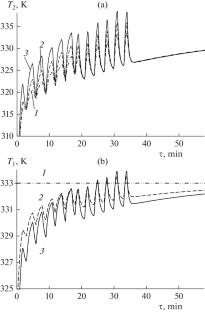
The results of numerical simulation and experimental study of heat and mass transfer in a stationary blown layer of colloidal capillary-porous materials of plant origin with cyclic radiation convective energy supply were presented. The mathematical model consists of the equations of gas phase mass conservation, filtration, and heat and mass transfer in phases, which allow for the internal resistance to heat and moisture transfer in particles when determining the heat and mass transfer coefficients. It includes the dependence of the specific heat of phase transition on particle moisture, particle shrinkage, and layer height during dehydration and the dependence of the effective coefficients of thermal conductivity of gas and vapor diffusion on the filtration rate. The results of modeling of dehydration of potato particles in a dense layer with cyclic radiation-convective energy supply were presented. It was shown that dehydration can be intensified and its duration can be reduced in comparison with the convective method. The calculated data were compared with the experimental data, confirming the adequacy of the model. The experimental kinetic dependences of desorption of activated carbon and zeolite with convective and radiation-convective energy supply were presented. The results of comparison indicate that the duration of desorption is markedly reduced when additional infrared irradiation is provided; for activated carbon, the process time is halved.
期刊介绍:
Theoretical Foundations of Chemical Engineering is a comprehensive journal covering all aspects of theoretical and applied research in chemical engineering, including transport phenomena; surface phenomena; processes of mixture separation; theory and methods of chemical reactor design; combined processes and multifunctional reactors; hydromechanic, thermal, diffusion, and chemical processes and apparatus, membrane processes and reactors; biotechnology; dispersed systems; nanotechnologies; process intensification; information modeling and analysis; energy- and resource-saving processes; environmentally clean processes and technologies.



 京公网安备 11010802042870号
京ICP备2023020795号-1
京公网安备 11010802042870号
京ICP备2023020795号-1

 分享
分享
 求助内容:
求助内容: 应助结果提醒方式:
 扫码关注我们
