Tengku Salwani Tengku Mansor, Yaakob Bin Che Man, Abdul Rohman
{"title":"Application of Fast Gas Chromatography and Fourier Transform Infrared Spectroscopy for Analysis of Lard Adulteration in Virgin Coconut Oil","authors":"Tengku Salwani Tengku Mansor, Yaakob Bin Che Man, Abdul Rohman","doi":"10.1007/s12161-010-9176-y","DOIUrl":null,"url":null,"abstract":"<p>Lard (LD) and virgin coconut oil (VCO) share some similarities such as having transparent to yellowish color and are solid at room temperature; hence, as a consequent, LD may be a potential oil adulterant in VCO. This study highlights the application of fast gas chromatography with surface acoustic wave detector (GC-SAW system) and Fourier transform infrared (FTIR) spectroscopy combined with chemometrics to analyze the presence of LD in VCO. Binary admixtures of LD in VCO in various percentage concentrations ranging from 1% to 50% (<i>v/v</i>) were assayed using the fast GC-SAW system and FTIR spectroscopy. Using the fast GC-SAW system, ten different chromatogram peaks were identified as the adulterant peaks. One peak in the fast GC-SAW system chromatogram was found to have the best relationship, with a coefficient of determination (<i>R</i>\n <sup>2</sup>) value of 0.9344. Furthermore, FTIR spectroscopy coupled with partial least square (PLS) and discriminant analysis (DA) can be successfully developed for quantification and classification of LD in VCO. The results showed that PLS able to predict the LD contents in VCO with equation of <span>\\( y = 0.{999} \\times + 0.00{6} \\)</span>, for the correlation between actual value of LD (<i>x</i>) and FTIR predicted value (<i>y</i>) with <i>R</i>\n <sup>2</sup> of 0.9990 at frequency regions of 3,020–3,000?cm<sup>?1</sup> and 1,120–1,000?cm<sup>?1</sup>. DA can classify VCO and that adulterated with LD using the FTIR spectra at the same frequency regions used in quantification.</p>","PeriodicalId":561,"journal":{"name":"Food Analytical Methods","volume":"4 3","pages":"365 - 372"},"PeriodicalIF":3.0000,"publicationDate":"2010-10-30","publicationTypes":"Journal Article","fieldsOfStudy":null,"isOpenAccess":false,"openAccessPdf":"https://sci-hub-pdf.com/10.1007/s12161-010-9176-y","citationCount":"53","resultStr":null,"platform":"Semanticscholar","paperid":null,"PeriodicalName":"Food Analytical Methods","FirstCategoryId":"97","ListUrlMain":"https://link.springer.com/article/10.1007/s12161-010-9176-y","RegionNum":3,"RegionCategory":"农林科学","ArticlePicture":[],"TitleCN":null,"AbstractTextCN":null,"PMCID":null,"EPubDate":"","PubModel":"","JCR":"Q2","JCRName":"FOOD SCIENCE & TECHNOLOGY","Score":null,"Total":0}
引用次数: 53
Abstract
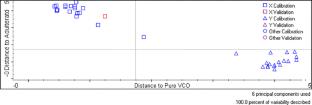
Lard (LD) and virgin coconut oil (VCO) share some similarities such as having transparent to yellowish color and are solid at room temperature; hence, as a consequent, LD may be a potential oil adulterant in VCO. This study highlights the application of fast gas chromatography with surface acoustic wave detector (GC-SAW system) and Fourier transform infrared (FTIR) spectroscopy combined with chemometrics to analyze the presence of LD in VCO. Binary admixtures of LD in VCO in various percentage concentrations ranging from 1% to 50% (v/v) were assayed using the fast GC-SAW system and FTIR spectroscopy. Using the fast GC-SAW system, ten different chromatogram peaks were identified as the adulterant peaks. One peak in the fast GC-SAW system chromatogram was found to have the best relationship, with a coefficient of determination (R2) value of 0.9344. Furthermore, FTIR spectroscopy coupled with partial least square (PLS) and discriminant analysis (DA) can be successfully developed for quantification and classification of LD in VCO. The results showed that PLS able to predict the LD contents in VCO with equation of \( y = 0.{999} \times + 0.00{6} \), for the correlation between actual value of LD (x) and FTIR predicted value (y) with R2 of 0.9990 at frequency regions of 3,020–3,000?cm?1 and 1,120–1,000?cm?1. DA can classify VCO and that adulterated with LD using the FTIR spectra at the same frequency regions used in quantification.
猪油(LD)和初榨椰子油(VCO)有一些相似之处,如透明到淡黄色,在室温下是固体;因此,LD可能是VCO中潜在的油掺杂物。本研究重点应用表面声波检测器快速气相色谱(GC-SAW系统)和傅里叶变换红外光谱(FTIR)结合化学计量学分析VCO中LD的存在。VCO中不同百分比浓度的LD二元混合物,浓度范围从1% to 50% (v/v) were assayed using the fast GC-SAW system and FTIR spectroscopy. Using the fast GC-SAW system, ten different chromatogram peaks were identified as the adulterant peaks. One peak in the fast GC-SAW system chromatogram was found to have the best relationship, with a coefficient of determination (R 2) value of 0.9344. Furthermore, FTIR spectroscopy coupled with partial least square (PLS) and discriminant analysis (DA) can be successfully developed for quantification and classification of LD in VCO. The results showed that PLS able to predict the LD contents in VCO with equation of \( y = 0.{999} \times + 0.00{6} \), for the correlation between actual value of LD (x) and FTIR predicted value (y) with R 2 of 0.9990 at frequency regions of 3,020–3,000?cm?1 and 1,120–1,000?cm?1. DA can classify VCO and that adulterated with LD using the FTIR spectra at the same frequency regions used in quantification.
期刊介绍:
Food Analytical Methods publishes original articles, review articles, and notes on novel and/or state-of-the-art analytical methods or issues to be solved, as well as significant improvements or interesting applications to existing methods. These include analytical technology and methodology for food microbial contaminants, food chemistry and toxicology, food quality, food authenticity and food traceability. The journal covers fundamental and specific aspects of the development, optimization, and practical implementation in routine laboratories, and validation of food analytical methods for the monitoring of food safety and quality.



 京公网安备 11010802042870号
京ICP备2023020795号-1
京公网安备 11010802042870号
京ICP备2023020795号-1

 分享
分享
 求助内容:
求助内容: 应助结果提醒方式:
 扫码关注我们
