{"title":"Spatial selectivity by shaping the static field: sweet spots and spider legs","authors":"Mark S. Conradi, Stephen A. Altobelli","doi":"10.1007/s00723-023-01548-5","DOIUrl":null,"url":null,"abstract":"<div><p>There is increasing interest in spatially localized NMR, such as low-cost NMR devices for organ-specific measurements, possibly with single-sided magnets. One method for obtaining spatial selectivity (to restrict the results to a specific organ) is to shape the static field, so that spins outside the central “sweet spot” are off-resonance and can be filtered out from the detected signal. However, the laws of magnetostatics dictate that the central sweet region will have “spider leg” extensions (extending outward from the center) where the field strength is unchanged from the central region. We address here the relative volumes of the central region and spider legs. We consider shaped fields of cylindrical symmetry of various orders n, where n reflects the leading term in field variation along the symmetry axis (that is, Z<sup>n</sup>). We find that this method of localization is unsuitable with low-order fields (2nd and 3rd orders), with a non-convergent fraction of volume in the spider legs. In these low-n cases, localization needs to be aided by a limited volume of rf field and/or by diffusion damping of echoes in regions of strong gradients. However, the fraction of volume residing in the spider legs becomes limited with higher-order fields, providing better localization. Results are also presented for two-dimensional fields.</p></div>","PeriodicalId":469,"journal":{"name":"Applied Magnetic Resonance","volume":"54 11-12","pages":"1689 - 1700"},"PeriodicalIF":1.1000,"publicationDate":"2023-06-09","publicationTypes":"Journal Article","fieldsOfStudy":null,"isOpenAccess":false,"openAccessPdf":"","citationCount":"1","resultStr":null,"platform":"Semanticscholar","paperid":null,"PeriodicalName":"Applied Magnetic Resonance","FirstCategoryId":"101","ListUrlMain":"https://link.springer.com/article/10.1007/s00723-023-01548-5","RegionNum":4,"RegionCategory":"物理与天体物理","ArticlePicture":[],"TitleCN":null,"AbstractTextCN":null,"PMCID":null,"EPubDate":"","PubModel":"","JCR":"Q4","JCRName":"PHYSICS, ATOMIC, MOLECULAR & CHEMICAL","Score":null,"Total":0}
引用次数: 1
Abstract
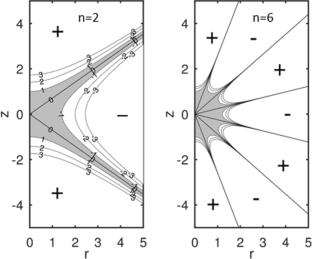
There is increasing interest in spatially localized NMR, such as low-cost NMR devices for organ-specific measurements, possibly with single-sided magnets. One method for obtaining spatial selectivity (to restrict the results to a specific organ) is to shape the static field, so that spins outside the central “sweet spot” are off-resonance and can be filtered out from the detected signal. However, the laws of magnetostatics dictate that the central sweet region will have “spider leg” extensions (extending outward from the center) where the field strength is unchanged from the central region. We address here the relative volumes of the central region and spider legs. We consider shaped fields of cylindrical symmetry of various orders n, where n reflects the leading term in field variation along the symmetry axis (that is, Zn). We find that this method of localization is unsuitable with low-order fields (2nd and 3rd orders), with a non-convergent fraction of volume in the spider legs. In these low-n cases, localization needs to be aided by a limited volume of rf field and/or by diffusion damping of echoes in regions of strong gradients. However, the fraction of volume residing in the spider legs becomes limited with higher-order fields, providing better localization. Results are also presented for two-dimensional fields.
期刊介绍:
Applied Magnetic Resonance provides an international forum for the application of magnetic resonance in physics, chemistry, biology, medicine, geochemistry, ecology, engineering, and related fields.
The contents include articles with a strong emphasis on new applications, and on new experimental methods. Additional features include book reviews and Letters to the Editor.



 京公网安备 11010802042870号
京ICP备2023020795号-1
京公网安备 11010802042870号
京ICP备2023020795号-1

 分享
分享
 求助内容:
求助内容: 应助结果提醒方式:
 扫码关注我们
