Miriam Angulo, Kevyn Guerra, Paola Arevalo, Edgar Trujillo, Elizabeth Monreal-Escalante, Carlos Angulo
{"title":"Probiotic Potential of Bacillus sp. 62A Isolated from a Marine Extreme Environment.","authors":"Miriam Angulo, Kevyn Guerra, Paola Arevalo, Edgar Trujillo, Elizabeth Monreal-Escalante, Carlos Angulo","doi":"10.1007/s12602-023-10182-3","DOIUrl":null,"url":null,"abstract":"<p><p>Antimicrobial resistance is an important health concern globally, and probiotics are considered an alternative to minimize it. The present study examined the in vitro probiotic characteristics and in vivo immunomodulatory potential of Bacillus sp. 62A - an extremophile bacterium. Bacillus sp. 62A was evaluated in vitro for its cytotoxicity, hemolytic activity, antibiotic susceptibility, and resistance to gastrointestinal conditions (bile salts, low pH, and intestinal adherence). Additionally, the immunomodulatory effect of Bacillus sp. 62A was studied in mice. The animals were supplemented daily with phosphate-buffered saline (control) and Bacillus sp. 62A at 1 × 10<sup>8</sup> colony forming units (CFU). Samples were taken on days 5 and 10. Isolated splenocytes were challenged with Escherichia coli for immunological analyses and immune-related gene expression. Serum and feces were collected for IgA and IgG determination. Bacillus sp. 62A did not show cytotoxicity, hemolytic activity, or resistance to antibiotics. Furthermore, the bacterium has autoaggregation and intestinal adhesion capacities and grows in the presence of bile salts and low pH. Bacillus supplementation in mice improved respiratory burst activity, nitric oxide production, and IL-1β and IL-6 gene expressions, mainly at 10 days. After E. coli challenge, Bacillus supplementation in mice induced an anti-inflammatory response through a decrease in immunological parameters and an increase in IL-10 gene expression. Moreover, serum IgA and IgG and fecal IgG augmented in supplemented mice. In conclusion, Bacillus sp. 62A has biosafe and immunomodulatory probiotic potential.</p>","PeriodicalId":20506,"journal":{"name":"Probiotics and Antimicrobial Proteins","volume":" ","pages":"794-806"},"PeriodicalIF":4.4000,"publicationDate":"2025-04-01","publicationTypes":"Journal Article","fieldsOfStudy":null,"isOpenAccess":false,"openAccessPdf":"","citationCount":"0","resultStr":null,"platform":"Semanticscholar","paperid":null,"PeriodicalName":"Probiotics and Antimicrobial Proteins","FirstCategoryId":"5","ListUrlMain":"https://doi.org/10.1007/s12602-023-10182-3","RegionNum":2,"RegionCategory":"生物学","ArticlePicture":[],"TitleCN":null,"AbstractTextCN":null,"PMCID":null,"EPubDate":"2023/10/27 0:00:00","PubModel":"Epub","JCR":"Q1","JCRName":"BIOTECHNOLOGY & APPLIED MICROBIOLOGY","Score":null,"Total":0}
引用次数: 0
Abstract
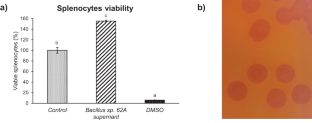
Antimicrobial resistance is an important health concern globally, and probiotics are considered an alternative to minimize it. The present study examined the in vitro probiotic characteristics and in vivo immunomodulatory potential of Bacillus sp. 62A - an extremophile bacterium. Bacillus sp. 62A was evaluated in vitro for its cytotoxicity, hemolytic activity, antibiotic susceptibility, and resistance to gastrointestinal conditions (bile salts, low pH, and intestinal adherence). Additionally, the immunomodulatory effect of Bacillus sp. 62A was studied in mice. The animals were supplemented daily with phosphate-buffered saline (control) and Bacillus sp. 62A at 1 × 10⁸ colony forming units (CFU). Samples were taken on days 5 and 10. Isolated splenocytes were challenged with Escherichia coli for immunological analyses and immune-related gene expression. Serum and feces were collected for IgA and IgG determination. Bacillus sp. 62A did not show cytotoxicity, hemolytic activity, or resistance to antibiotics. Furthermore, the bacterium has autoaggregation and intestinal adhesion capacities and grows in the presence of bile salts and low pH. Bacillus supplementation in mice improved respiratory burst activity, nitric oxide production, and IL-1β and IL-6 gene expressions, mainly at 10 days. After E. coli challenge, Bacillus supplementation in mice induced an anti-inflammatory response through a decrease in immunological parameters and an increase in IL-10 gene expression. Moreover, serum IgA and IgG and fecal IgG augmented in supplemented mice. In conclusion, Bacillus sp. 62A has biosafe and immunomodulatory probiotic potential.
期刊介绍:
Probiotics and Antimicrobial Proteins publishes reviews, original articles, letters and short notes and technical/methodological communications aimed at advancing fundamental knowledge and exploration of the applications of probiotics, natural antimicrobial proteins and their derivatives in biomedical, agricultural, veterinary, food, and cosmetic products. The Journal welcomes fundamental research articles and reports on applications of these microorganisms and substances, and encourages structural studies and studies that correlate the structure and functional properties of antimicrobial proteins.



 京公网安备 11010802042870号
京ICP备2023020795号-1
京公网安备 11010802042870号
京ICP备2023020795号-1

 分享
分享
 求助内容:
求助内容: 应助结果提醒方式:
 扫码关注我们
