Provenance of Oligocene–Miocene sediments in the Subei area, eastern Altyn Tagh fault and its geological implications: Evidence from detrital zircons LA-ICP-MS U–Pb chronology
Jianfeng Li , Zhicheng Zhang , Wenhao Tang , Ke Li , Zhiwen Luo , Jie Li
{"title":"Provenance of Oligocene–Miocene sediments in the Subei area, eastern Altyn Tagh fault and its geological implications: Evidence from detrital zircons LA-ICP-MS U–Pb chronology","authors":"Jianfeng Li , Zhicheng Zhang , Wenhao Tang , Ke Li , Zhiwen Luo , Jie Li","doi":"10.1016/j.jseaes.2014.02.015","DOIUrl":null,"url":null,"abstract":"<div><p>Oligocene–Miocene strata in the Subei and Xiaobiegai basins of the Subei area, located in the eastern Altyn Tagh fault (ATF), northern Tibetan Plateau, record important characteristics of the ATF evolution. Detrital zircons laser ablation-inductively coupled plasma-mass spectrometry (LA-ICP-MS) U–Pb ages from two samples, together with paleocurrent directions and clastic composition in the Xishuigou section demonstrate that sediments in the Subei basin originated from the Danghenanshan range along its southern margin. Detrital zircons U–Pb ages from three samples in the Xiaobiegai basin, together with paleocurrent directions and clastic composition, indicate that sediments in the Xiaobiegai basin may partly originate from terranes along the northeastern margin of the basin in addition to the Danghenanshan range. Our results, combined with regional evolution, suggest that the Xiaobiegai and the Subei basins was a combined basin in Oligocene–early Miocene. This basin was folded, tilted, and dislocated at ca. 8<!--> <!-->Ma by rapid uplift of the northern Tibetan plateau and rapid strike-slip of the ATF. As a result, the Subei basin became a thrust–fold belt of the Danghenanshan range front, and the Xiaobiegai basin grew into an intermontane basin in the northeastern part of the Danghenanshan range. Thus, the Subei area gradually acquired its present morphotectonic patterns.</p></div>","PeriodicalId":50253,"journal":{"name":"Journal of Asian Earth Sciences","volume":"87 ","pages":"Pages 130-140"},"PeriodicalIF":2.4000,"publicationDate":"2014-06-15","publicationTypes":"Journal Article","fieldsOfStudy":null,"isOpenAccess":false,"openAccessPdf":"https://sci-hub-pdf.com/10.1016/j.jseaes.2014.02.015","citationCount":"18","resultStr":null,"platform":"Semanticscholar","paperid":null,"PeriodicalName":"Journal of Asian Earth Sciences","FirstCategoryId":"89","ListUrlMain":"https://www.sciencedirect.com/science/article/pii/S1367912014000728","RegionNum":3,"RegionCategory":"地球科学","ArticlePicture":[],"TitleCN":null,"AbstractTextCN":null,"PMCID":null,"EPubDate":"","PubModel":"","JCR":"Q2","JCRName":"GEOSCIENCES, MULTIDISCIPLINARY","Score":null,"Total":0}
引用次数: 18
Abstract
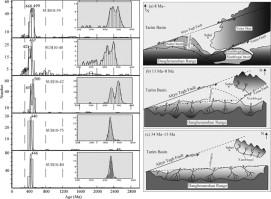
Oligocene–Miocene strata in the Subei and Xiaobiegai basins of the Subei area, located in the eastern Altyn Tagh fault (ATF), northern Tibetan Plateau, record important characteristics of the ATF evolution. Detrital zircons laser ablation-inductively coupled plasma-mass spectrometry (LA-ICP-MS) U–Pb ages from two samples, together with paleocurrent directions and clastic composition in the Xishuigou section demonstrate that sediments in the Subei basin originated from the Danghenanshan range along its southern margin. Detrital zircons U–Pb ages from three samples in the Xiaobiegai basin, together with paleocurrent directions and clastic composition, indicate that sediments in the Xiaobiegai basin may partly originate from terranes along the northeastern margin of the basin in addition to the Danghenanshan range. Our results, combined with regional evolution, suggest that the Xiaobiegai and the Subei basins was a combined basin in Oligocene–early Miocene. This basin was folded, tilted, and dislocated at ca. 8 Ma by rapid uplift of the northern Tibetan plateau and rapid strike-slip of the ATF. As a result, the Subei basin became a thrust–fold belt of the Danghenanshan range front, and the Xiaobiegai basin grew into an intermontane basin in the northeastern part of the Danghenanshan range. Thus, the Subei area gradually acquired its present morphotectonic patterns.
期刊介绍:
Journal of Asian Earth Sciences has an open access mirror journal Journal of Asian Earth Sciences: X, sharing the same aims and scope, editorial team, submission system and rigorous peer review.
The Journal of Asian Earth Sciences is an international interdisciplinary journal devoted to all aspects of research related to the solid Earth Sciences of Asia. The Journal publishes high quality, peer-reviewed scientific papers on the regional geology, tectonics, geochemistry and geophysics of Asia. It will be devoted primarily to research papers but short communications relating to new developments of broad interest, reviews and book reviews will also be included. Papers must have international appeal and should present work of more than local significance.
The scope includes deep processes of the Asian continent and its adjacent oceans; seismology and earthquakes; orogeny, magmatism, metamorphism and volcanism; growth, deformation and destruction of the Asian crust; crust-mantle interaction; evolution of life (early life, biostratigraphy, biogeography and mass-extinction); fluids, fluxes and reservoirs of mineral and energy resources; surface processes (weathering, erosion, transport and deposition of sediments) and resulting geomorphology; and the response of the Earth to global climate change as viewed within the Asian continent and surrounding oceans.



 京公网安备 11010802042870号
京ICP备2023020795号-1
京公网安备 11010802042870号
京ICP备2023020795号-1

 分享
分享
 求助内容:
求助内容: 应助结果提醒方式:
 扫码关注我们
