Jiaqi Zhao, Ya Bai, Zhenhua Li, Dr. Jinjia Liu, Dr. Wei Wang, Pu Wang, Dr. Bei Yang, Dr. Run Shi, Prof. Geoffrey I. N. Waterhouse, Prof. Xiao-Dong Wen, Prof. Qing Dai, Prof. Tierui Zhang
{"title":"Plasmonic Cu Nanoparticles for the Low-temperature Photo-driven Water-gas Shift Reaction","authors":"Jiaqi Zhao, Ya Bai, Zhenhua Li, Dr. Jinjia Liu, Dr. Wei Wang, Pu Wang, Dr. Bei Yang, Dr. Run Shi, Prof. Geoffrey I. N. Waterhouse, Prof. Xiao-Dong Wen, Prof. Qing Dai, Prof. Tierui Zhang","doi":"10.1002/anie.202219299","DOIUrl":null,"url":null,"abstract":"<p>The activation of water molecules in thermal catalysis typically requires high temperatures, representing an obstacle to catalyst development for the low-temperature water-gas shift reaction (WGSR). Plasmonic photocatalysis allows activation of water at low temperatures through the generation of light-induced hot electrons. Herein, we report a layered double hydroxide-derived copper catalyst (LD-Cu) with outstanding performance for the low-temperature photo-driven WGSR. LD-Cu offered a lower activation energy for WGSR to H<sub>2</sub> under UV/Vis irradiation (1.4 W cm<sup>−2</sup>) compared to under dark conditions. Detailed experimental studies revealed that highly dispersed Cu nanoparticles created an abundance of hot electrons during light absorption, which promoted *H<sub>2</sub>O dissociation and *H combination via a carboxyl pathway, leading to the efficient production of H<sub>2</sub>. Results demonstrate the benefits of exploiting plasmonic phenomena in the development of photo-driven low-temperature WGSR catalysts.</p>","PeriodicalId":125,"journal":{"name":"Angewandte Chemie International Edition","volume":"62 13","pages":""},"PeriodicalIF":16.9000,"publicationDate":"2023-02-03","publicationTypes":"Journal Article","fieldsOfStudy":null,"isOpenAccess":false,"openAccessPdf":"","citationCount":"5","resultStr":null,"platform":"Semanticscholar","paperid":null,"PeriodicalName":"Angewandte Chemie International Edition","FirstCategoryId":"92","ListUrlMain":"https://onlinelibrary.wiley.com/doi/10.1002/anie.202219299","RegionNum":1,"RegionCategory":"化学","ArticlePicture":[],"TitleCN":null,"AbstractTextCN":null,"PMCID":null,"EPubDate":"","PubModel":"","JCR":"Q1","JCRName":"CHEMISTRY, MULTIDISCIPLINARY","Score":null,"Total":0}
引用次数: 5
Abstract
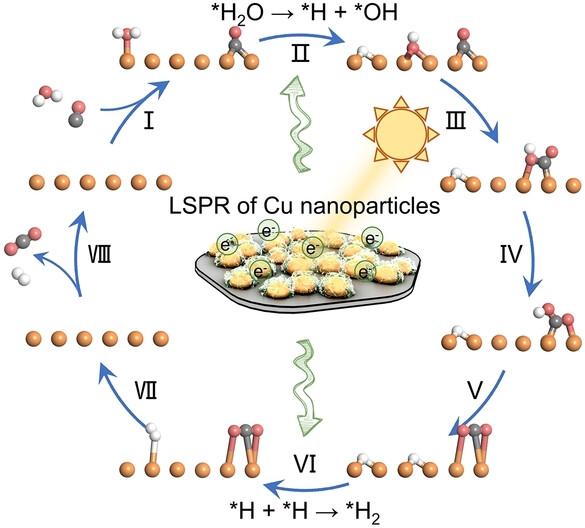
The activation of water molecules in thermal catalysis typically requires high temperatures, representing an obstacle to catalyst development for the low-temperature water-gas shift reaction (WGSR). Plasmonic photocatalysis allows activation of water at low temperatures through the generation of light-induced hot electrons. Herein, we report a layered double hydroxide-derived copper catalyst (LD-Cu) with outstanding performance for the low-temperature photo-driven WGSR. LD-Cu offered a lower activation energy for WGSR to H2 under UV/Vis irradiation (1.4 W cm−2) compared to under dark conditions. Detailed experimental studies revealed that highly dispersed Cu nanoparticles created an abundance of hot electrons during light absorption, which promoted *H2O dissociation and *H combination via a carboxyl pathway, leading to the efficient production of H2. Results demonstrate the benefits of exploiting plasmonic phenomena in the development of photo-driven low-temperature WGSR catalysts.
热催化中水分子的活化通常需要较高的温度,这是低温水气转换反应(WGSR)催化剂开发的一个障碍。等离子体光催化允许在低温下通过产生光诱导的热电子激活水。本文报道了一种具有优异性能的层状双氢氧化物衍生铜催化剂(LD-Cu),用于低温光驱动WGSR。与黑暗条件下相比,LD-Cu在UV/Vis照射下为WGSR生成H2提供了较低的活化能(1.4 W cm−2)。详细的实验研究表明,高度分散的Cu纳米颗粒在光吸收过程中产生了大量的热电子,通过羧基途径促进*H2O解离和*H结合,从而有效地生成H2。结果表明,利用等离子体现象开发光驱动的低温WGSR催化剂是有益的。
期刊介绍:
Angewandte Chemie, a journal of the German Chemical Society (GDCh), maintains a leading position among scholarly journals in general chemistry with an impressive Impact Factor of 16.6 (2022 Journal Citation Reports, Clarivate, 2023). Published weekly in a reader-friendly format, it features new articles almost every day. Established in 1887, Angewandte Chemie is a prominent chemistry journal, offering a dynamic blend of Review-type articles, Highlights, Communications, and Research Articles on a weekly basis, making it unique in the field.



 京公网安备 11010802042870号
京ICP备2023020795号-1
京公网安备 11010802042870号
京ICP备2023020795号-1

 分享
分享
 求助内容:
求助内容: 应助结果提醒方式:
 扫码关注我们
