Mengxue Du, Katalee Jariyavidyanont*, Rui Zhang, Alicyn M. Rhoades, Christoph Schick and René Androsch*,
{"title":"Thermal Stability of Shear-Induced Crystal Nuclei of Poly(l-lactic acid)","authors":"Mengxue Du, Katalee Jariyavidyanont*, Rui Zhang, Alicyn M. Rhoades, Christoph Schick and René Androsch*, ","doi":"10.1021/acsapm.2c01365","DOIUrl":null,"url":null,"abstract":"<p >Knowledge of the conditions required to obtain an isotropic melt of the polymer of interest, which before was subjected to shear and crystallization, is important for understanding and prediction of crystallization in polymer processing. In this work, the thermal stability of crystallization precursors of qualitatively different structures, namely, classical crystal remnants and oriented shish-like nuclei, is analyzed for poly(<span>l</span>-lactic acid) (PLLA). Shearing the melt at different rates leads to generation of shish-like and point-like nuclei which grow at identical temperature to crystals of similar stability/melting temperature. Analysis of the crystallization kinetics and of the semicrystalline morphology by differential scanning calorimetry and polarized-light optical microscopy, respectively, after subjecting the melt to different maximum temperatures, showed that disordering/isotropization of remnants of crystals, which melt close to 179 °C, occurs in a temperature window about 5–10 K higher than the melting temperature. Shish-like nuclei, generated at 135 °C during shearing the melt 10 s at 2 s<sup>–1</sup>, survive heating to a higher temperature than in the case of self-nuclei, however, with their number/nucleation efficacy exponentially decreasing with time over a period of several 10<sup>3</sup> s at 190 °C. In contrast to many other polymers, oriented shish-like structures disappear well below the equilibrium melting temperature, allowing mild melting conditions to obtain an isotropic structure. The stability of the remaining structures in the melt seems to be caused/controlled by molecular interactions rather than by slow diffusion of the chain segments toward a random-coiled structure as the longest relaxation times (reptation) at about 180 °C are several orders of magnitude shorter than the observed lifetime of the ordered structures.</p>","PeriodicalId":7,"journal":{"name":"ACS Applied Polymer Materials","volume":"4 10","pages":"7823–7833"},"PeriodicalIF":4.7000,"publicationDate":"2022-09-28","publicationTypes":"Journal Article","fieldsOfStudy":null,"isOpenAccess":false,"openAccessPdf":"","citationCount":"1","resultStr":null,"platform":"Semanticscholar","paperid":null,"PeriodicalName":"ACS Applied Polymer Materials","FirstCategoryId":"92","ListUrlMain":"https://pubs.acs.org/doi/10.1021/acsapm.2c01365","RegionNum":2,"RegionCategory":"化学","ArticlePicture":[],"TitleCN":null,"AbstractTextCN":null,"PMCID":null,"EPubDate":"","PubModel":"","JCR":"Q2","JCRName":"MATERIALS SCIENCE, MULTIDISCIPLINARY","Score":null,"Total":0}
引用次数: 1
Abstract
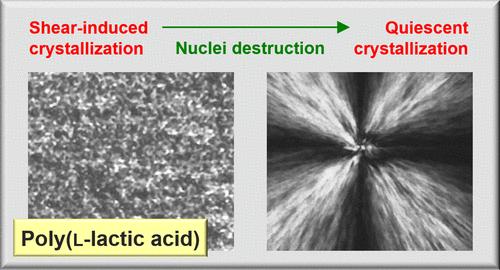
Knowledge of the conditions required to obtain an isotropic melt of the polymer of interest, which before was subjected to shear and crystallization, is important for understanding and prediction of crystallization in polymer processing. In this work, the thermal stability of crystallization precursors of qualitatively different structures, namely, classical crystal remnants and oriented shish-like nuclei, is analyzed for poly(l-lactic acid) (PLLA). Shearing the melt at different rates leads to generation of shish-like and point-like nuclei which grow at identical temperature to crystals of similar stability/melting temperature. Analysis of the crystallization kinetics and of the semicrystalline morphology by differential scanning calorimetry and polarized-light optical microscopy, respectively, after subjecting the melt to different maximum temperatures, showed that disordering/isotropization of remnants of crystals, which melt close to 179 °C, occurs in a temperature window about 5–10 K higher than the melting temperature. Shish-like nuclei, generated at 135 °C during shearing the melt 10 s at 2 s–1, survive heating to a higher temperature than in the case of self-nuclei, however, with their number/nucleation efficacy exponentially decreasing with time over a period of several 103 s at 190 °C. In contrast to many other polymers, oriented shish-like structures disappear well below the equilibrium melting temperature, allowing mild melting conditions to obtain an isotropic structure. The stability of the remaining structures in the melt seems to be caused/controlled by molecular interactions rather than by slow diffusion of the chain segments toward a random-coiled structure as the longest relaxation times (reptation) at about 180 °C are several orders of magnitude shorter than the observed lifetime of the ordered structures.
期刊介绍:
ACS Applied Polymer Materials is an interdisciplinary journal publishing original research covering all aspects of engineering, chemistry, physics, and biology relevant to applications of polymers.
The journal is devoted to reports of new and original experimental and theoretical research of an applied nature that integrates fundamental knowledge in the areas of materials, engineering, physics, bioscience, polymer science and chemistry into important polymer applications. The journal is specifically interested in work that addresses relationships among structure, processing, morphology, chemistry, properties, and function as well as work that provide insights into mechanisms critical to the performance of the polymer for applications.



 京公网安备 11010802042870号
京ICP备2023020795号-1
京公网安备 11010802042870号
京ICP备2023020795号-1

 分享
分享
 求助内容:
求助内容: 应助结果提醒方式:
 扫码关注我们
