Jenneke E. van Atteveld, Iris E. Verhagen, Marry M. van den Heuvel-Eibrink, Hanneke M. van Santen, Inge M. van der Sluis, Natascia Di Iorgi, Jill H. Simmons, Leanne M. Ward, Sebastian J.C.M.M. Neggers
{"title":"Vitamin D supplementation for children with cancer: A systematic review and consensus recommendations","authors":"Jenneke E. van Atteveld, Iris E. Verhagen, Marry M. van den Heuvel-Eibrink, Hanneke M. van Santen, Inge M. van der Sluis, Natascia Di Iorgi, Jill H. Simmons, Leanne M. Ward, Sebastian J.C.M.M. Neggers","doi":"10.1002/cam4.4013","DOIUrl":null,"url":null,"abstract":"<div>\n \n \n <section>\n \n <h3> Background</h3>\n \n <p>Prevalent vitamin D deficiency (VDD) and low bone mineral density (BMD) have led to vitamin D supplementation for children with cancer, regardless vitamin D status. However, it remains unsettled whether this enhances bone strength. We sought to address this issue by carrying out a systematic review of the literature.</p>\n </section>\n \n <section>\n \n <h3> Methods</h3>\n \n <p>We conducted a literature search using PubMed, Embase, and Cochrane databases. Studies including children up to 5 years after cancer therapy were assessed for the association between 25-hydroxyvitamin D (25OHD) levels and BMD <i>Z</i>-scores or fractures, and the effect of vitamin D supplementation on BMD or fractures. Evidence quality was assessed using the GRADE methodology.</p>\n </section>\n \n <section>\n \n <h3> Results</h3>\n \n <p>Nineteen studies (16 observational and 3 interventional, mainly involving children with hematologic malignancies) were included. One study which analyzed 25OHD as a threshold variable (≤10 ng/ml) found a significant association between 25OHD levels and BMD <i>Z</i>-scores, while 25OHD as a continuous variable was not significantly associated with BMD <i>Z</i>-scores in 14 observational studies. We found neither a significant association between lower 25OHD levels and fractures (2 studies), nor between vitamin D (and calcium) supplementation and BMD or fracture frequency (3 studies) (very low quality evidence).</p>\n </section>\n \n <section>\n \n <h3> Conclusion</h3>\n \n <p>There is a lack of evidence for an effect of vitamin D (and calcium) supplementation on BMD or fractures in children with cancer. Further research is needed; until then, we recommend dietary vitamin D/calcium intake in keeping with standard national guidelines, and periodic 25OHD monitoring to detect levels <20 ng/ml. Vitamin D/calcium supplementation is recommended in children with low levels, to maintain levels ≥20 ng/ml year-long.</p>\n </section>\n </div>","PeriodicalId":139,"journal":{"name":"Cancer Medicine","volume":"10 13","pages":"4177-4194"},"PeriodicalIF":3.1000,"publicationDate":"2021-06-08","publicationTypes":"Journal Article","fieldsOfStudy":null,"isOpenAccess":false,"openAccessPdf":"https://sci-hub-pdf.com/10.1002/cam4.4013","citationCount":"12","resultStr":null,"platform":"Semanticscholar","paperid":null,"PeriodicalName":"Cancer Medicine","FirstCategoryId":"3","ListUrlMain":"https://onlinelibrary.wiley.com/doi/10.1002/cam4.4013","RegionNum":2,"RegionCategory":"医学","ArticlePicture":[],"TitleCN":null,"AbstractTextCN":null,"PMCID":null,"EPubDate":"","PubModel":"","JCR":"Q2","JCRName":"ONCOLOGY","Score":null,"Total":0}
引用次数: 12
Abstract
Background
Prevalent vitamin D deficiency (VDD) and low bone mineral density (BMD) have led to vitamin D supplementation for children with cancer, regardless vitamin D status. However, it remains unsettled whether this enhances bone strength. We sought to address this issue by carrying out a systematic review of the literature.
Methods
We conducted a literature search using PubMed, Embase, and Cochrane databases. Studies including children up to 5 years after cancer therapy were assessed for the association between 25-hydroxyvitamin D (25OHD) levels and BMD Z-scores or fractures, and the effect of vitamin D supplementation on BMD or fractures. Evidence quality was assessed using the GRADE methodology.
Results
Nineteen studies (16 observational and 3 interventional, mainly involving children with hematologic malignancies) were included. One study which analyzed 25OHD as a threshold variable (≤10 ng/ml) found a significant association between 25OHD levels and BMD Z-scores, while 25OHD as a continuous variable was not significantly associated with BMD Z-scores in 14 observational studies. We found neither a significant association between lower 25OHD levels and fractures (2 studies), nor between vitamin D (and calcium) supplementation and BMD or fracture frequency (3 studies) (very low quality evidence).
Conclusion
There is a lack of evidence for an effect of vitamin D (and calcium) supplementation on BMD or fractures in children with cancer. Further research is needed; until then, we recommend dietary vitamin D/calcium intake in keeping with standard national guidelines, and periodic 25OHD monitoring to detect levels <20 ng/ml. Vitamin D/calcium supplementation is recommended in children with low levels, to maintain levels ≥20 ng/ml year-long.
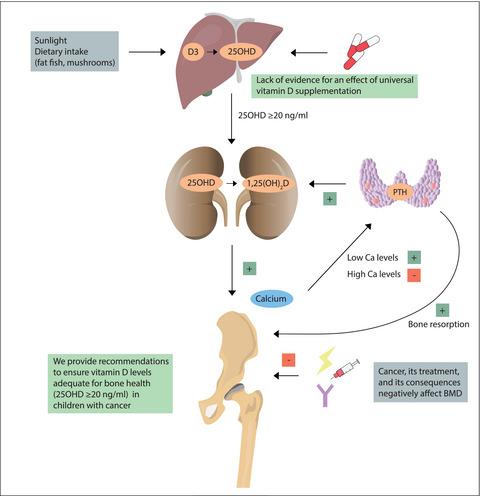
普遍的维生素D缺乏(VDD)和低骨密度(BMD)导致癌症儿童补充维生素D,无论维生素D水平如何。然而,这是否能增强骨骼强度仍不确定。我们试图通过对文献进行系统回顾来解决这个问题。方法使用PubMed、Embase和Cochrane数据库进行文献检索。研究包括癌症治疗后长达5年的儿童,评估25-羟基维生素D (25OHD)水平与骨密度z评分或骨折之间的关系,以及补充维生素D对骨密度或骨折的影响。使用GRADE方法评估证据质量。结果共纳入19项研究(16项观察性研究,3项介入性研究,主要涉及血液系统恶性肿瘤患儿)。一项研究将25OHD作为阈值变量(≤10 ng/ml)进行分析,发现25OHD水平与BMD z -评分之间存在显著相关性,而在14项观察性研究中,25OHD作为连续变量与BMD z -评分之间无显著相关性。我们没有发现较低的25OHD水平与骨折(2项研究)之间存在显著关联,维生素D(和钙)补充与骨密度或骨折频率(3项研究)之间也没有显著关联(证据质量非常低)。结论补充维生素D(和钙)对癌症儿童骨密度或骨折的影响尚缺乏证据。需要进一步的研究;在此之前,我们建议饮食中维生素D/钙的摄入量与标准的国家指南保持一致,并定期监测25OHD,以检测其水平≤20 ng/ml。维生素D/钙水平低的儿童建议补充维生素D/钙,维持≥20 ng/ml一年。
期刊介绍:
Cancer Medicine is a peer-reviewed, open access, interdisciplinary journal providing rapid publication of research from global biomedical researchers across the cancer sciences. The journal will consider submissions from all oncologic specialties, including, but not limited to, the following areas:
Clinical Cancer Research
Translational research ∙ clinical trials ∙ chemotherapy ∙ radiation therapy ∙ surgical therapy ∙ clinical observations ∙ clinical guidelines ∙ genetic consultation ∙ ethical considerations
Cancer Biology:
Molecular biology ∙ cellular biology ∙ molecular genetics ∙ genomics ∙ immunology ∙ epigenetics ∙ metabolic studies ∙ proteomics ∙ cytopathology ∙ carcinogenesis ∙ drug discovery and delivery.
Cancer Prevention:
Behavioral science ∙ psychosocial studies ∙ screening ∙ nutrition ∙ epidemiology and prevention ∙ community outreach.
Bioinformatics:
Gene expressions profiles ∙ gene regulation networks ∙ genome bioinformatics ∙ pathwayanalysis ∙ prognostic biomarkers.
Cancer Medicine publishes original research articles, systematic reviews, meta-analyses, and research methods papers, along with invited editorials and commentaries. Original research papers must report well-conducted research with conclusions supported by the data presented in the paper.