Peng Wan, Mingming Jiang, Yun Wei, Tong Xu, Yang Liu, Sihao Xia, Longxing Su, Daning Shi, Xiaosheng Fang, Caixia Kan
{"title":"Junction-Enhanced Polarization Sensitivity in Self-Powered Near-Infrared Photodetectors Based on Sb2Se3 Microbelt/n-GaN Heterojunction","authors":"Peng Wan, Mingming Jiang, Yun Wei, Tong Xu, Yang Liu, Sihao Xia, Longxing Su, Daning Shi, Xiaosheng Fang, Caixia Kan","doi":"10.1002/adom.202202080","DOIUrl":null,"url":null,"abstract":"<p>Polarization-sensitive photodetectors (PDs) based on anisotropic materials spark considerable interest for their potential applications in security surveillance, optical switches, and remote sensing. However, high-thickness or bulk anisotropic materials generally exhibit low polarization sensitivity, hindering their practical applications in polarization photodetection. Herein, a near-infrared (NIR) PD based on a p-type Sb<sub>2</sub>Se<sub>3</sub> microbelt (MB)/n-GaN heterojunction is proposed. The Sb<sub>2</sub>Se<sub>3</sub> MB/GaN PD effectively combines the anisotropy of the Sb<sub>2</sub>Se<sub>3</sub> MB with the heterogeneous integration. The PD presents self-powered detection properties with a responsivity over 12 mA W<sup>−1</sup>, a specific detectivity exceeding 5 × 10<sup>10</sup> Jones, and a response speed (the rising/decaying times ≈74 ms/75 ms) under NIR illumination. More importantly, the heterojunction-based PD has a higher anisotropy ratio of 1.37, which is 1.3 times amplified as compared to the vertical photoconductive-type PDs (the anisotropy ratio of 1.06). The p-n junction's effect on carrier generation and recombination causes the increased polarization sensitivity of Sb<sub>2</sub>Se<sub>3</sub> MB/GaN PDs, as confirmed by finite element method analysis. This work not only offers a deeper insight into polarization sensitivity regulated by junction or interface but also provides a practical method for developing high-sensitivity polarization detectors based on high-thickness or bulk anisotropic materials.</p>","PeriodicalId":116,"journal":{"name":"Advanced Optical Materials","volume":"11 3","pages":""},"PeriodicalIF":7.2000,"publicationDate":"2022-11-30","publicationTypes":"Journal Article","fieldsOfStudy":null,"isOpenAccess":false,"openAccessPdf":"","citationCount":"7","resultStr":null,"platform":"Semanticscholar","paperid":null,"PeriodicalName":"Advanced Optical Materials","FirstCategoryId":"88","ListUrlMain":"https://onlinelibrary.wiley.com/doi/10.1002/adom.202202080","RegionNum":2,"RegionCategory":"材料科学","ArticlePicture":[],"TitleCN":null,"AbstractTextCN":null,"PMCID":null,"EPubDate":"","PubModel":"","JCR":"Q1","JCRName":"MATERIALS SCIENCE, MULTIDISCIPLINARY","Score":null,"Total":0}
引用次数: 7
Abstract
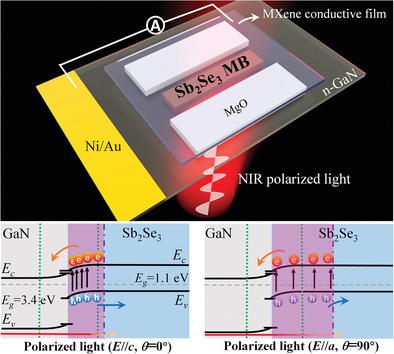
Polarization-sensitive photodetectors (PDs) based on anisotropic materials spark considerable interest for their potential applications in security surveillance, optical switches, and remote sensing. However, high-thickness or bulk anisotropic materials generally exhibit low polarization sensitivity, hindering their practical applications in polarization photodetection. Herein, a near-infrared (NIR) PD based on a p-type Sb2Se3 microbelt (MB)/n-GaN heterojunction is proposed. The Sb2Se3 MB/GaN PD effectively combines the anisotropy of the Sb2Se3 MB with the heterogeneous integration. The PD presents self-powered detection properties with a responsivity over 12 mA W−1, a specific detectivity exceeding 5 × 10¹⁰ Jones, and a response speed (the rising/decaying times ≈74 ms/75 ms) under NIR illumination. More importantly, the heterojunction-based PD has a higher anisotropy ratio of 1.37, which is 1.3 times amplified as compared to the vertical photoconductive-type PDs (the anisotropy ratio of 1.06). The p-n junction's effect on carrier generation and recombination causes the increased polarization sensitivity of Sb2Se3 MB/GaN PDs, as confirmed by finite element method analysis. This work not only offers a deeper insight into polarization sensitivity regulated by junction or interface but also provides a practical method for developing high-sensitivity polarization detectors based on high-thickness or bulk anisotropic materials.
期刊介绍:
Advanced Optical Materials, part of the esteemed Advanced portfolio, is a unique materials science journal concentrating on all facets of light-matter interactions. For over a decade, it has been the preferred optical materials journal for significant discoveries in photonics, plasmonics, metamaterials, and more. The Advanced portfolio from Wiley is a collection of globally respected, high-impact journals that disseminate the best science from established and emerging researchers, aiding them in fulfilling their mission and amplifying the reach of their scientific discoveries.




 京公网安备 11010802042870号
京ICP备2023020795号-1
京公网安备 11010802042870号
京ICP备2023020795号-1

 分享
分享
 求助内容:
求助内容: 应助结果提醒方式:
 扫码关注我们
