下载PDF
{"title":"Genetic predisposition to colorectal cancer: syndromes, genes, classification of genetic variants and implications for precision medicine","authors":"Laura Valle, Eduardo Vilar, Sean V Tavtigian, Elena M Stoffel","doi":"10.1002/path.5229","DOIUrl":null,"url":null,"abstract":"<p>This article reviews genes and syndromes associated with predisposition to colorectal cancer (CRC), with an overview of gene variant classification. We include updates on the application of preventive and therapeutic measures, focusing on the use of non-steroidal anti-inflammatory drugs (NSAIDs) and immunotherapy. Germline pathogenic variants in genes conferring high or moderate risk to cancer are detected in 6–10% of all CRCs and 20% of those diagnosed before age 50. CRC syndromes can be subdivided into nonpolyposis and polyposis entities, the most common of which are Lynch syndrome and familial adenomatous polyposis, respectively. In addition to known and novel genes associated with highly penetrant CRC risk, identification of pathogenic germline variants in genes associated with moderate-penetrance cancer risk and/or hereditary cancer syndromes not traditionally linked to CRC may have an impact on genetic testing, counseling, and surveillance. The use of multigene panels in genetic testing has exposed challenges in the classification of variants of uncertain significance. We provide an overview of the main classification systems and strategies for improving these. Finally, we highlight approaches for integrating chemoprevention in the care of individuals with genetic predisposition to CRC and use of targeted agents and immunotherapy for treatment of mismatch repair-deficient and hypermutant tumors. Copyright © 2018 Pathological Society of Great Britain and Ireland. Published by John Wiley & Sons, Ltd.</p>","PeriodicalId":232,"journal":{"name":"The Journal of Pathology","volume":"247 5","pages":"574-588"},"PeriodicalIF":5.2000,"publicationDate":"2018-12-25","publicationTypes":"Journal Article","fieldsOfStudy":null,"isOpenAccess":false,"openAccessPdf":"https://sci-hub-pdf.com/10.1002/path.5229","citationCount":"117","resultStr":null,"platform":"Semanticscholar","paperid":null,"PeriodicalName":"The Journal of Pathology","FirstCategoryId":"3","ListUrlMain":"https://onlinelibrary.wiley.com/doi/10.1002/path.5229","RegionNum":2,"RegionCategory":"医学","ArticlePicture":[],"TitleCN":null,"AbstractTextCN":null,"PMCID":null,"EPubDate":"","PubModel":"","JCR":"Q1","JCRName":"ONCOLOGY","Score":null,"Total":0}
引用次数: 117
引用
批量引用
Abstract
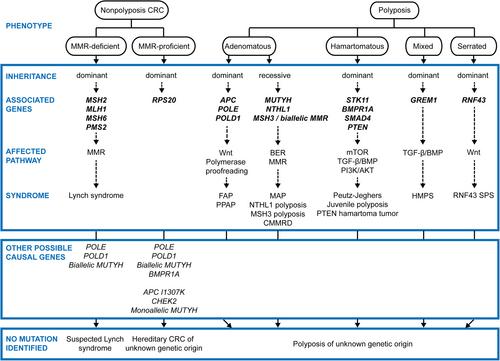
This article reviews genes and syndromes associated with predisposition to colorectal cancer (CRC), with an overview of gene variant classification. We include updates on the application of preventive and therapeutic measures, focusing on the use of non-steroidal anti-inflammatory drugs (NSAIDs) and immunotherapy. Germline pathogenic variants in genes conferring high or moderate risk to cancer are detected in 6–10% of all CRCs and 20% of those diagnosed before age 50. CRC syndromes can be subdivided into nonpolyposis and polyposis entities, the most common of which are Lynch syndrome and familial adenomatous polyposis, respectively. In addition to known and novel genes associated with highly penetrant CRC risk, identification of pathogenic germline variants in genes associated with moderate-penetrance cancer risk and/or hereditary cancer syndromes not traditionally linked to CRC may have an impact on genetic testing, counseling, and surveillance. The use of multigene panels in genetic testing has exposed challenges in the classification of variants of uncertain significance. We provide an overview of the main classification systems and strategies for improving these. Finally, we highlight approaches for integrating chemoprevention in the care of individuals with genetic predisposition to CRC and use of targeted agents and immunotherapy for treatment of mismatch repair-deficient and hypermutant tumors. Copyright © 2018 Pathological Society of Great Britain and Ireland. Published by John Wiley & Sons, Ltd.
结直肠癌的遗传易感性:综合征、基因、遗传变异分类及其对精准医学的影响
本文综述了与结直肠癌(CRC)易感性相关的基因和综合征,并对基因变异分类进行了概述。我们包括预防和治疗措施的最新应用,重点是非甾体抗炎药(NSAIDs)和免疫治疗的使用。在所有crc中,6-10%检测到具有高或中度癌症风险的基因的种系致病性变异,在50岁之前诊断的患者中,这一比例为20%。CRC综合征可细分为非息肉病和息肉病实体,其中最常见的分别是Lynch综合征和家族性腺瘤性息肉病。除了已知和新发现的与高外显性结直肠癌风险相关的基因外,鉴定与中等外显性癌症风险和/或传统上与结直肠癌无关的遗传性癌症综合征相关的基因的致病种系变异可能对基因检测、咨询和监测产生影响。在基因检测中使用多基因面板暴露了对不确定意义的变异进行分类的挑战。我们概述了主要的分类系统和改进这些系统的策略。最后,我们强调了在CRC遗传易感性个体的护理中整合化学预防的方法,以及使用靶向药物和免疫疗法治疗错配修复缺陷和超突变肿瘤的方法。版权所有©2018英国和爱尔兰病理学会。John Wiley &出版;儿子,有限公司
本文章由计算机程序翻译,如有差异,请以英文原文为准。



 京公网安备 11010802042870号
京ICP备2023020795号-1
京公网安备 11010802042870号
京ICP备2023020795号-1

 分享
分享
 求助内容:
求助内容: 应助结果提醒方式:
 扫码关注我们
